Coffee, Fungus, and a Family's Fight in Nicaragua's Highlands
A remote farming community in Nicaragua's Miraflor reserve confronts the coffee rust epidemic, and one family's harvest reveals both loss and endurance.
By Morgan Hall8 min read
A Village at the End of a Bumpy Road
Nestled in the northern mountains of Nicaragua, within the Miraflor Nature Reserve—one of seventy-eight protected areas in the country recognized for environmental resources and biodiversity—sits El Sontule, a coffee-farming village of fewer than 200 residents. The nearest city, Estelí, lies under forty miles away, yet the bus journey consumes almost two hours, climbing steep dirt tracks and crossing a small river along the way.
In August 2013, I made that winding trip aboard a vintage American school bus—the kind visitors fondly call a chicken bus. My purpose was to understand coffee rust, or la roya, the fungal outbreak that had by then spread through much of Central America's coffee belt and was ravaging the crop. The dirt road led me to the Pérez Villarreyna family, organic Arabica growers who cultivate beneath forest shade. Uriel, the eldest son and a tour guide based in Estelí, had set up the visit. His father, Marvin Pérez, heads Vicente Talavera, one of two principal coffee cooperatives in El Sontule. Both cooperatives are part of PRODECOOP, a distribution network of thirty-eight cooperatives that markets roughly half organic and half conventional coffee.
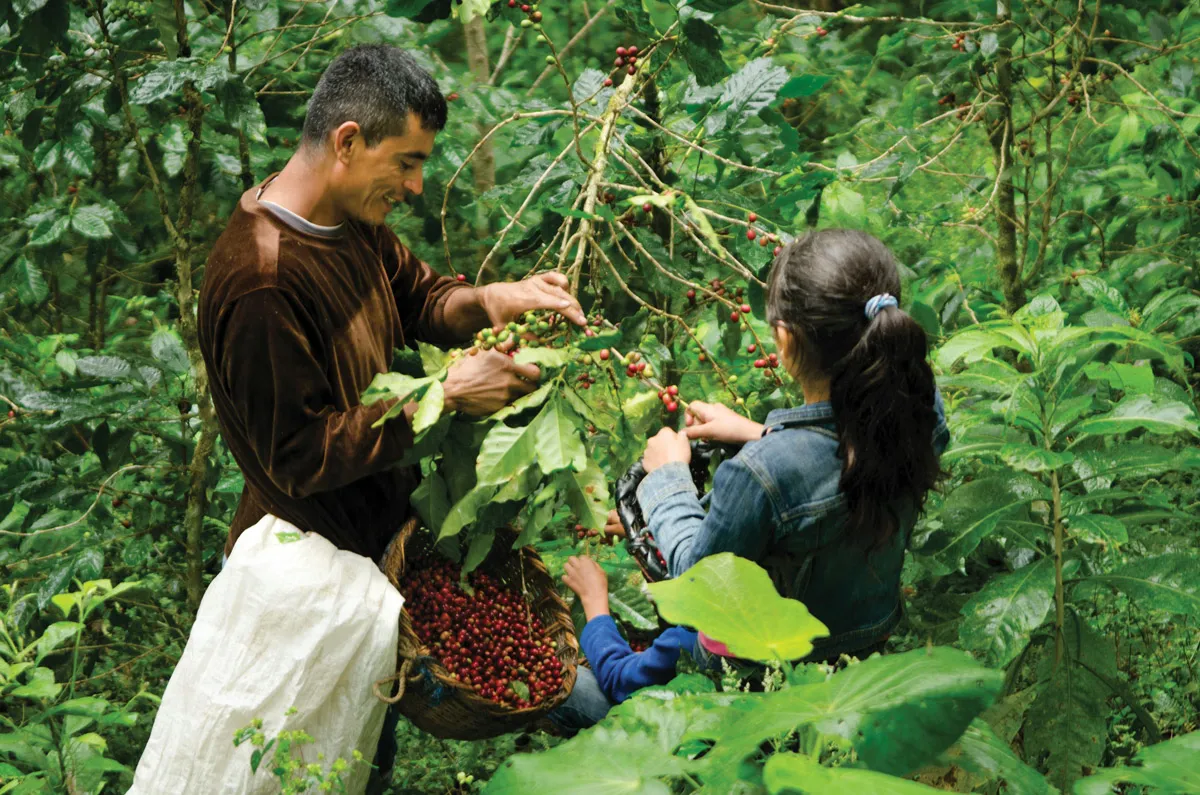
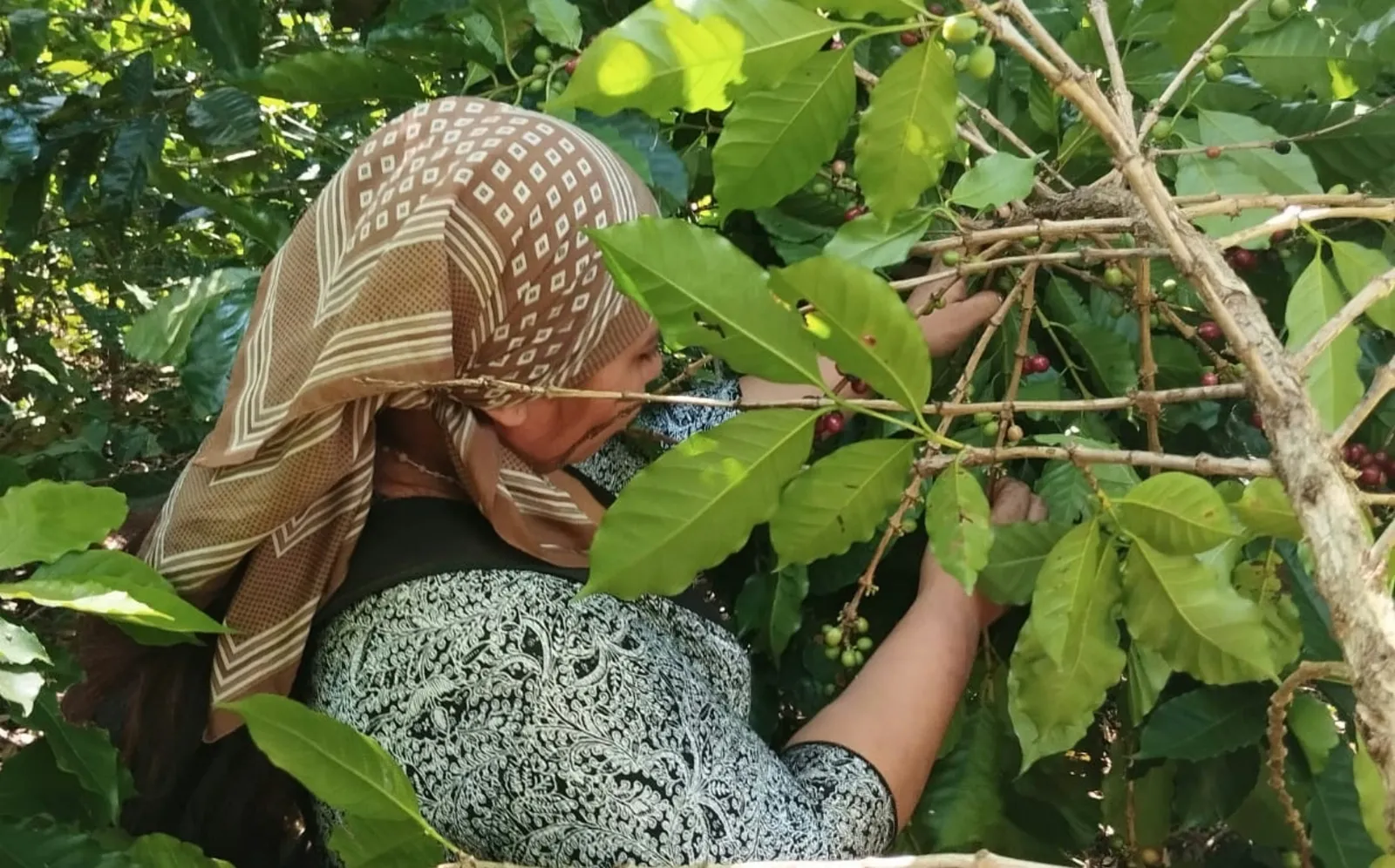
Marlon Villarreyna and his niece pick beans on his family’s coffee plot.
The family's home is a modest wooden structure. Pérez and his wife, Mefalia Villarreyna, share it with their youngest son Wilder, twenty-one, and two nephews: Jeyson, fifteen, and Freyder, eleven. The evangelical church stands next door, and the community's elementary and middle schools are about a ten-minute walk away. High school lies in another community, a trip that takes students a couple of hours on horseback each way.
For more than fifty years, the Pérez Villarreynas have worked in coffee. Their forebears were landless peasants laboring on plantations that enriched absentee owners. Following the 1979 Sandinista revolution, the new government dismantled large landholdings and handed ownership to those who worked the land. During the US-sponsored Contra War that followed, El Sontule's residents banded together for unity, to defend their interests, and at times to fight. Neighboring Honduras then permitted the United States to train and deploy fighters from its territory; with the Miraflor area only sixty miles from the border, it suffered heavily.
Worn down by the fighting, Nicaraguans voted the Sandinistas out of office in 1990, hoping to persuade the United States to withdraw support for the Contra forces, lift its embargo, and end the violence. The incoming administration of Violeta Chamorro did not back the cooperative system, but El Sontule's people retained the land they had received during the Sandinista-era redistribution.
In a normal year they would have walked among verdant hills. But this year, the bare plants had discarded their orange spotted leaves, the crumpled remains littering the ground.
Since the war years, nothing has struck El Sontule harder than rust.
A Harvest Unlike Others
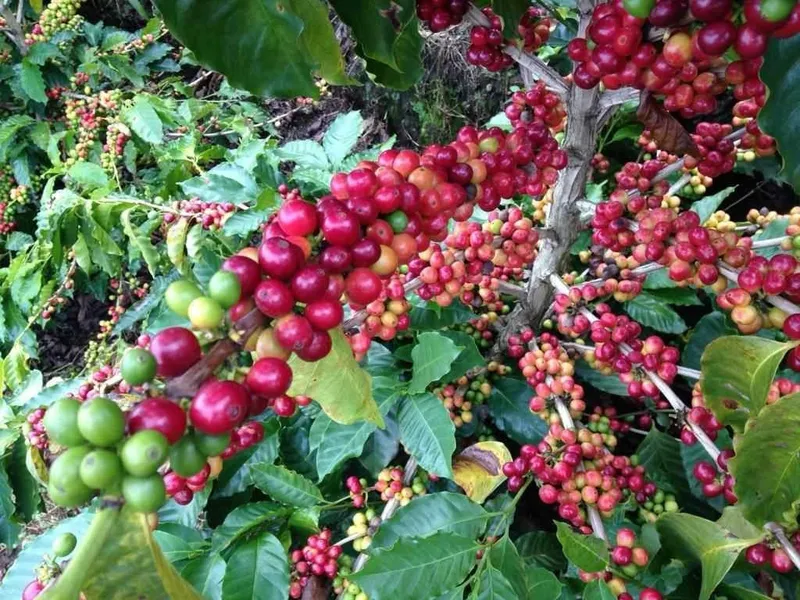
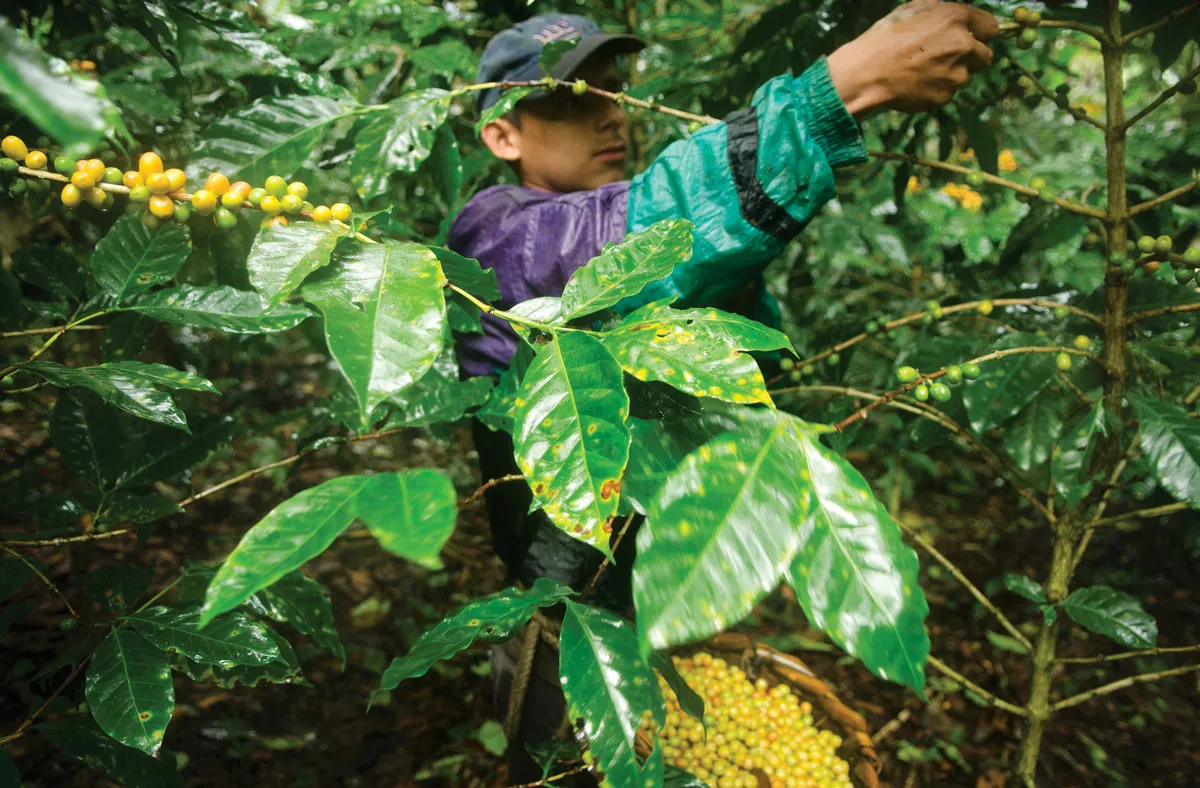
I came back in January 2014 for the harvest. Normally the month hums with activity in El Sontule. School is out until mid-February, and families spread across the hillsides, moving among the coffee trees to gather the red fruit. The day I joined Jeyson, he was helping his uncle Marlon Villarreyna and a couple of cousins bring in Marlon's crop. His half brother Freyder came along to pop cherries into his mouth, biting through the hard pulp for the sweet, honey-like syrup coating each bean. The harvest is described with the verb cortar, to cut, yet all the work was done by hand: fruits popped off the trees one at a time with thumb and forefinger, then dropped into handmade woven baskets.
In a normal year they would have walked among verdant hills. But this year, the bare plants had discarded their orange spotted leaves, the crumpled remains littering the ground. Many plants had been cut back severely. Others had died. The Pérez Villarreynas had felled the infected trees and replanted, hoping the new ones—which need at least three years before a first decent harvest—would not also fall victim to roya. Marvin Pérez treated his saplings with an organic fungicide, Bordeaux mixture, caldo Bordelés, as protection. Meanwhile, they expected little from this season.
How much a given family gathered depended heavily on luck. The Pérez Villarreynas had lost more than eighty percent of their coffee to rust. Some neighbors, by contrast, had lost little. Across El Sontule overall, farmers saw a forty percent reduction in the 2012–2013 harvest—small compared with the nearly ninety percent drop in the 2013–2014 season, according to Suyen Baharona, program coordinator at the Center for Global Education, which has run educational trips focused on social justice to El Sontule and other parts of Nicaragua for fifteen years.
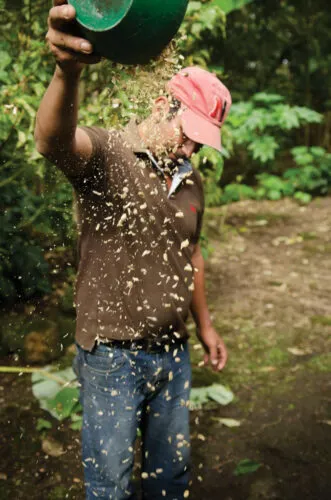
Marvin Pérez drops his coffee beans to the ground, allowing the wind to winnow away their parchment.
Scientists Disagree on the Cause
Researchers do not agree on why this epidemic is happening in Central America now. Many point to climate change, arguing that warmer, wetter conditions let the rust spread into places it previously could not. Other scientists hold that modern practices—pesticide use and deforestation—are responsible, disrupting the ecosystem balances that had kept the rust, always present in small amounts in Central America, from exploding out of control.
El Sontule is a rural community without many resources, yet its residents take pride in high ecological and educational standards. Most growers, young and old, are informed and articulate on environmental issues and have plenty to say about growing practices and environmental management. Ask El Sontule's farmers about the rust and, like many scientists, they blame cambio climático, climate change. "There was a time when there was winter, and then after there was summer," Marvin Pérez says. "Now, it can be raining in the summer. We'll have times where it's really hot, and then suddenly, it's raining."
From Tree to Bean to Cup
In the fields, once the cherries are detached one by one, the shiny red fruits go into large white sacks and are carried—on foot or by horse—to the community's shared washing and pulping station. Workers pulp the cherries by hand; the newly naked beans return to their sacks and ferment in the sun for a few days. The pulp is likewise left out and eventually becomes compost. After fermentation, the coffee is washed and sorted: the lowest-quality beans are discarded, the middle tier stays with the farmers, and the best goes to PRODECOOP's facilities in Palacaguina, a warmer, drier town about an hour from El Sontule.
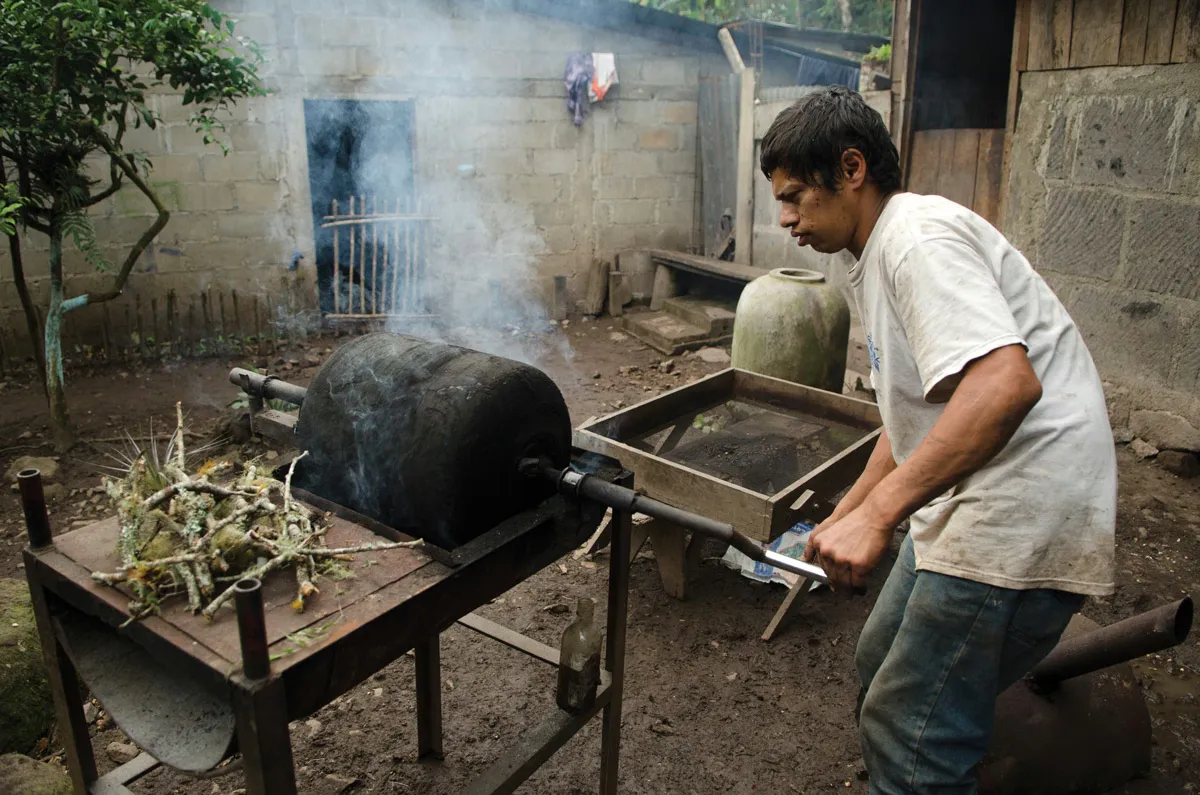
Jackson Flores turns his roasting chamber to evenly roast the beans inside.
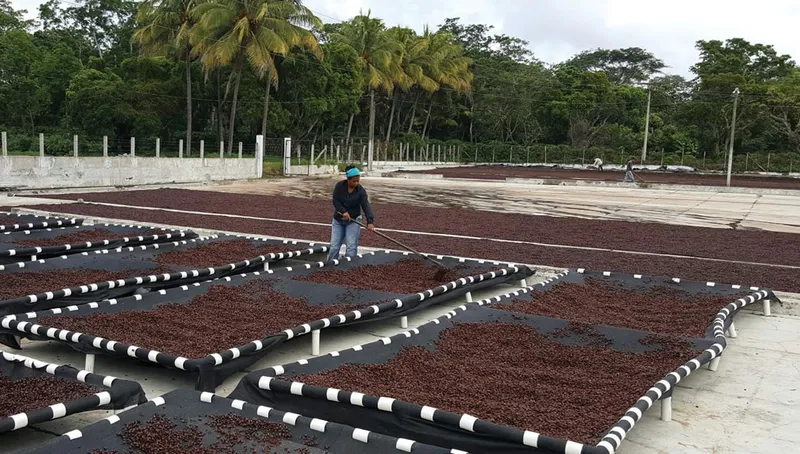
Before Marvin and I boarded the old school bus to Palacaguina—brightly painted outside, plastered inside with stickers of Jesus, the Virgin Mary, and Wile E. Coyote—he helped his neighbors load their bulging pink sacks of coffee onto the roof. Under the hot sun in Palacaguina, workers dried beans on vast concrete patios, then sorted them by quality, with separate machinery at every stage for organic and conventional beans. The coffee is then shipped to buyers in the United States, Europe, and Asia.
The second-tier coffee the Pérez Villarreynas keep follows a different path after washing. Given sun, it dries outdoors for three days. During my visit, despite summer, rain had come and gone for days, so Mefalia dried the beans at home in a large iron pot on the clay oven. The coffee still wore a thin parchment, so Marvin, Freyder, and Jeyson carried it to a nearby house belonging to Jeyson's grandfather, where they dumped it into a man-made hollow in a rock. Taking a long wooden stick leaning against the house, Freyder, Jeyson, and Marvin took turns pounding the coffee in the hole to free the beans from the parchment. Now and then Jeyson or Marvin would scoop some out and let it fall back slowly, the wind carrying the parchment away. They kept winnowing until no beans bore the papery coating. The coffee was ready to roast.
Marvin took the coffee to a neighbor, Jackson Flores, who roasts for the village. Freyder followed as fast as he could, arms full of kindling from cut-down coffee plants. Jackson's roaster resembles a pig on a spit: thin iron handles protrude from two sides of a large hollow oval, which he filled with green beans. Thick with soot, the roaster turned slowly over the fire. Every so often, Jackson or Marvin would insert a thin iron trier into a small hole to pull out a few beans and check color and aroma.
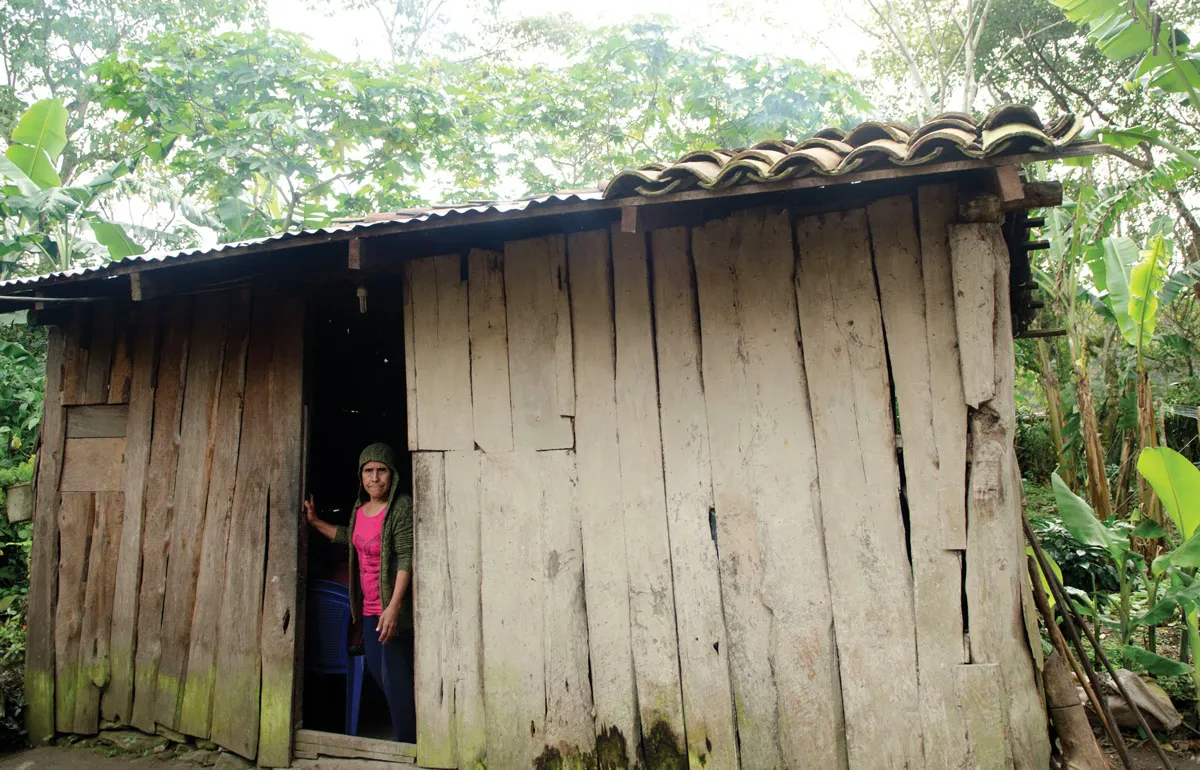
In El Sontule, Nicaragua, Modesta Flores, sixty, takes a quick break from cooking in her daughter’s kitchen.
When the coffee reached a deep chocolate brown, Jackson tipped it onto a mesh screen to cool, the smell of fresh coffee filling the air. Then came the best part: back to the Pérez Villarreyna kitchen, grinding beans by hand, adding the grounds to a big pot of boiling water, straining, and pouring the rich, bitter brew into their red thermos—a constant on the kitchen table, somehow always magically full of warm coffee. Friends and family usually fill the kitchen, stopping by to chat over a cup. "We don't have enough coffee to export right now," Pérez says, "but we have enough to drink."
A Threat to Staying Put
Even though El Sontule's residents still have coffee to drink, and some have enough to export, rust remains a threat to their ability to remain here. As a Fair Trade member, the Vicente Talavera cooperative receives a $20 premium per quintal (100 pounds) of coffee. They call it a premio social, a social premium used to renovate plantations or cover school fees and supplies. Fewer exports, of course, mean less money. "If we don't have coffee because of roya, we won't have social projects," Pérez says.
"We don't have enough coffee to export right now," says Pérez, "but we have enough to drink."
Nearly 400,000 coffee workers across Central America have already lost their jobs because of rust, according to Oxfam and Promecafe, and many have left their homes for already crowded cities or tried their luck heading to the United States without papers. USAID estimates that rust could end up costing the region an estimated 500,000 workers in the coming years if progress is not made. And while the Pérez Villarreynas have lost much of their coffee, they still have it better than some. Mefalia teaches at the local school, and the family runs a homestay for tourists. They also keep a large garden, growing food to eat and sell. Uriel and Wilder are both studying at universities in Estelí.
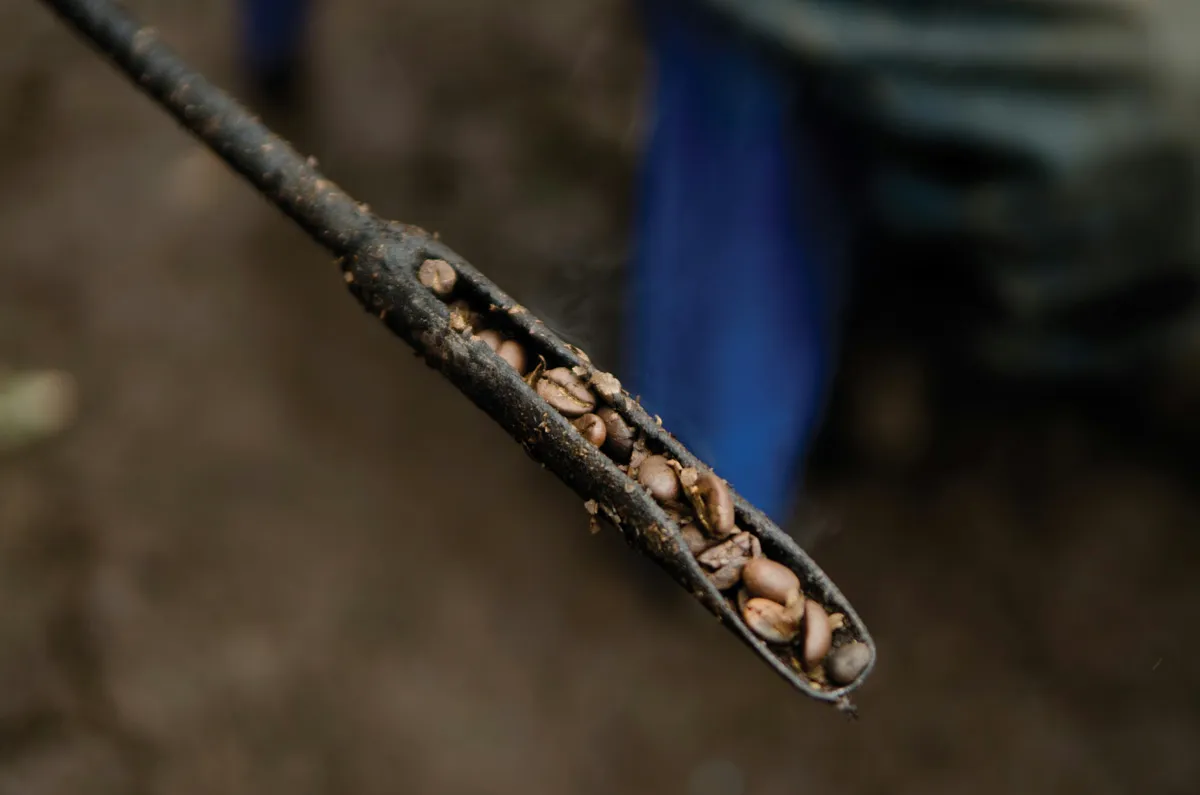
The trier Flores uses.
On my last night in El Sontule, the Pérez Villarreynas bought two chickens from a neighbor and made a big, delicious meal. They invited Mefalia's mother, Modesta, and Jackson, the local roaster, stopped by for red beans and rice. After dinner we drank Flor de Caña rum and homemade lemonade and listened to a baseball game on the radio.
The glow of the wood fire in the stove, along with the lone lightbulb in the kitchen, warmed the clay-floored room. Mefalia sat near the stove, feeding bits of tortilla to the two dogs, Scott and Campeón. I played a card game with Freyder, Jeyson, Jackson, Wilder, and Marvin. At the end of the table was, as always, the red thermos, signaling hot, delicious coffee ready to be enjoyed. Caffeine doesn't keep me awake, so I poured myself a cup, black, to counteract the rum.
Hopefully, that thermos will remain there.