Decoding Coffee Certifications: What Those Little Logos Really Tell You
From organic to B Corp, certification seals on coffee bags promise transparency—but understanding their distinct aims and limitations is key to making informed choices.
By Avery Gray7 min read
Scan the coffee aisle at any grocery store and you'll spot a slew of certification logos. What do they actually signify? What criteria must be met to earn one? And is it obvious who really benefits?
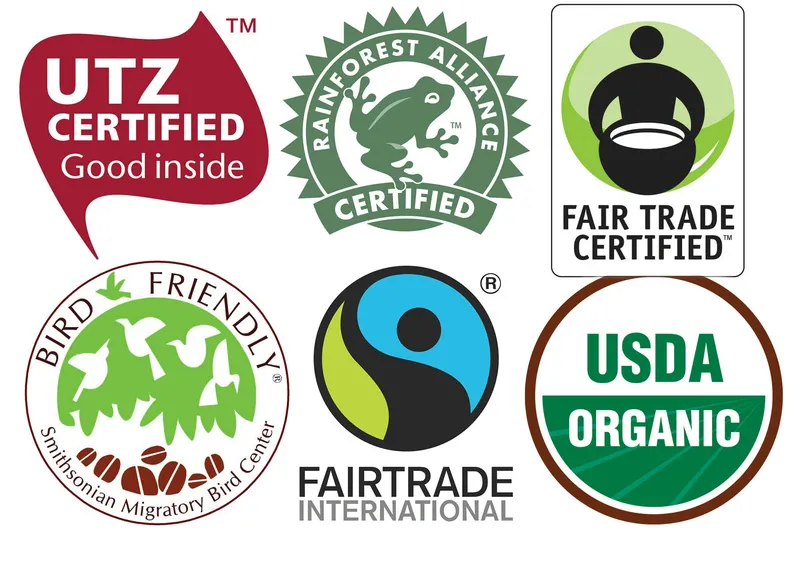
Certification schemes exist to shed light on how a product is made and sold—and coffee is far from the only category. Odds are you've encountered seals like USDA Certified Organic, Fair Trade USA, Smithsonian Bird-Friendly, and Rainforest Alliance on countless items. These marks indicate that a farm, cooperative, or company adheres to a specific set of values and standards.
Yet can you explain what "certified organic" entails, what B Corp status means, or how direct trade sourcing works? Despite the abundance of tiny logos on our purchases, much remains unclear about their meaning, effectiveness, and actual impact. We spoke with roasters and industry experts to unpack the value of coffee certifications and how they convey worth to consumers.
What Certification Means for Roasters
Coffee By Design, a Portland, Maine roastery, initially explored certifications as a way to go beyond stated values and communicate concretely with customers. "As we started to look at the various certification programs out there and what our customers were asking for, the two most common were organic and Fair Trade," recalls Mary Allen Lindemann, co-founder and community builder at Coffee By Design.
In deciding which to pursue, Lindemann compared the programs' differences and how each would function in a roastery. USDA Organic, for instance, centers on production methods and is overseen by the US Department of Agriculture; it demands verification at every link in the coffee chain. A bag bearing the seal guarantees that all steps—from farming to roasting—comply with USDA organic standards, requiring certification across the entire production process.
Other programs focus exclusively on the farm level. Fair Trade, for example, aims to safeguard farmers' livelihoods through a minimum price for green coffee. Fair Trade USA™, founded in 1998, is an independent third-party certifier that was originally part of Fairtrade International until splitting in 2011; Fairtrade International then established Fairtrade America as its US branch. Both programs seek to offer sustainable solutions via price premiums. During her research, Lindemann examined TransFair USA, the precursor to Fair Trade USA.
That pricing structure has three components: a floor price per pound, a Fair Trade premium, and an organic differential. As of May 2022, the minimum price set by Fair Trade USA and Fairtrade America is $1.40/lb, with a $0.20 premium and an additional $0.30 for organic-certified coffees. If the commodity market price exceeds the Fair Trade minimum, both programs defer to the market rate. The $1.40/lb floor ensures farmers receive fair compensation when the market dips below that level.
Certification types vary further: some assess a retailer's business practices; some focus solely on raw materials or sourcing; and others, like organic, require a blend of sourcing and retail practices that multiple parties must uphold. Coffee By Design ultimately became a USDA-certified organic roasting facility, enabling them to sell certified organic coffees at the farm level (they also sell non-organic coffees, which most roasters may do provided the coffees are kept separate). "At the time, the organic certification made a lot of sense to us. We said, 'why not look at farms that have been certified?' We should take the time and effort to make sure our manufacturing facility is certified as well," Lindemann explains. "We knew that it was a matter of that third-party saying, 'Yes, this coffee and facility meet [quality standards] within the guidelines.'"
Which Values Are Being Promoted?
For consumers, certifications simplify purchasing by visually representing personal values. In a recent YouTube video, James Hoffmann, coffee professional and co-founder of Square Mile Coffee Roasters in London, suggested, "a helpful way to think about these certifications is to consider which set of values overlap with your own." In essence, certifications let roasters put their principles front and center on a bag and help consumers find information quickly—but what does each one truly stand for?
Much of the confusion around coffee certifications stems from their distinct intentions and how shoppers interpret the labels. It's tempting to lump certifications together as indicators of "better" or "more sustainable" coffee. Yet most have a specific mission and promote a particular set of values.
Fair Trade USA, for instance, seeks to establish standards grounded in ethical principles—higher premiums, economic development, and healthy working conditions. Its website states: "Fair Trade Certified™ is an award-winning, rigorous, and globally recognized sustainable sourcing model that improves livelihoods, protects the environment, and builds resilient, transparent supply chains."
Another program gaining ground in coffee is B Corp. B Lab, the nonprofit network that certifies businesses, defines B Corp Certification as "a designation that a business is meeting high standards of verified performance, accountability, and transparency on factors from employee benefits and charitable giving to supply chain practices and input materials."
Organic certifications, by contrast, zoom in on how an item is grown and processed, and are often conferred by a government body. In the US, the USDA defines organic certification as "foods [that] are grown and processed according to federal guidelines addressing, among many factors, soil quality, animal raising practices, pest and weed control, and use of additives. Organic producers rely on natural substances and physical, mechanical, or biologically based farming methods to the fullest extent possible." While organic certification may indirectly yield ethical benefits, price premiums are not a requirement for the seal.
The distinction between government-run and values-driven certifications doesn't rank one above another. Rather, these differences help companies and consumers identify the certifications that best match their professional and personal priorities.
When the Certification Comes from Within
Beyond established third-party programs, some large companies—notably Starbucks and Nespresso—have created internal schemes to guide purchasing and sourcing. Occasionally, these companies place stickers or logos on bags that resemble third-party certification marks.
Hoffmann notes in his video that such programs exist to control supply chains. "It's about having a guaranteed supply of the qualities of coffees that they need and want for their businesses, sourced in a way that marries up with the perceived ethics of their customer base and hopefully the ethics of the company itself."
Starbucks' internal verification, Coffee and Farmer Equity (CAFE) Practices, is "a verification program that measures farms against economic, social and environmental criteria." SCS Global Services monitors these practices, checking farms against 200 different indicators. Nespresso runs the AAA Sustainable Quality™ Program, developed with the Rainforest Alliance, and Peet's Coffee has announced that its sourcing practices were verified by Enveritas, a nonprofit that provides "sustainability assurance for the coffee industry," according to its website.
These programs depend on outside verification, and how rigorously standards are applied can be ambiguous. Starbucks' CAFE Practices, for example, has faced criticism more than once, with reports of forced labor on farms that held the company's internal accreditation. Starbucks' website does not specify how frequently accredited farms are audited, but reports allege that farms may go two to three years without an audit.
What Does It All Add Up To?
A common assumption is that certified coffee is automatically superior. But superior in what sense? More sustainable? Better tasting? What does the certification say about the coffee inside the bag?
Stuart Ritson of Osito Coffee, a small importing company, points out that certification's benefit isn't always about flavor—it's about impact. "It is a bonus and a benefit to a producer who does Fair Trade and organic [certification] that even if their coffee is commodity level and not particularly good in terms of cup quality," Ritson says, "they can still get a price that's very decent for that coffee."
That aligns with how consumers use certifications: to make socially and environmentally responsible purchases. In a study by Wiser, 74% of participants said they were more likely to buy a product bearing the USDA Organic logo.
Still, the actual truthfulness of a certification's programs—or their impact—can be hard to gauge from a bag alone. Without a clear grasp of what a certification means, consumers may mistakenly assume a coffee is doing more good than it is. Take greenwashing, or portraying a product as more environmentally or socially responsible than it is. In coffee, this might look like marketing beans as organic without USDA certification (the USDA website has a whole section on proper labeling) or making unproven claims about sustainable farming. In 2022, Keurig Green Mountain was ordered to pay a $10 million settlement after falsely claiming in ads that its coffee pods were recyclable.
Fair Trade America has even coined the term fairwashing, when "companies misrepresent how equitable they are in terms of labor practices, wages, and equality for workers." Its website urges consumers to be cautious and critical when reading a label: "Unlike vague buzzwords, certifications on product packaging (like our Fairtrade label) do have standards and regulations. These labels offer real protection to the environment and to workers. You should be able to research the labels and see clearly defined standards and regulations listed transparently online."
Coffee certification programs can help validate a business's practices against specific standards, but as in most things, clarity is essential. The next time you pick up a bag of coffee, examine it closely—and don't hesitate to ask questions and seek out information to determine whether a certification is authentic, goes beyond buzzwords, and aligns with your values.