Inside a Swiss Roastery: How ViCAFE Balances Automation and Craft
ViCAFE supplies 17 cafes from its Zurich roastery, relying on integrated software to link every machine so the team can devote more attention to quality and traceability. The company's roots in a revived soda brand helped make automation feel familiar.
By Casey Adams8 min read
This roastery profile series is brought to you by Loring.
Recall the last time a sip of coffee stopped you in your tracks—so unexpectedly delicious and distinctive that it felt like your first taste of coffee all over again. Christian Forrer, founder of ViCAFE in Zurich, Switzerland, set out to create that kind of moment not just once, but consistently: to deliver a transformative experience in every cup, one that would renew customers' appreciation for what they were drinking.
Forrer grew up in Eglisau, a small town in northern Switzerland. Eglisau is perhaps best known as the birthplace of Vivi Kola, a historic Swiss soda brand launched in 1938. Pascal Herzog, ViCAFE's COO and head of impact, notes that Vivi Kola used to give free sodas to schoolchildren on Wednesdays—a tradition that illustrates the brand's "emotional connection" to the town, particularly for people like Forrer who grew up there. Production ceased in 1986.
ViCAFE's story is closely intertwined with that of the soda brand: it began in 2010 when Forrer decided to bring Vivi Kola back. Herzog says Forrer wanted to recreate "this positive experience that he had as a child growing up." The revival was an immediate success: within the first two hours of the relaunch, 2,500 bottles of Vivi Kola were sold from a small cafe called ViCAFE.
Anticipating that customers might not visit regularly just for cola, Forrer purchased a small coffee roaster for the Eglisau shop. In 2014, he opened the first ViCAFE Espresso Bar in Zurich.
Today, ViCAFE operates 17 retail locations across Switzerland, in places such as Basel, Eglisau, and Zurich. Herzog says the roastery plans to open two new cafes in 2025. Many of ViCAFE's locations are small, which helps support that pace of expansion. "Most of them are a takeaway concept, like a window-in-a-wall concept," Herzog says.
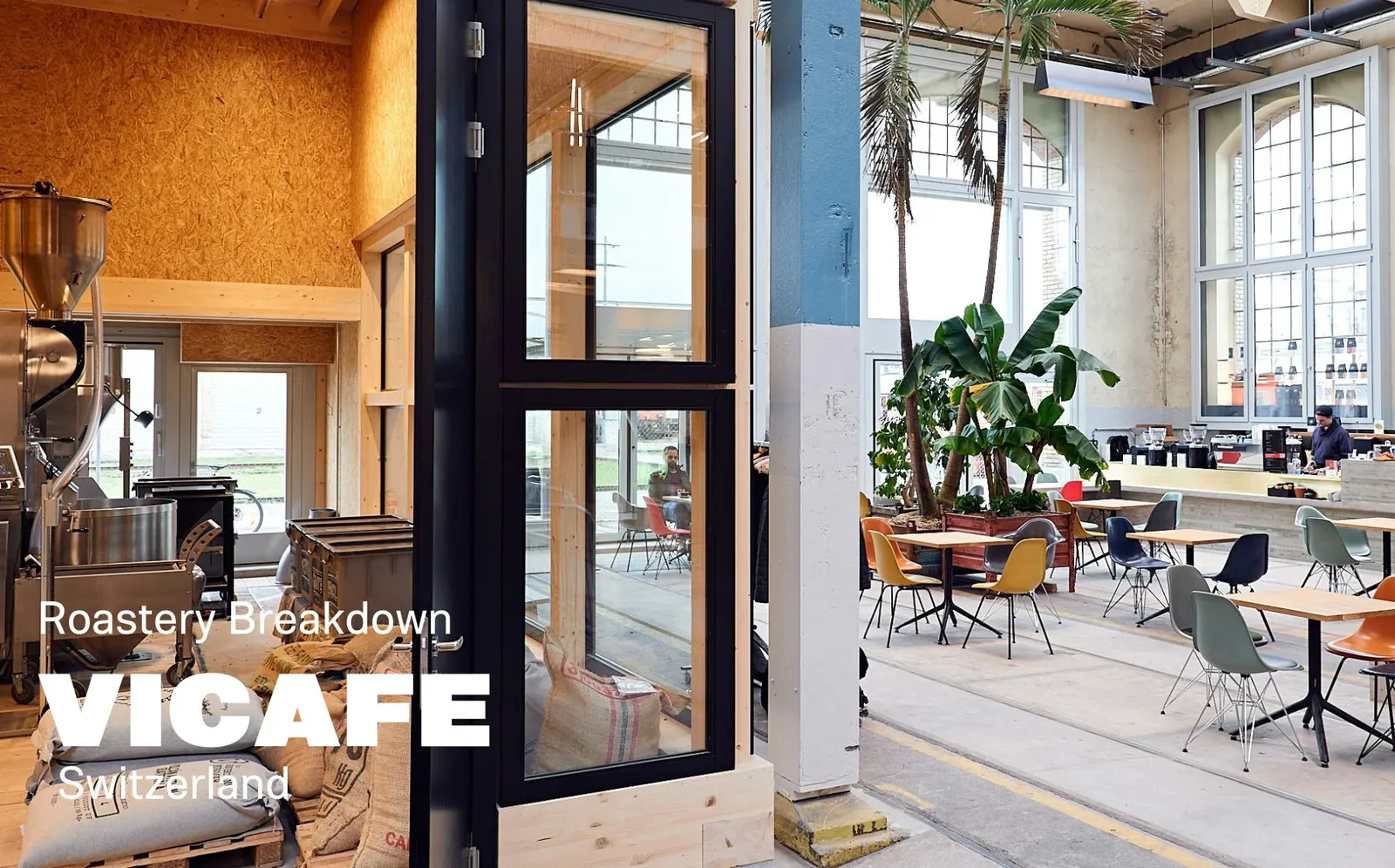
After outgrowing its previous roasting space, ViCAFE moved in November 2023 into its current headquarters: an old train station in Zurich. The move enabled the company to increase roasting capacity, automate much of its facility, and bring most daily operations under one roof (the Vivi Kola bottling plant remains in Eglisau).
Herzog remembers how constrained the former roasting space was: "We basically had an office in one place, then we used an old railway canteen to do the baking, and then the roasting was in a third place," he says.
By contrast, the new space is large enough for ViCAFE to bake pastries for the cafes and roast coffee for its cafes and online store; it also runs a cafe on site. The train station serves as a large business hub, and ViCAFE shares the space with a brewery, a chocolate maker, and a soap manufacturer.
The move has done more than allow ViCAFE to automate its roasting operations—it has also connected the company to the wider Zurich community. "It's quite nice, not only that everyone from ViCollective is under one roof, but that we are also part of a greater community," Herzog says.
Quick Facts:
Location: Zurich, Switzerland
Footprint: 1,500 square meters, including the roasting space, office, and cafe
Capacity: 180 tons (360,000 pounds) in 2024, projected to reach 210 tons in 2025
Retail and/or wholesale roasting: Both
Large-Scale Roasting
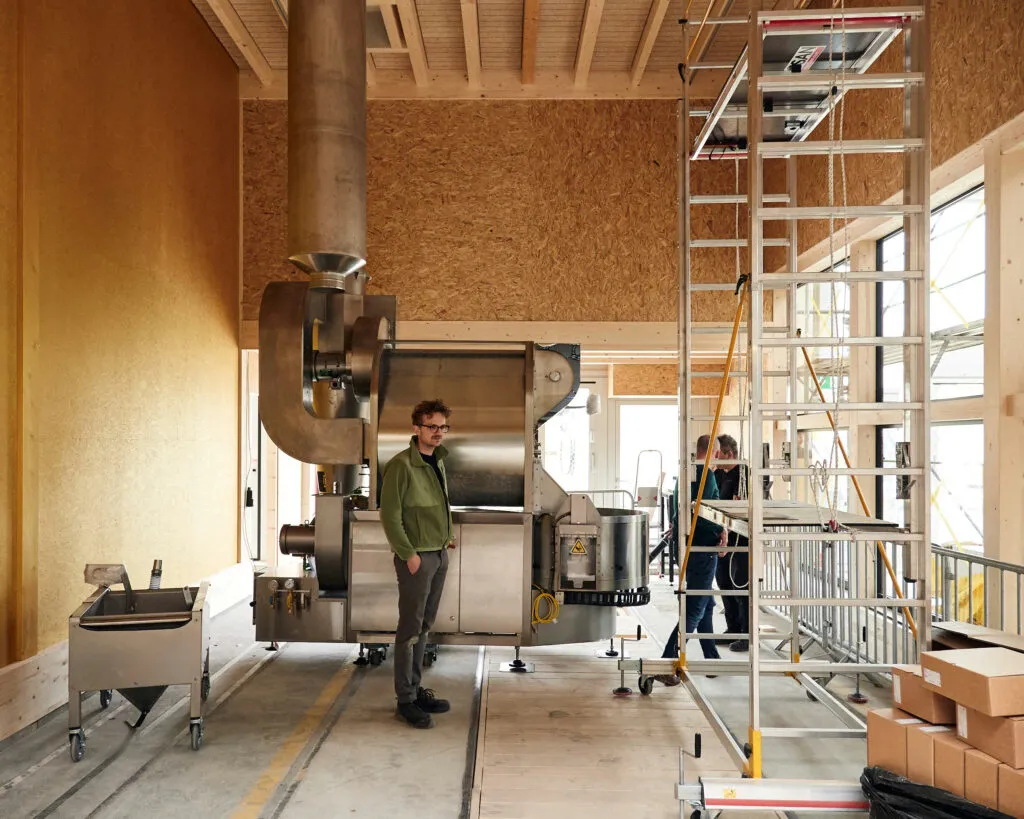
ViCAFE roasts 180 tons of green coffee annually on its Loring S70 roaster, exclusively for the Swiss market. Herzog says that while there is room for a second roaster, the S70 currently meets the roastery's needs.
Supplying 17 cafes might seem like a heavy load, but Herzog explains that one delivery driver can stock most locations with two tours around Zurich—one in the morning and one before lunch. "We have our own bakery, so we need to start the first tour normally at 5 o'clock with all the baked goods and some beans for coffee shops that need them." He points out that Switzerland is small, so driving to many of ViCAFE's locations is comparable to a quick trip to the suburbs.
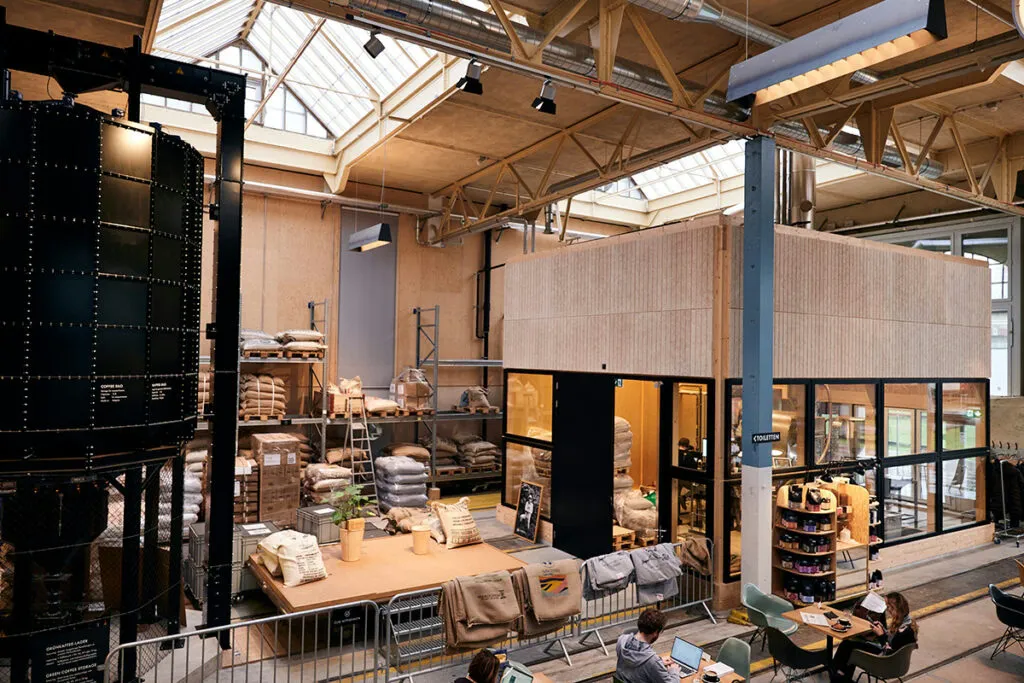
Most of the company's green coffee, however, is stored in Basel, 70 miles from Zurich along the Rhine River. "Every Monday, the truck drives to Basel, and then gets the beans that we need for basically the week or two weeks," Herzog says.
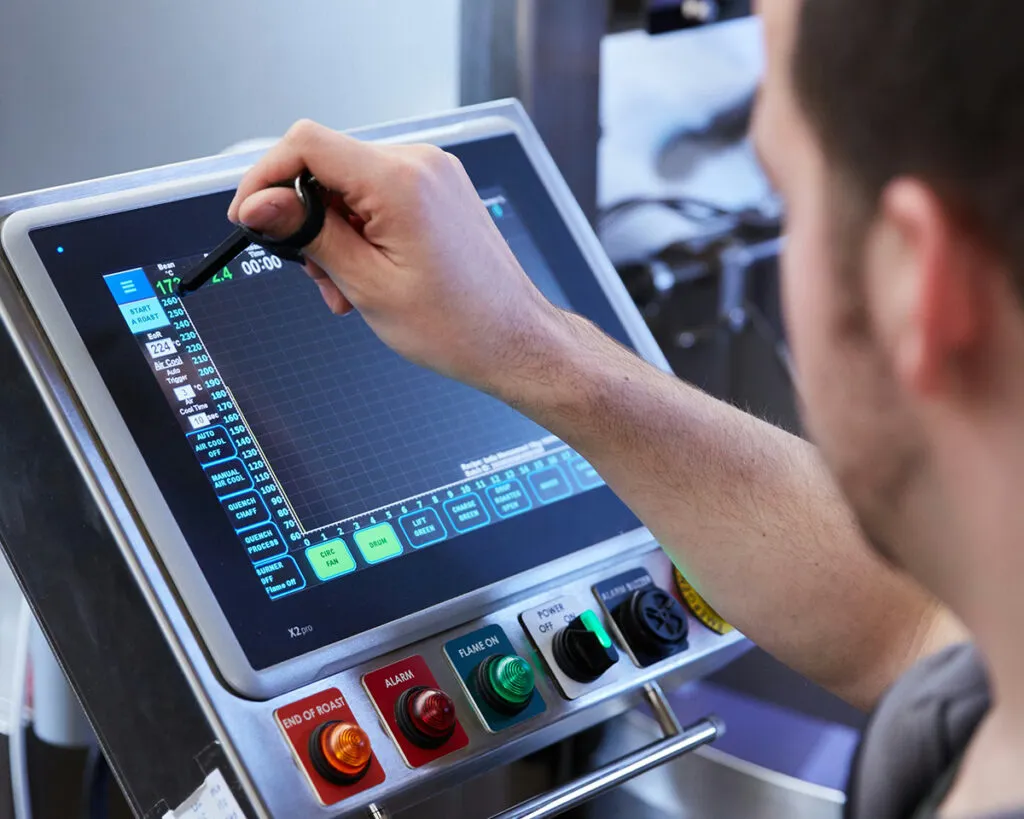
Once the coffee arrives at the roastery, ViCAFE's distinctive roasting model comes into play: nearly every step is automated, and every piece of equipment is linked through powerful software. Green coffee is loaded into the roaster and roasted according to a roast plan; it then passes through a destoner and is sent to a large coffee silo to rest—all at the push of a button. From there, the coffee travels by conveyor belt to be packed into bags, organized, and dispatched by the fulfillment team.
Herzog notes that this workflow is fairly typical, but what sets ViCAFE apart is the integration of its software so that every part of production communicates with the others. "What is crucial is that we have the full software integration … we have a fully integrated workflow with a software that talks to each and every machine," he says. "Automation is very much about the software, and less about the machines themselves."
The automation process begins with planning. "The head roaster, he does the planning," Herzog says. "Every morning, at 7 o'clock, they create a roast plan, which is then entered into the software. They do a packaging plan which is also entered into the software."
On longer roasting days—10-hour days with two people working—the roastery can turn over more than two tons of coffee. On half days, it can produce up to 1.4 tons.
While automation is sometimes dismissed or seen as contrary to hand-crafted coffee, Herzog believes that "there is no contradiction between automation and making a high-quality product where the roaster can pay attention to each and every detail." He says automated processes help the team concentrate on quality control and maintaining high standards.
Even so, "It did take some time to get used to the idea of automating as much as possible, and to have a more in-depth understanding of machinery and how those machines work and what we need to do," Herzog says.
He acknowledges that ViCAFE's origins as a cola company and bottling factory made automation more plausible, even though the bottling plant is not integrated in the same way as the roastery. "We have 24 machines at the bottling factory that are basically fully synchronized," Herzog says. "And we have people, for example, working in maintenance over there, which can help us also to transfer some of the knowledge and experience."
Still, maintaining a personal touch remains important for the roastery. "We really try to only buy coffee from coffee farmers and farms that we have visited and met personally," Herzog says.
That ethos has extended to how ViCAFE thinks about other products, such as milk. "We have started, with other roasting companies, a cooperative a couple of years ago to produce the first organic oat milk in Switzerland," Herzog says. "The idea was that we put so much effort into sourcing trips and visiting farmers and have these collaborations, but at the same time, we buy oat milk with random oats." ViCAFE also became a B-Corp-certified business and tries to apply its sourcing model to "different aspects when it comes to the value chain."
Equipment Breakdown
Roasthubs automation software: ViCAFE is able to automate and connect its machinery through software designed by Belgium-based Roasthubs. Before adopting the software, Herzog says they "had an Excel-based system before, but again, lots of manual work you need to do, lots of human errors, as well as people just forget or they don't do things properly. And with this, it became much easier."
The software lets Herzog and the team visually track where coffee is moving and set the queue for each day's roast. If you wanted to see how full the silos are, for example, you could check the software to determine which compartments are full and which are empty.
The roasting software enables traceability down to every bag of coffee. "I can click on a roast log number and then you see each and every green parcel that went into this roast number," Herzog says. "If you want to be a professional player in wholesale, for example, and you can't offer those guys full traceability, all back to a single coffee bag, then you're in a very difficult position."
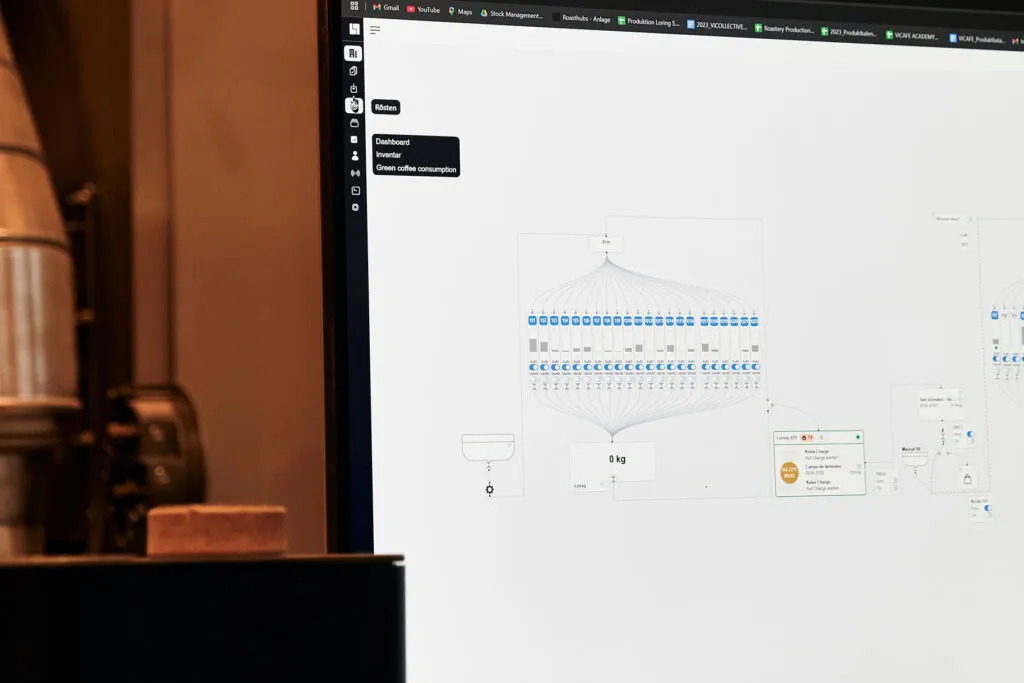
This system also helps ViCAFE keep roasting operations lean—on the day we spoke with Herzog, three people were working in the roastery handling the entire day's fulfillment, packaging, and roasting. "With the few people that we have, we can hopefully give them jobs and professional challenges that are interesting and that make them grow in the coffee space," Herzog says.
Roasted coffee silo: ViCAFE stores roasted coffee in a large silo, allowing the coffees to rest before packaging. Afterward, they travel via a conveyor belt into the silo.
"It's one big silo, but it has 16 compartments," Herzog says. "We can block certain cells for certain qualities. So for example, for decaf, we have a blocked cell only for decaf coffee to avoid any mix-up." The coffee travels through tubes that connect the destoner to the silo, which are located under the floor between the railway tracks of the building.
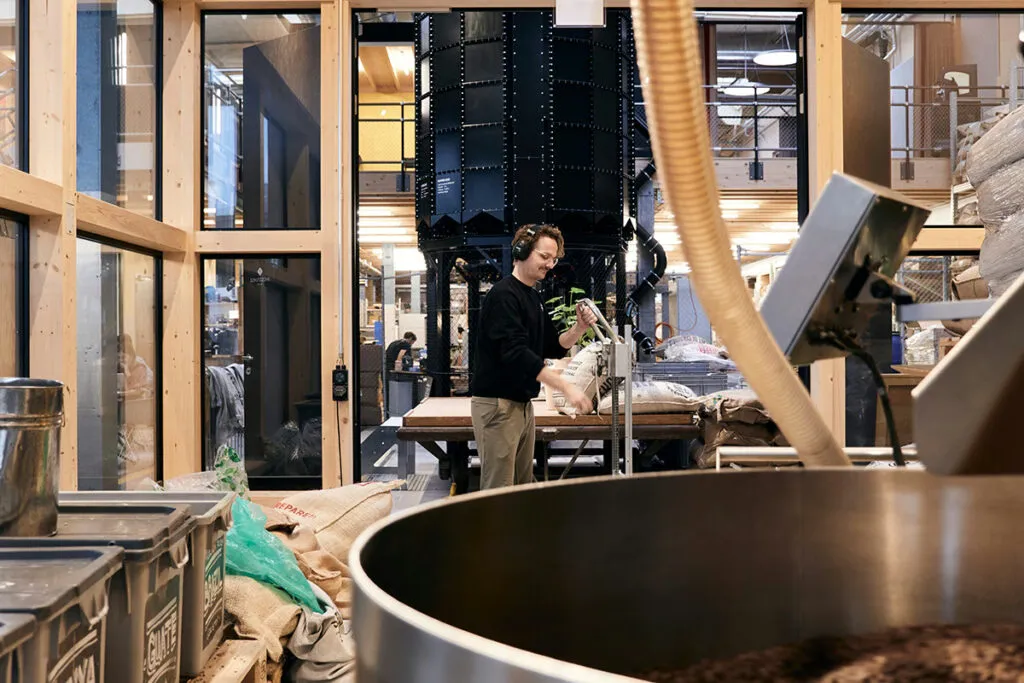
Packaging: Coffee then moves from the silo to a carousel packaging machine made by a company based in Bologna, Italy, to pack retail bags.
"Every parcel that you prepare for the online shop or for your espresso bar … somebody needs to prepare a parcel," Herzog says. "Somebody needs to prepare a delivery for an espresso bar. So you can automate your roasting, you can automate your packaging, but in the end, you need a lot of space to do your fulfillment."
A Worthwhile Learning Curve
Herzog says that learning all the new systems and machinery was a challenge. "It was a steep learning curve earlier this year, and my confidence level is much, much higher now than if you would have talked half a year ago," he says.
But he also sees the team growing around him. "They are solving problems themselves, and hopefully we also give them the trust and the knowledge … that they are in a position to confidently take decisions and make it happen," he says.
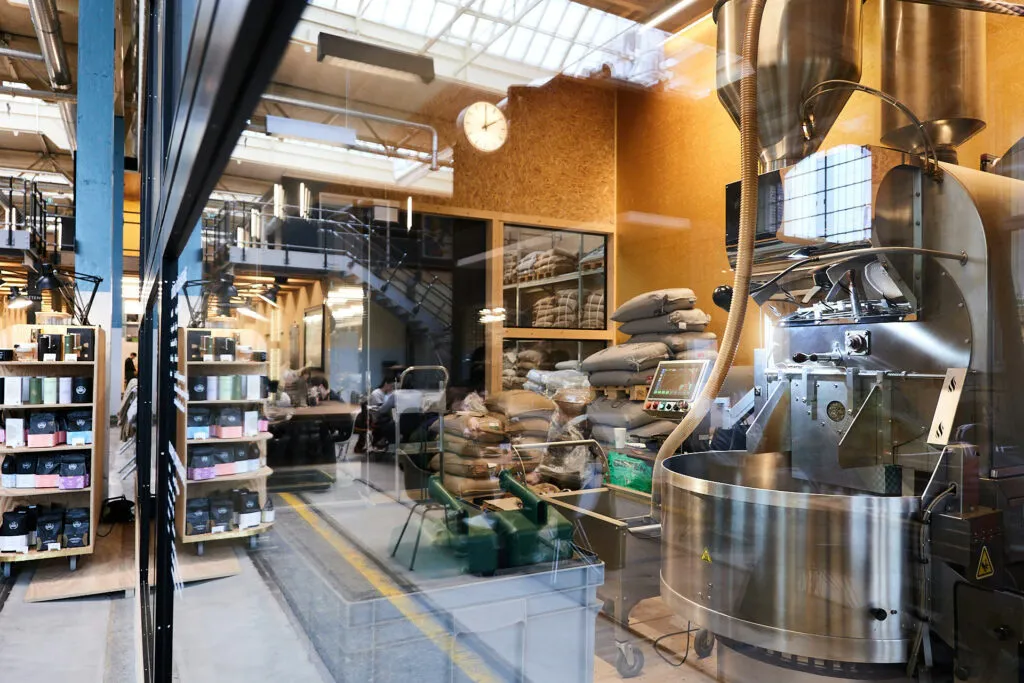
Before this new system, Herzog says the roastery's team members worked in much more strictly defined roles. "I think what we changed as well … is that every person was very much on their little job. One person doing fulfillment, another one preparing pouches, and the third doing roasting. And now we work more in teams, so we move around with the team in the roastery."
In the end, he says, automation is a powerful tool, but it still depends on people—and the roastery's tools can only run if workers feel empowered and supported. "Yeah, the tool is the software," he says. "But the people are, in the end, the success factor number one."
Ashley Rodriguez contributed reporting to this story.