High-Altitude Experimentation: A Colombian Farm’s Unconventional Path
At a fog-shrouded estate outside Bogotá, two producers are testing fermentation methods and building a network with neighboring growers to push the boundaries of specialty coffee.
By Kai Reed11 min read
A Rough Road to a Rare Microclimate
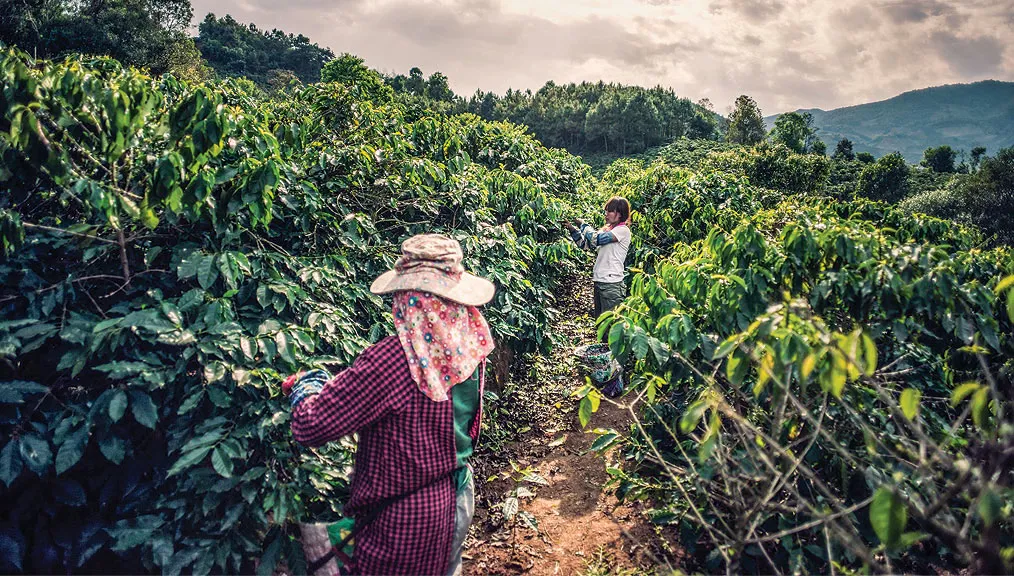
Bouncing along the back seat of Felipe and Elisa Madinan’s car, I can feel almost every one of the centuries-old cobblestones on El Camino Real, a ten-kilometer royal road in Colombia laid down in the sixteenth century. About ninety minutes west of Bogotá, we turn onto another cobblestone track called El Ocaso and start the climb toward La Palma y El Tucán, the couple’s farm. The temperature falls almost at once, and the vegetation shifts from wild, untended shrubs to fruit and coffee trees. Felipe points to a slender tree, about the height of a small house, and identifies it as a fifty-year-old heirloom typica—a veteran giant among coffee plants. The air now feels damp and carries the scent of jasmine, coffee cherries, and rich earth. Fog begins to steal over the road, and a thick cloud settles above us. It is immediately obvious why the Madinans picked this spot: its unusual microclimate is a world away from the warm, sunny regions of Colombia I had already visited.
Felipe, a passionate visionary who radiates energy, tells me his coffee history as we drive. Before this farm, he had built a successful business importing and exporting both commercial and specialty Colombian coffees. Then, in 2008, the market collapsed, several large companies defaulted on their debts, and his company failed. He returned to Colombia determined to stay in coffee. While he began to shape his vision for La Palma y El Tucán, his partner Carlos Arevalo—a Q instructor and agronomist—started working on farming and processing concepts. Together they concluded that if they were going to produce and export again, they had to do something different, something special. Above all, they would focus on specialty—not merely specialty coffee but literally the top one percent. “No more depending on quantity and small margins that have huge risks,” Felipe says.
They chose to concentrate on micro-lots sold to top-end specialty roasters. They also wanted to operate in an environmentally responsible way and to have a significant social impact on producers in the area. In essence, their goal was to build a quality-driven farm where they could work personally with roasters and neighboring producers to create a one-of-a-kind product. Elisa, who handles sales, logistics, and communications for the project, says, “Ever since we founded this project, experimentation and innovation have been two key drivers that define everything we do. The fact is that we just couldn’t surrender to the belief that the traditional way of doing things was the only way. This is not to assert that the traditional way is evil, but that it is to be evaluated and integrated to face the challenges imposed by a change in the context in which the tradition was designed.”
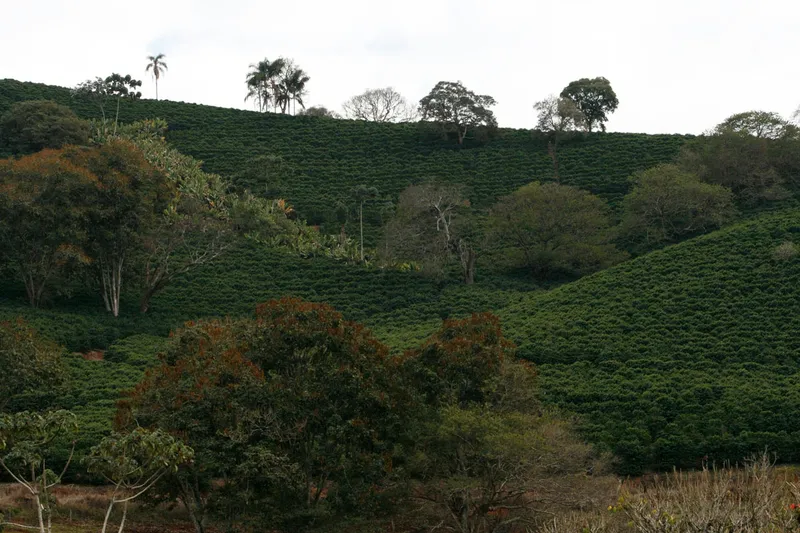
Felipe and Carlos examined nearly fifty farms before finding an abandoned one outside Zipacón. Sitting at almost 1,800 meters (nearly 6,000 feet), its microclimate offered nearly constant fog and cloud cover. The resulting colder nights slow the growth of the coffee trees and extend the time the cherries have to develop sugars and organic acids.
Designing a Farm from Scratch
They bought the property in 2011 and started work immediately. Few producers get to design their farms, and planting new varietals is an uncommon luxury. Usually farms pass down through generations, and what worked and grew before continues to work and grow. La Palma y El Tucán covers fourteen hectares, but Felipe and Carlos decided to plant coffee on only eleven and leave the rest to nature. First, they planted nitrogen-fixing trees in specific locations to help build fertile soil. Native fruit trees and shrubs went in to add further nutrients to the earth. These also provided some shade that would support the slow-growth environment they hoped to create. The plantings attracted native insects and wildlife that contribute to the farm’s overall health. Carlos explained that robust animal and plant life is essential to a successful specialty coffee farm. He believes it shows up in the cup and helps keep long-term environmental impact to a minimum.
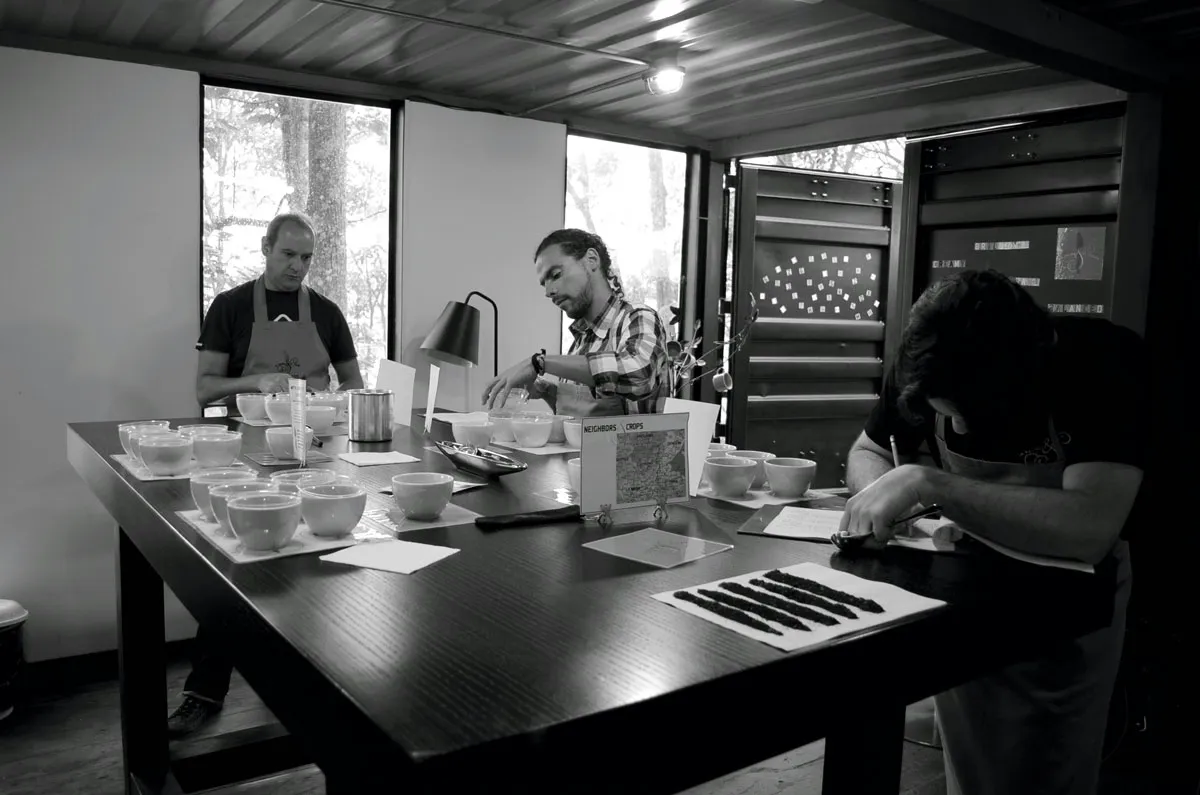
Carlos Arevalo and Felipe Madinan cupping on the farm.
At last it was time to plant coffee. They divided the farm into five sections by varietal. Green-tip geisha, copper-tip geisha, yellow catimor, red bourbon, and SL28 were each selected for their specific flavor profiles. Felipe described the excitement and slight fear about how some of these varietals would perform. SL28, known for being highly citric and phosphoric, is a common Kenyan coffee, but Felipe had no records of how it would behave in Colombia. This fearless, perhaps headlong approach runs through the whole project.
We reach the top of El Ocaso. At the farm entrance stands a large, new house built for the family that lives and works there. Carlos is waiting, and for a few moments we stand looking over the valley of coffee plots. Though I cannot see any, I hear birds—many of them—and with the soft light through the fog, the valley is lush and green. Felipe fidgets with excitement as he waits for me to take everything in. Then he smiles and heads into the forest to show me the farm.
As we walk through a field of green-tip geisha trees, Felipe and Carlos keep saying, “We’re almost there,” but I am not sure exactly what “there” is. That suits me fine, because I am floating with joy in this sea of healthy geisha trees covering the valley. The large shade trees around the plot block almost all sunlight that filters through the low cloud cover.
I want to drink this coffee. I want to drink it now. “Where’s the cupping lab?” I ask.
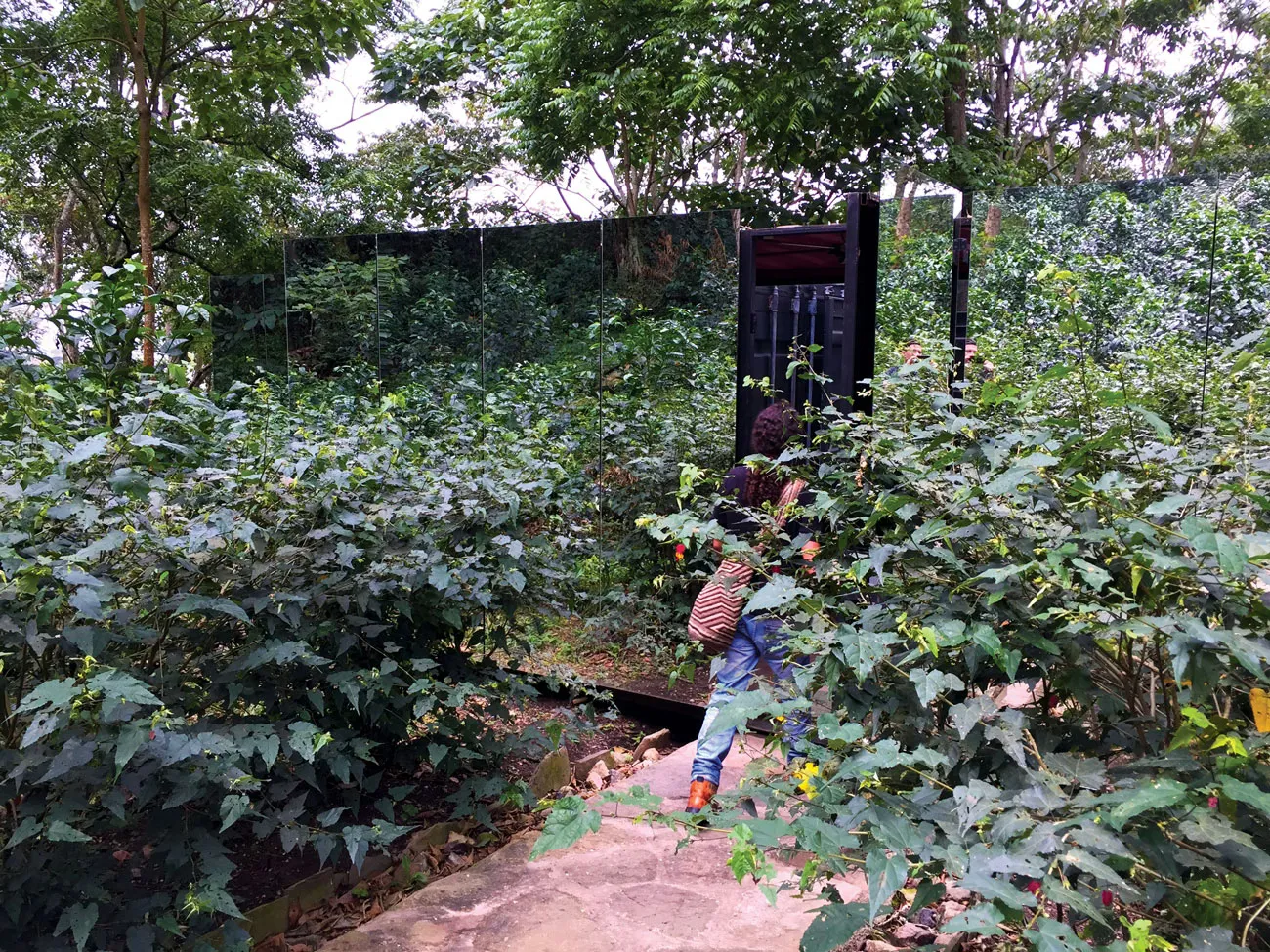
A few rows ahead, Carlos laughs. He stops and opens a door that seems to come from nowhere, and a cupping lab appears out of the trees. “It has the Predator effect,” Carlos says. The lab is covered in mirrors from ground to roof, so the reflected geisha trees sway in mirrored motion with the real ones as a breeze sweeps over the top of the valley. It is made of two large shipping containers welded together with the adjoining walls removed. The main room features an oversized wooden cupping table in the center. A sample roaster sits in a pocket room on the left. Grinders and hot water towers line a bar along the right side of the room. Out back, a deck offers a view across the rest of the geisha fields.
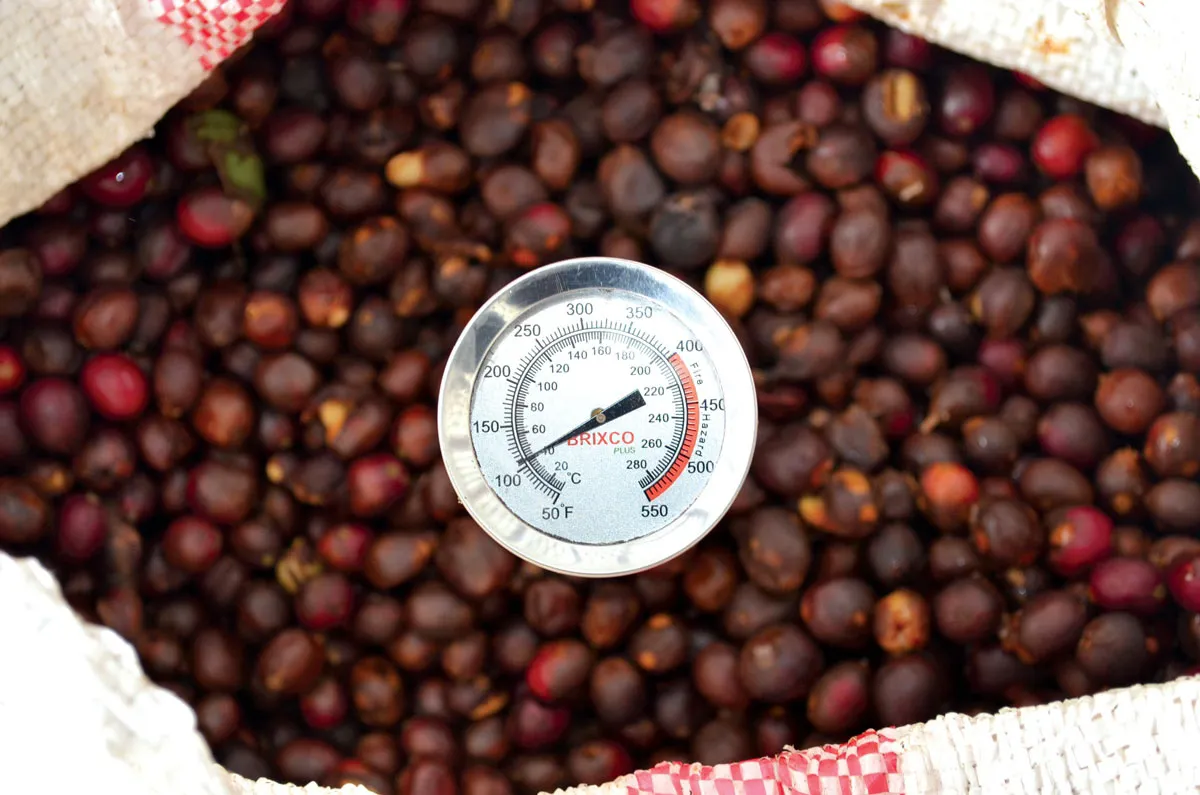
A temperature reading of coffee cherries.
Then we cup some of the most remarkable coffees. We taste four varietals that have gone through three different processing methods. The coffees are extraordinary but still being refined. I hesitate to describe them in too much detail for that reason, but one thing stands out: their confectionary-like qualities. They have large, sugar-laden lychee notes mixed with exotic melons. High amounts of phosphoric acid create mouthwatering, juicy aspects unlike any I have found in Colombia. Many walk the fine experimental line between fermented and complex while staying tropical yet approachable. Stacks upon stacks of notebooks and cupping forms in the lab offer a small glimpse of the research done on the cupping side.
The coffees in the lab came both from La Palma y El Tucán itself and from what they call the Neighbors Program. This program buys high-quality cherry at a premium from neighboring farms. Their buying price starts at Fair Trade levels, and they offer more for higher-quality lots. La Palma y El Tucán processes these lots separately and labels them with the producer’s name. They give feedback on quality as well as growing tips to help neighbors with their next harvest. They also donate new coffee trees grown in the La Palma y El Tucán nursery to participants in the Neighbors Program and provide organic fertilizer.
“The average grower in our network is over sixty years old,” Elisa says. “Coffee’s slow maturation and market volatility discourages younger generations from maintaining legacy farms, oftentimes seeking new opportunity in cities like Bogota (with little success). If future generations are going to continue their legacy, it has to make economic sense.”
It’s clear from the attention to detail at the plant level to the beautifully constructed washing mill and density channels that every aspect of the farm was meticulously planned in order to yield coffees that are in the highest percentile of specialty.
Later in the trip, Felipe and Elisa took me to meet José Reyes, one of the farmers in the Neighbors Program. We woke him from a nap, and after wiping the sleep from his eyes he grumpily agreed to show us his crops. His farm was the size of an average backyard in my hometown in Arkansas and was full of wild coffee trees. More than six varietals grew there and seemed to have no order.
“Our neighbors had limited market access and little incentive for quality beyond quantity,” says Elisa. “Due to the high humidity, drying coffee is very hard in this incredibly unique ecosystem. Therefore, farmers would sell wet parchment, which sells at a penalty and discounted price.” Working directly with farms to increase quality, pay, and pride can have a big influence on coffee families. Simple things like having their name on the label in some of the most prestigious cafés in the world can actually make an impact. The hope is to bring back real economic gains and respect to coffee production in the region.
From Cherry Selection to Fermentation
We leave the lab and head to the washing station. Many small, spring-fed creeks run through La Palma y El Tucán, and the largest flows beside the wet mill. The green-painted mill is three stories tall, with vines and indigenous plants growing on the different terraces. Solar panels cover the roof and supply a third of the power used on the farm. Carlos shows me a circular water system they are testing to reclaim, filter, and recycle the mill’s water. He then points to a large PVC pipe and explains that the pulp travels 100 yards down to a composting facility where it becomes fertilizer.
Carlos and I walk back to the top of the wet mill, and he shows me the cherry selection process, which begins by measuring the brix level of each lot. Once a lot is approved, it goes to the main tank to be pulped and sorted. The pulped coffee then flows through four beautifully built Kenyan density channels. In each channel a wooden board is set at a specific height in the water. As the coffee flows through, denser beans travel below the board while less dense ones get stuck or float above. Those floaters are scooped out and removed from the lot. Traveling with clean water, the coffee then enters three divided, water-filled fermentation tanks beautifully constructed of yellow, green, and red tiles. The three tanks help with volume or lot separation depending on which coffees they are milling.
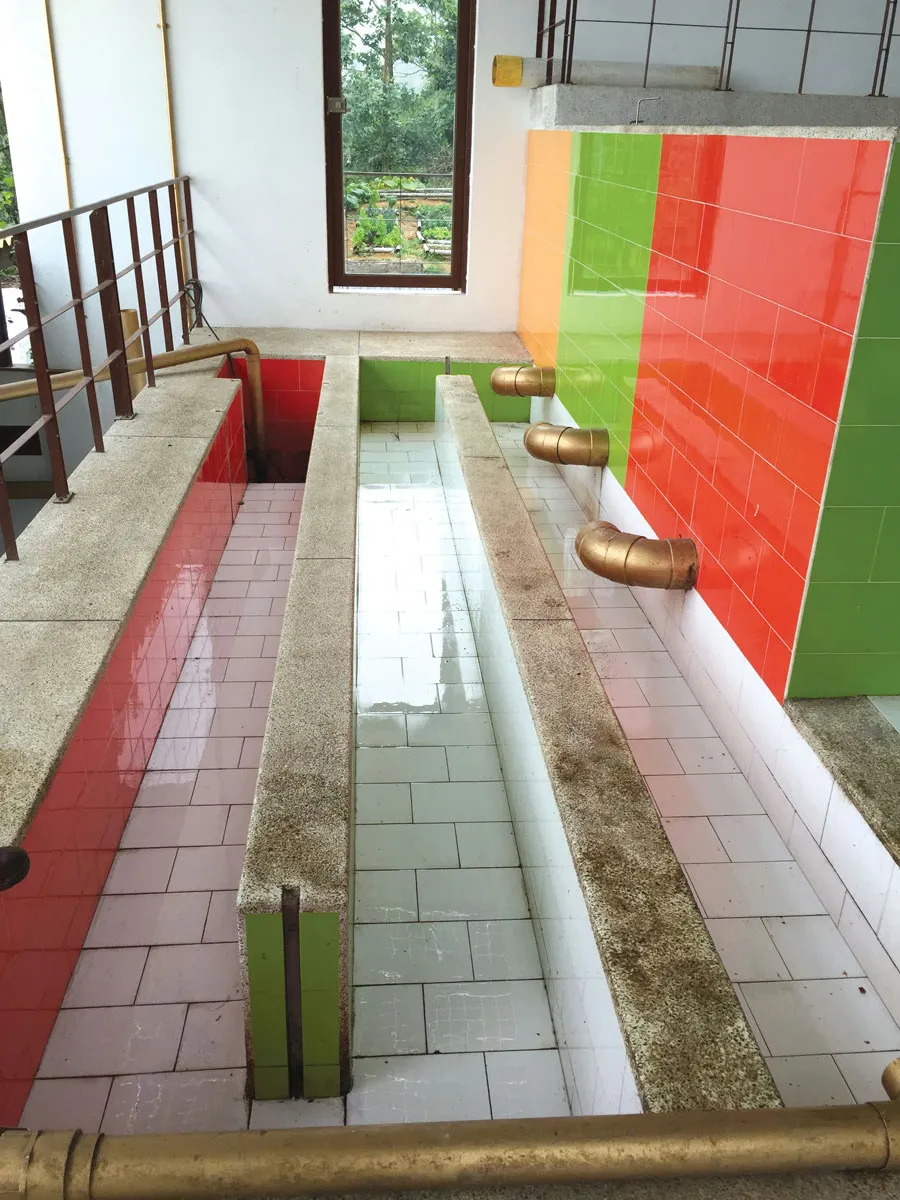
The washing station at La Palma y El Tucán.
The four density channels might seem like overkill, but Carlos explains that they are only looking for the best of the best. “We need the beans that have the highest sugar and organic acid content,” he says. “Density allows us to have a measurement on the coffee before it is dried.”
To me it is already clear from the attention to detail at the plant level to the beautifully constructed washing mill and density channels that every aspect of the farm was meticulously planned to yield coffees in the highest percentile of specialty. And all of this is just the prelude to the processing stage, before the real magic happens during fermentation.
There is no denying the impact processing has on the cup. Natural processing can bring out huge fruits and sugars, while washing can yield crisp, complex flavors, and so forth. Felipe and Carlos are doing something unique. La Palma y El Tucán has developed two processing techniques they call lactic acid processing and acetic acid processing. By manipulating temperature, using anaerobic or aerobic tanks, tweaking pH levels, and influencing other factors, the processes encourage the growth of certain bacteria, which in turn create either lactic or acetic acid.
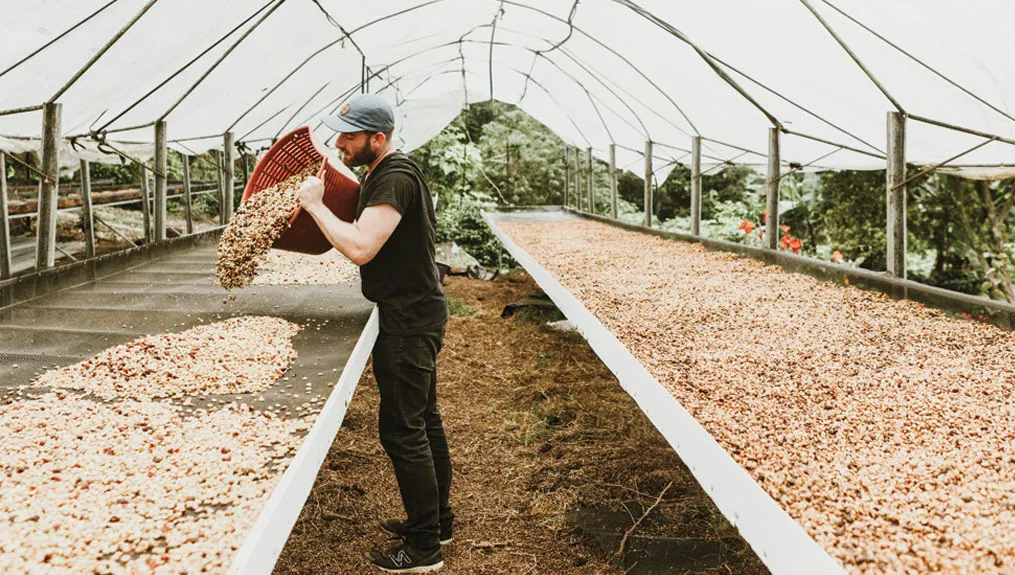
For the lactic acid process, the coffee is sorted by density and stored in a tank. The pulped coffee is then placed in a large, black, food-grade plastic bin about the size of a small hot tub with an airtight lid. A small tube with a one-way valve is attached, allowing oxygen to escape but preventing air from coming back in. During the forty- to sixty-hour fermentation, bacteria produce methane, which fills the container and pushes the oxygen out. This anaerobic container encourages faster growth of lactic acid bacteria. Next, the coffee is placed into a tiled reservoir filled with clean water for a second, twelve- to twenty-four-hour wet fermentation. The time varies for each batch depending on the moisture content and the outside air temperature. After fermentation the coffee moves to plastic-covered, raised African drying beds. The beds have moisture meters built into the tent and a fan that controls the moisture level inside. The coffee is dried to twenty percent moisture content. Finally, it goes to mechanical dryers to remove another eight percent of moisture. The dryers run on coffee parchment recycled from the dry mills.
The acetic acid–processed coffees are prepped the same way. The divergence comes at fermentation, when the coffee goes directly into the tiled reservoir. It ferments for thirty-six to forty hours, and the key here, Carlos explains, is to use cold water to keep the pH level high. Otherwise a fermented, fruit-vinegar taste appears in the coffee. Most washed methods, he explains, cannot sustain that long a fermentation. The coffee is also agitated every ten hours. After fermentation, it is dried in the same manner as the lactic acid–processed coffees.
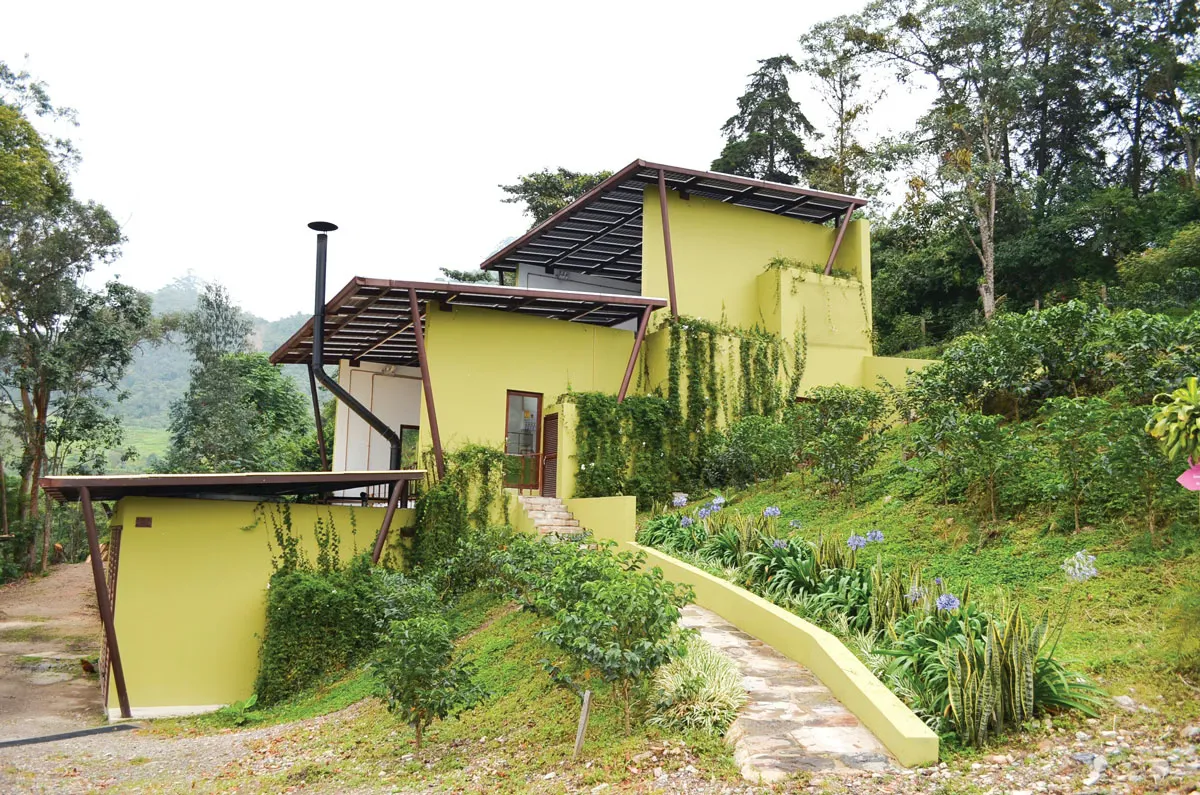
The washing station.
Both of these new processing methods, it should be clear, create a perfect situation for bacteria to have a dramatic effect on the coffee’s cup profile.
A Name That Carries a Lesson
After spending the weekend with Felipe, Elisa, and Carlos, I began to understand the meaning behind the name La Palma y El Tucán—the palm tree and the toucan. Both are becoming endangered in Colombia and need each other to thrive. The analogy to producer and roaster became evident to me after the visit. It takes progressive, educated risk takers to make this new breed of specialty coffee successful.
“We believe it is a historic duty to investigate, study, be interdisciplinary, and integrate new approaches,” Elisa says. “Radical purism has no place in this world of constant change. It is OK to respect the traditions and ways of old, but these should be integrated and adapted for new contexts. No extremism: we must find a balance. Let’s open our minds, jump into the void outside of the comfort zone, and along the way discover a new coffee paradigm.”