Behind the Specialty Coffee Transaction Guide: An Inside Look at Anonymity, Data, and the Fight for Fair Prices
Chad Trewick and Peter W. Roberts discuss how they protect data donors' identities, the feedback loop with contributors, and the road ahead for their pricing transparency tool.
By Harper Parker13 min read
In the multibillion-dollar specialty coffee sector, merely 10 percent of the money flows directly back to the countries that grow the beans. In 2018, the United States alone took in more revenue than the combined earnings of all 25 million coffee farmers worldwide.
These figures are jarring, yet the industry is beginning to confront the supply chain's value distribution. As momentum builds for transparency and sustainability, researchers and coffee professionals are collaborating to tackle the coffee price crisis.
We recently introduced Chad Trewick and Peter W. Roberts, the leaders behind the Specialty Coffee Transaction Guide. After a productive workshop with producers in Guatemala and presentations at the 2019 Specialty Coffee Expo in Boston, the two continue to offer their perspectives on the Guide and what lies ahead for specialty coffee pricing.
This interview has been edited for length and clarity.
Why is anonymity so crucial to this project as it stands, and how have you protected it with data donors?
Chad Trewick: We request all purchasing data that falls within the 'specialty coffee range'—for lack of a clearer boundary, we define that as 80 points and above. It's essential to us that contributors don't cherry-pick only the prices they're proud of. What we want is the complete set of their coffee purchase data for the last two seasons.
We do set a minimum data requirement of around 30 contracts. That's simply to ensure the integrity and validity of the data. We are extremely deliberate—and I believe cautious—about making sure no single data donor can be identified within the dataset. We take a strategic approach to onboarding different donors, always prioritizing the principle that no one donor should be recognizable.
Some have told us they don't care about anonymity and would rather have their name attached to their prices. We tell them that perhaps one day we'll reach a point where those who wish to can publicize their prices, but that's not what this project is about right now.
Peter Roberts: I think what holds people back from contributing to a public good is the belief that certain things must stay behind the curtain. But if they can contribute to larger pools so that the tables become more accurate and more representative, that's exactly where we want to be.
Chad, you're very open about acknowledging your own role in this issue throughout your career. Do you find that others are reluctant to admit they're part of the problem too?
CT: I think the data they contribute speaks to what they recognize. It speaks to an appetite for some kind of alternative pricing mechanism, which is precisely what we're aiming for here.
A very personal story: the first time my husband joined me on a trip to Kenya, he reopened my eyes to all the remnants of colonialism, racism, servant culture, and all those things you stop seeing—as unpleasant as that sounds. I don't want to say you turn off to it or become blind, but it moves into your periphery, and you lose a certain sensitivity to it.
I think that's a self-preservation instinct. If you're a buyer and you know you must confront the realities in coffee-producing communities all the time, you need some kind of defenses as a human being. If we had intimate, quiet conversations with many of these people, they'd say, 'F*ck man, it's real hard, I am really, really exhausted from the living conditions I just saw on that farm in Honduras,' for example.
{I was having a conversation with a big company buyer} about all these things, and at the end of the day, he says, 'You know, I know these things, but I have a job and a family that depends on that job, so while I know these things, I'm fulfilling company priorities because they're providing for my own existence.' So it's kind of sticky stuff for people to feel comfortable talking about.
PR: I also think there's another piece that comes into this: there's a sort of generic fear of change and of the unknown. That's why I love this first 21, because they went through all that with us. They did it in the context of, 'Well, what happens if these guys do this work, they produce something, it's a big ole thud, now I did all that work and there's nothing.'
I think that next wave coming in is going to be a little more straightforward simply because people have seen the first results. Negotiations hopefully are going to be a little more challenging for some, because someone's going to not just look at the C price.
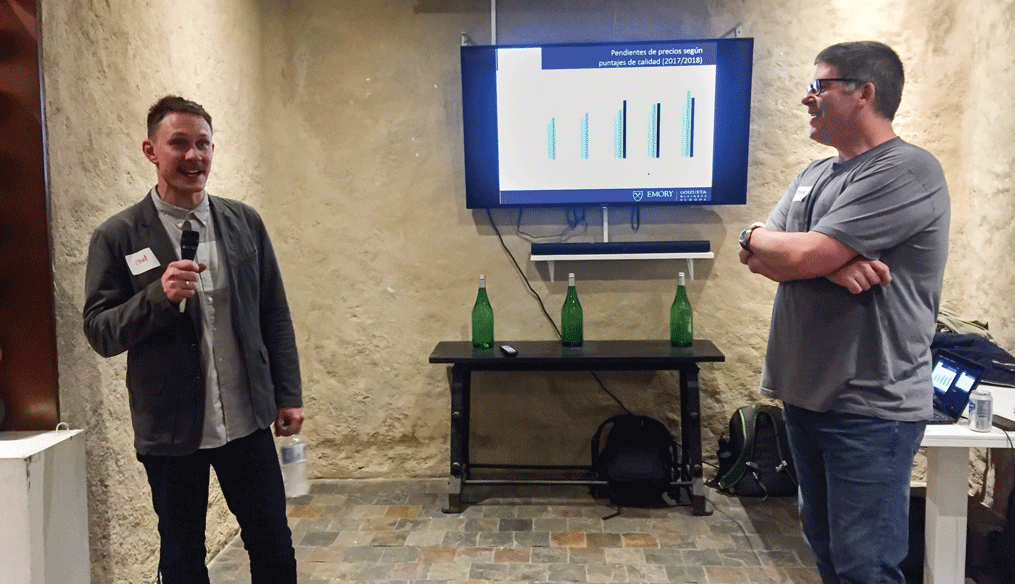
Chad Trewick (left) and Peter Roberts in Guatemala for a workshop with stakeholders.
When you first received all the data, did you reveal it to the initial batch of donors before publishing the results?
PR: We had two rounds of feedback, because we wanted to make sure that everybody was comfortable with what they were buying into. I think it's one thing for a university professor who spends his entire life looking at medians and mins and maxes and tables, but it's possible that one or two of the donors might have said, 'Oh, I didn't expect this to look like this at all.' So once we got enough donors in that we could still have anonymity, we wanted to show everybody roughly what the report might look like, and also get feedback that says, 'Is this the sort of impact that you wanted to create?'
Before we went live, we had the same sort of idea, because we didn't want any one of our data donors to be the ones that found a horrible mistake and want to leave the project, we want to do all that sort of cleaning in advance. That's the kind of inside piece that folks got.
We're trying to be fully transparent. I do think that idea of saying our donors are going to be our advisers moving forward in this project, and that everybody can be on board and make sure things look right before it goes public, is an important part of the process.
Have you heard from any of the original data donors now the results are published? Are they updating their practices, and if they have, will the next two years of their data look different?
CT: I have heard from people anecdotally that they are excited to look at the Guide and see how their own behaviors stack up. They're not necessarily those data donors themselves, but they're other downloaders who say, 'Wow, this is really illuminating, I can look and see how my own pricing behaviors stack up to the data donors.' For me, that's usership right there, that's the thing doing what it's supposed to do.
In terms of what we expect from existent data donors forward and whether we'll see their numbers go up, I don't know. I think time will tell how the pricing that is included in the Guide evolves, and that will be influenced by the number of contracts that are in there, who the data donors are, external market conditions, all manner of things are going to influence this a little bit. I hadn't thought about it that way, will we see this change? I don't know, I love it!
PR: The idea of users…the data donors are one group, but we sort of tend to talk about Guide recipients as from the top: you're a producer, you're a supporting organization, cooperative, exporter, importer, roaster. We're very interested in terms of how the Guide is picked up, so we track downloads by category to make sure that the information is indeed getting in all spots up and down the value chain.
It's one thing to download the data, but can you tell us about how you used it? So we just reached out and got a hundred responses to a very quick survey asking things like, 'Were you able to use the information in the Guide in any conversations of negotiations? If yes, how did it go?' There are some that express a certain amount of frustration, but there's an interesting sort of positivity on both the buying and selling side.
It's going to be really, really important working at origin so that people who maybe have always been on the wrong side of those negotiation biases can actually talk about techniques that relate to relationship building, that relate to effective negotiations, all that kind of stuff.
I've been thinking a lot about what happens to these numbers over time, because there are so many different dynamics. There are two different ways that 2018 to '19 is going to change: one is change among the existing cohort, and the second is change in the cohort. We don't want to report year over year change as, 'Oh, coffee prices fell,' when what happened was you expanded your sample into a lower paying segment.
I would imagine when we do 2019 we will have a quick overview of if you would have restricted the sample to just the people that were there this year and next, and it gives you a cleaner look year to year. It would be really nice to see changes that were not so correlated in C price, because that's what we're trying to do.
I was inspired by the 'world café' open discussion at the Ask Me About Cost of Production event in Portland in November, and wanted to follow up about whether, and how, we should start this conversation with consumers?
CT: One consumer at that event came up to me afterwards, and what she said was, 'You know what you need to keep telling people? Is that unless stated otherwise, it needs to be assumed that coffee comes from conditions analogous to modern-day slavery and environmental exploitation. Period.' She said that would get so many people's attention.
In my humble opinion, that is our reality. Unless somebody says otherwise, I know what coffee production value chains look like. I see this Guide as a really good sort of launching pad for other conversations that are maybe ready to digest for consumers. So if you start to fast-forward a number of years when we have a significant enough amount of data that we can go and partner with institutions in producing countries to say, 'Okay, here's this price that the market says they're paying—how can you contextualize that in your local economy so that we understand what that means?' Does that mean somebody cannot meet even the poverty line? Does that mean somebody can pay themselves and their workers minimum wage? Or does it mean that they have a thriving environment and can reinvest in their farm? You can start to think of breaking down the way that pricing communicated in the Guide is translated into local economies and what it means so that it becomes more of a consumer-facing proposition to say, 'Well I don't know man, does this coffee shop pay the median Guide prices or not? Because I know if it doesn't then this is bad news.'
We're not there yet, but we definitely think that we could get there. We need to build it up a little bit and make sure that it's a useful, relied upon, and trusted tool with a lot of integrity for the industry before we broach that conversation with consumers.
PR: One of the things that something like this and its correlated efforts have to figure out is the idea of making the conversations positive and not negative. One thing when you think about what coffee needs in general is an idea of people with a higher willingness to pay, and it's really hard to be arguing, 'I want to pay 35 dollars for this bag of coffee and you're going to tell me about all the horrible exploitation of poverty and stuff like this.'
The second thing is this idea of translating the kind of conversations we're having here, the kind of producer conversations, so people do not want, as they're trying to pick their coffee or bag of coffee as a consumer, to basically have like a 35-minute lecture on all the nuances of cost.
CT: And how do we empower farmers? It kind of goes back to the beginning, this is information that allows them to think about and consider all manner of things that until now, they haven't really had access to. And make no mistake, it's going to raise interesting questions, not just of the thing in general, but of their own trading partners. Information can cause tension, but hopefully at the end, tension generates change. I think that the biggest benefit we have here to offer producers in terms of empowering them is this information.
How can café owners address the conversation more?
PR: The question owners should be asking their importer is if the coffee is above or below the median. I'm hoping we're going to cultivate something along the lines where you can put a little more credibility into those conversations, but I think that they're the first wave because they're going to want to communicate to their folks that they do their very best to buy from places where the farmer and farmer's land should enjoy that cup of coffee as much as you do, the idea that says are we compensating farmers, are we allowing for best farm practices, or are we saying 'Mmm, this coffee is built on the back of slavery!'—doesn't taste as good. Hopefully shop owners can be on the frontline of that storytelling.
CT: I would also say that they can start applying pressures, for example not only asking are these prices above or below, but sort of steering their purchases toward people who are contributing to the Guide, people who are helping to make this tool viable and useful to the industry.
What's next for the project?
CT: We are in the process of recruiting and onboarding, we have a goal of 20 more donors this year. I think we're probably halfway there—we've got good, lively conversations with the next batch of donors.
We will publish a mid-year revision of the 2018 version of the Guide that is going to include at least 10 new data donors. We feel like June is our line in the sand for when this becomes a more formal tool. That's the point at which we will start talking about governance and verification protocol and an advisory board and how many meetings are there quarterly, and all these things that we feel like we need to do to lend credibility to and sort of formalization of the Specialty Coffee Transaction Guide.
Any final thoughts?
PR: People will focus on one thing being revealed with the Transaction Guide, which is the actual numbers. The one thing it revealed to me is that there are actually parts of the specialty coffee market that aren't as broken as others, but also people want a market context that produces better outcomes—there's more of those folks in coffee than I would have thought.
The individuals and organizations that are revealing parts of themselves to me, that is every bit as exciting and enthusiastic. I think when we have those conversations moving forward, instead of, 'Oh, we're all at the mercy of this awful thing called the C price,' we're at the collective mercy of a bunch of folks that seem a little more interested. If all that we end up doing is we're stimulating the ability of this group to come together and do something, it's really, really nice to know that a group exists.
CT: I would just hope that with as many alarm bells that have been ringing lately that a tool like this that really aims to be an alternative price discovery tool is appropriately leveraged because it exists. I think it's important to recognize that it is a relatively small slice of our industry now, but that our goal is to grow it, and the more that we grow it the more representative and informative the tool will become.
As a former coffee buyer, if I had had a tool like this and I would have had to spend so much less time justifying paying prices in excessive commodity pricing, it would have been a different role, it would have been a more positive experience. I think that there are a lot of people in that situation, and I think that there are a lot of people who want to continue to enjoy drinking good coffee, and they're recognizing increasingly that if we don't change our behavior, it's going to go away. That's a big bummer! Look at the industry that's built around connoisseurship of coffee—all of us! It's a big deal.
When the first buyers who articulated to me said, 'Oh I need a tool like this,' I felt immediately those same pressures from the financial departments that they were feeling, because I can remember sitting in a quarterly business review meeting and going, 'Well, yeah the market's down, but I gotta pay this higher price!'
I very much feel like if I had had this kind of a tool, I think we would have been able to move things forward. I think if this tool had existed for the industry before, we would already see the sort of stratification of specialty coffees paying up here.
To Read Part 1 of this interview, click here. For more information on the Specialty Coffee Transaction Guide, visit.