Beyond the Container: Sailing Ships and the Future of Coffee Transport
Coffee drinkers often learn where their beans were grown and who grew them, yet the voyage that brings those beans across the ocean—by far the most carbon-intensive leg of the journey—rarely enters the conversation. A handful of small operators are trying to change that by moving cargo under sail.
By Riley Turner5 min read
Do you know how your coffee gets to you? You probably know which country it comes from; perhaps you even know the name of the farmer.
The modern specialty coffee industry is adept at informing the consumer of all the varied aspects of the supply chain—from farm to mill, roaster to café. But there’s a step usually left out that is so ubiquitous in modern trade that it is hardly thought about: shipping.
Ocean freight is a sprawling, hard-to-see system: a tangled global network of companies and middlemen, individual vessels registered under distant flags of convenience, and enormous fleets that function like floating cities. Nearly all products and commodities move around the planet aboard these giants, well beyond the view or thoughts of most people.
Sea freight is more energy-efficient than moving goods by air or rail, and it carries the overwhelming share of global cargo. It is also a famously polluting sector: maritime shipping is responsible for no less than three percent of worldwide greenhouse gas emissions, and absent intervention, that share could climb to as much as 17% by 2050.
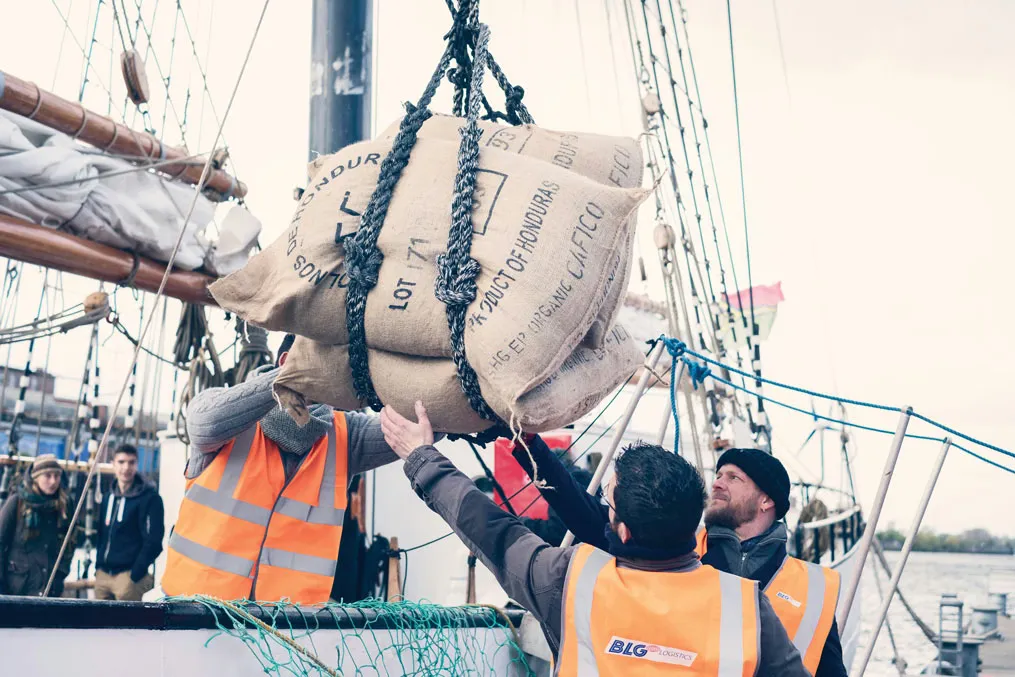
Hoisting coffee from Honduras.
“International shipping is a major contributor to climate change,” says Simon Bullock, a Ph.D. researcher at the Tyndall Centre for Climate Change Research at the University of Manchester in England. “It emits more carbon dioxide a year than Germany.” That figure says nothing about other forms of contamination, from wastewater to oil spills and local air pollution.
Given how much the coffee trade discusses climate change and sustainability, the giant container ship in the room is hard to overlook. But coffee has to get from point A to point B. Faced with the realities of modern commerce and the climate crisis, is there an alternative to cargo ships?
Sail Power: An Old Answer to a New Problem
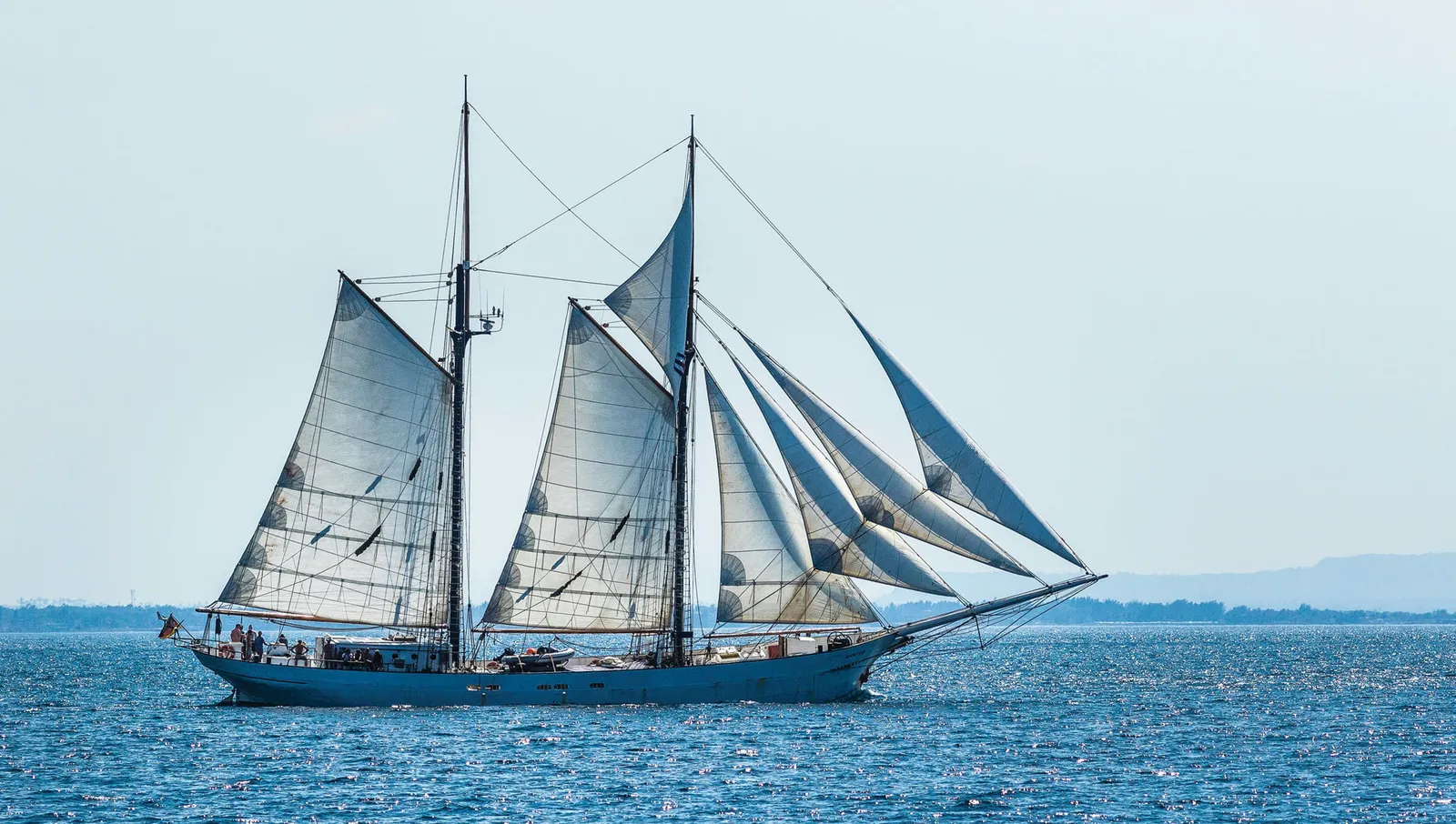
Timbercoast, a German company that moves freight across the Atlantic aboard its schooner Avontuur, belongs to a small but expanding group of ventures trying to take on the established shipping industry by offering a greener way to move coffee. Master mariner Cornelius Bockermann founded the company, which for the past few years has sailed rum, tea, wine, and other goods between Bremen and Honduras, Mexico, and Canada.
After locating the Avontuur in 2014 and refitting it with the help of more than 160 volunteers, the team set about finding cargo to carry. Ben Decosse, Director of Business Development at Timbercoast, says coffee was always central to the company’s plans. Editor’s note: Shortly before going to press, Decosse announced his departure from Timbercoast.
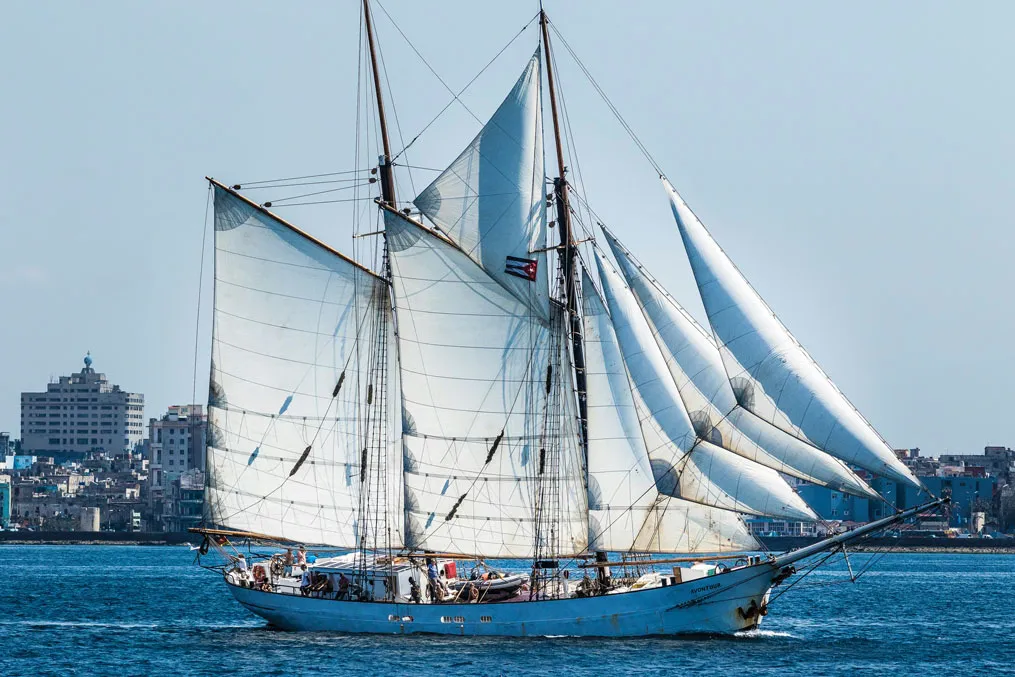
The Avontuur off the coast of Cuba.
“Coffee has always seemed to be one of those cutting-edge products that is looking to always better itself,” says Decosse, “and so we started knocking on a lot of coffee importers’ doors. We ended up buying some rum, because no one would ship stuff with us, and we only needed to go down to the Canary Islands to do it.” Once at the Canary Islands, they were contracted to collect 20 tons of coffee in Honduras and cross the Atlantic.
According to Decosse, the Avontuur—Dutch for “adventure”—can hold roughly 80 tons of coffee. For scale, a standard 20-foot container carries about 22 tons of green coffee, and the biggest vessels haul thousands of containers in a single voyage. Sail-based freight, then, will not be going head-to-head with the major carriers any time soon.
Coffee at a Snail’s Pace
Timbercoast may serve a niche, but its mission has earned a devoted following. Slokoffie is a Bremen coffee company created expressly to import and roast coffee carried by the Avontuur. Thomas Riedel-Fricke, together with cofounder Maik Hembluck, was moved to start Slokoffie after helping rebuild the Avontuur and becoming drawn to the idea of carbon-neutral shipping. When it became apparent that no one else would finance the ship’s first Atlantic crossing, Riedel-Fricke and Hembluck founded Slokoffie and contracted 20 tons of coffee from Honduras.
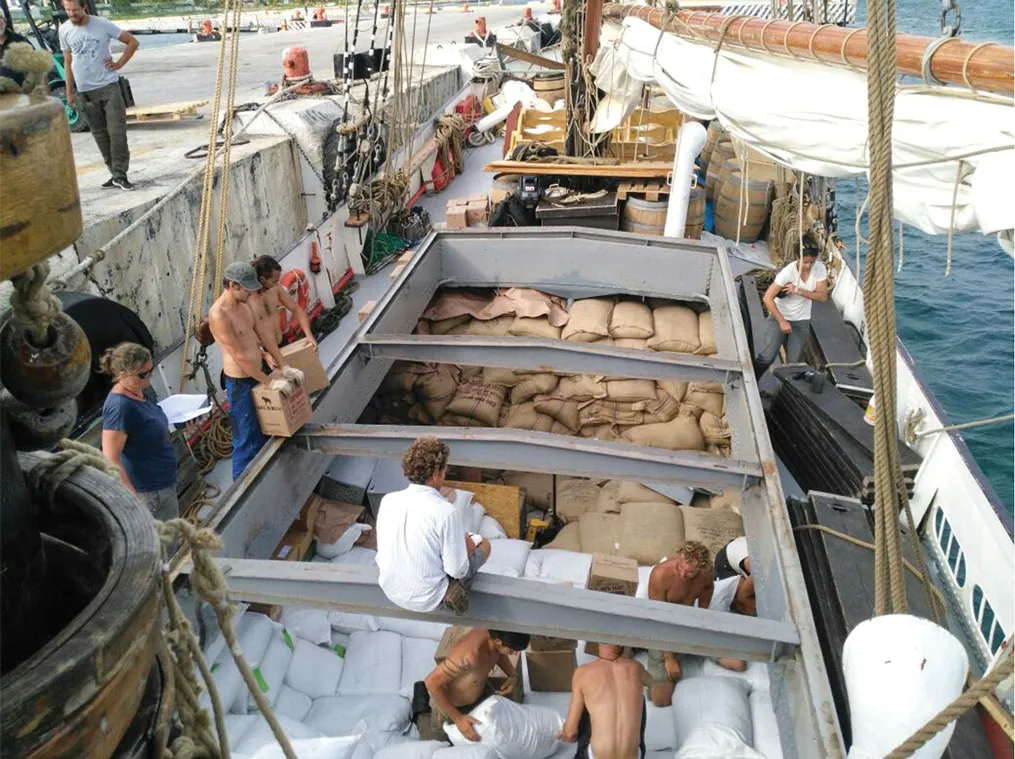
Cargo hold of the Avontuur Photo courtesy of Timbercoast
“Both of us were thrilled by the idea to sail cargo, to accomplish ocean transportation in a completely environmentally friendly manner,” says Riedel-Fricke. “No exhaust gases, no noise pollution in the water, just powered by wind and current.”
Betting 20 tons of coffee on zero prior coffee experience was a risk, yet Slokoffie is now preparing its next shipment and building new contacts in Colombia as it considers expanding its range.
The carbon-free shipping movement remains small, with just a handful of companies currently operating cargo sailboats. Still, as attention to the climate crisis grows and the pollution generated by business as usual mounts, expansion looks likely. To support that growth, a European initiative aims to establish small cargo hubs in ports around the North Sea so local businesses can access sustainably shipped goods directly.
For Decosse, watching the tiny Avontuur enter port beside towering cargo ships captures exactly what they are up against.
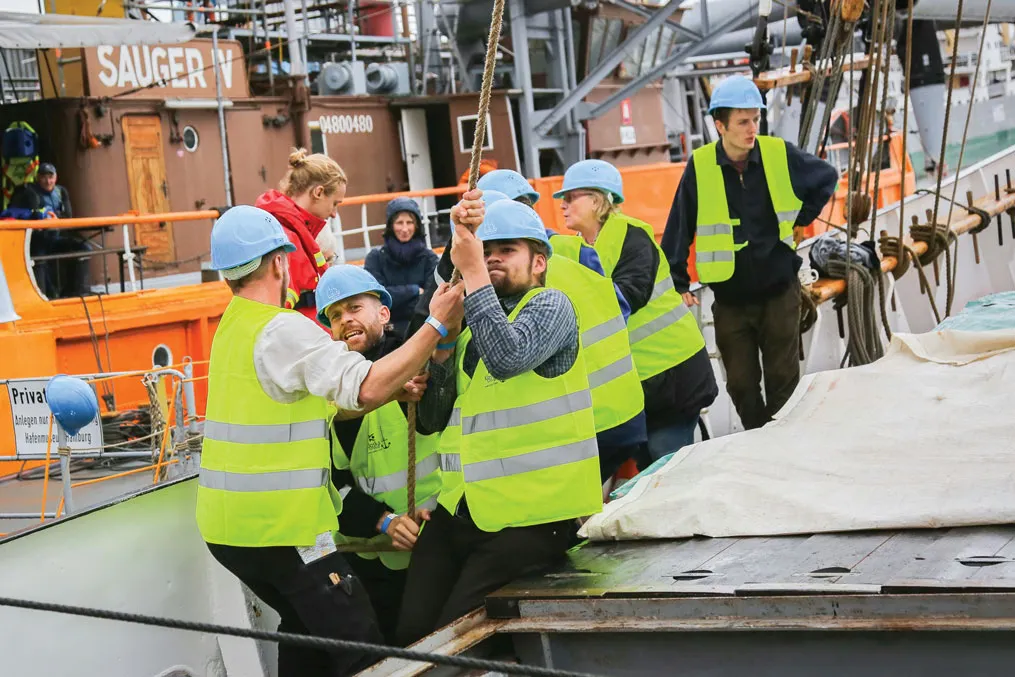
Unloading bags of coffee at port.
“These container ships, they can only dodge the world’s attention for so long before real change needs to take place,” he says. “There’s a lot of pressure starting to unfold on them because they’re burning the worst fuels, fuels that are illegal on land. Something has to give—if they’re not going to do it, we need to do it. We need to create the demand, and we need to raise the awareness.”
Honduras alone exported nearly 160,000 tons of specialty coffee in 2016, most of it by sea. For comparison, it would take the Avontuur 2,000 trips to transport all that coffee to Germany. Obviously, small-scale schooners will not solve the problem of cargo shipping alone; it will take creativity from innovators, oversight from regulatory bodies, and commitment from traditional shipping companies to enact real change.
The Future of Ocean Transport
Can sailboat shipping be part of the solution, at least on a small scale?
“Shipping needs to decarbonize,” says Bullock, “and sails are part of the solution. Although sail-only ships are unlikely to replace a large proportion of oceanic trade, sail-assisted ships can deliver major gains in energy efficiency.”
At Timbercoast, they are taking this advice and looking to the future. In collaboration with students at Oldenburg University, Decosse says they are drawing up plans for a modern sailboat that would hugely increase their carrying capabilities while utilizing automatic sales and potentially hydrogen technology.
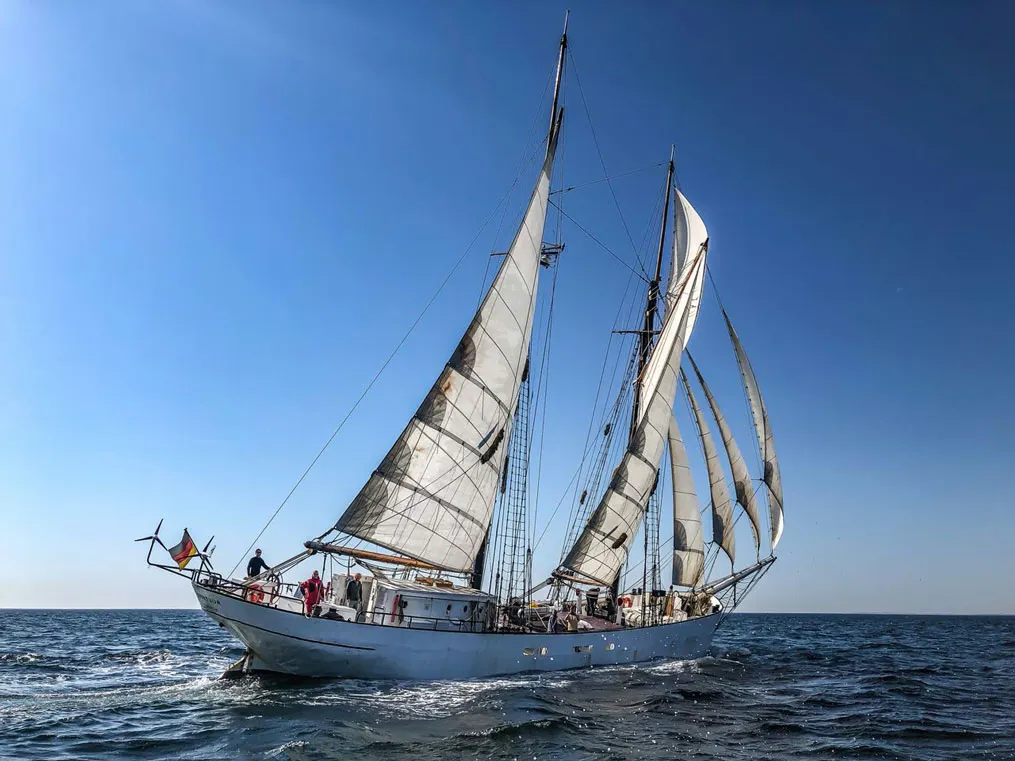
The Avontuur.
“That would be 330 containers and zero emissions,” explains Decosse. “This is the kind of direction that we’re heading in at the moment—if we’re fast, that ship can be in the water in five years.”
Until then, the Avontuur and other small schooners will continue to navigate around leviathan cargo ships, using the trade winds to carry coffee, cocoa, and rum across the Atlantic in the most sustainable way currently possible.
Cover photo features the Avontuur sailing off the coast of Cuba. Photo courtesy of Timbercoast.