How Bicarbonate in Water Shapes the Way Coffee Is Roasted
A roaster's account of discovering that the water used for brewing—not just the roast profile—can decide whether a coffee tastes bright or ashy.
By Robin Ross6 min read
In early 2009, two years after opening our first café, we were preparing to launch our roasting business. Word had reached us of the extraordinary coffees coming out of Scandinavia, and we concluded that the only responsible way to shape our own roasting style was to go and taste them in person. It would be a delicious piece of research, too.
Our travels took us to the renowned Tim Wendelboe café in Norway. The coffees there were the lightest roasts we had ever encountered, yet they were fully developed and thoroughly enjoyable. We admired how he coaxed full flavor out of the beans without any trace of carbon or ash, and we resolved to do the same.
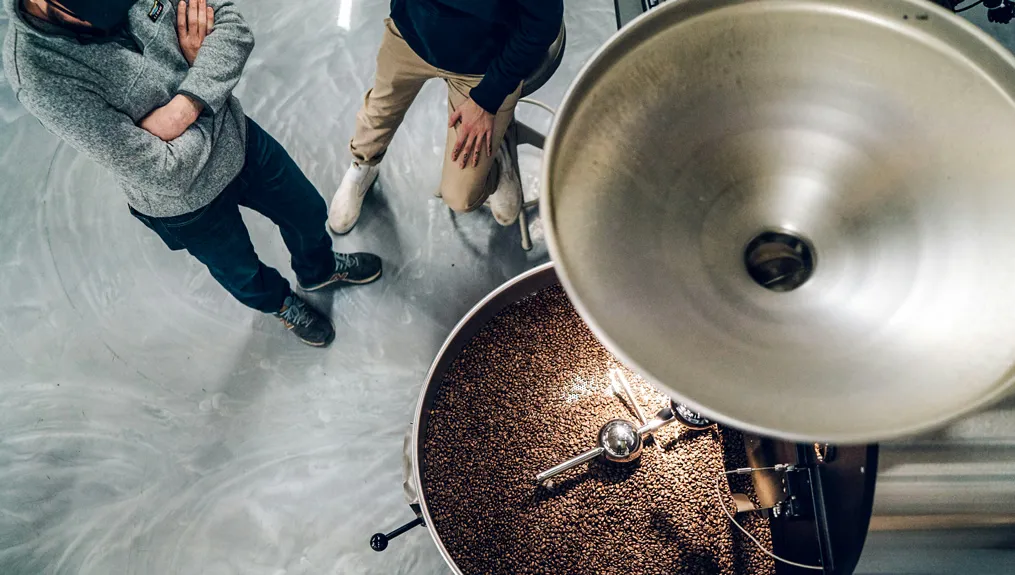
As it happened, we used the same roasting machine—a Probat UG15—so we felt confident that, given time, we could match that style.
Bringing the Lesson Home
We flew back to Calgary determined to produce outstanding light roasts.
We did not succeed. Then we failed again, several more times. Eventually, after close to a year, our roasting reached a respectable standard, and we arranged a coffee exchange with Tim. It's worth noting that, by our own assessment at the time, we were by a wide margin the lightest roasters in Canada and much of the United States as well. 
Our stylistic rule was that every coffee would be roasted light, so as to bring forward its natural sweetness, acidity, and distinctive flavors while carrying no carbon or ash taste at all. We cupped and brewed relentlessly and believed we were meeting our roasting goals.
Then Tim's feedback arrived. He was considerate and detailed in reviewing our coffees, but in the end he reported that, to his palate, carbon and ash flavors dominated them. Disappointed as I was, I attributed this to his superior tasting ability and carried on developing my own.
In 2011, Sebastian and I made a second trip to Oslo. This time we carried coffee with us and had arranged in advance to meet and cup with Tim at his café and roastery. This would be our redemption.
A Second Chance
I approached the roasts with extreme care. I picked our finest green coffee and spent months developing profiles. On the day of the final roasts, every second of data in my profiles lined up exactly (thanks to custom roast-logging software I had written), and I cupped the coffees repeatedly. They were excellent! I even packed them in a second five-pound coffee bag without a valve, to shield the coffee from the low pressure of the airplane cabin. I was ready.
When we reached Tim's place, I handed over the coffees, and he set up a cupping with three of ours and eight others we knew nothing about.
Sebastian and I worked through the table and tasted some extremely ash-heavy coffees, so ashy that their origin was completely hidden. I also came across some "kind of" ashy coffees with little origin character; then I found some delicious, sweet, nuanced, and balanced ones. I knew our coffees well but could not pick them out, and dread washed over me.
We revealed the coffees, and to my slight relief the very ashy ones were not ours—but to my dismay, ours were the moderately ashy ones with very little origin character. The most vibrant and balanced cups were Tim's. 
I felt embarrassed and disheartened. I slept poorly that night. My mind raced through possible explanations. Had the travel, despite my precautions, still damaged the coffee? Could relative humidity or altitude somehow be responsible? I knew a fair amount about water at the time.
I had studied some basic water chemistry, used titration tests, and even worked with a local laboratory to test and adjust our water. Even so, at the time I never once considered water a plausible reason for the gap between the bright, vibrant, origin-forward coffees I tasted in Calgary and the dull, roasty, generic coffees on the table in Oslo.
A Variable That Explained Everything
Jump ahead to 2014. We were honored to be invited by Tim to submit samples for a cupping he would use to choose sponsors for the MAD Symposium, an event about the future of food held in Copenhagen. This was a major opportunity. The MAD Symposium had been founded by the legendary chef René Redzepi of Noma, regarded at the time as the best restaurant in the world.
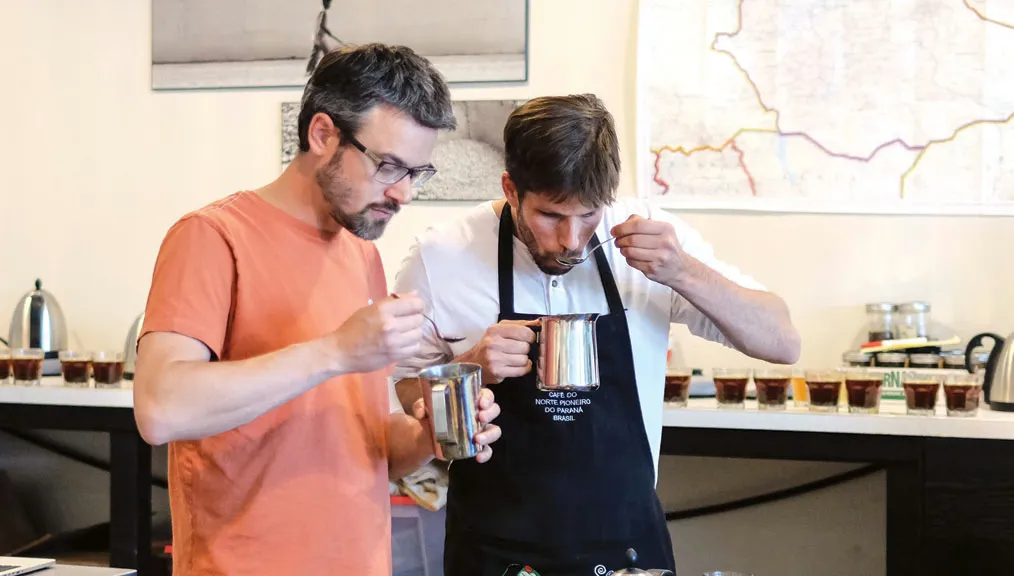
Phil Robertson (left) and Sebastian Sztabzyb
In the back of my mind—actually, at the front of it—I thought, "What's the point? Our coffees are going to taste like ash bombs there." Still, I could not resist a good challenge, so Sebastian and I agreed to send samples.
Given how ashy our coffees had tasted in Oslo, I knew we would have to roast lighter than our usual level. But I was still unsure how to set a benchmark that would guarantee the coffee was properly developed and didn't simply taste grainy and generic, the way under-roasted coffee does. It was like trying to sail the ocean without a map or compass.
Before roasting and shipping the samples for MAD, Sebastian and I traveled to Rimini, Italy, for the 2014 World Barista Championship. One of the Phil & Sebastian baristas was representing Canada, and we went along as coaches.
It was in Rimini that I met Maxwell Colonna-Dashwood, and we hit it off right away. It turned out that his passion for water, and his knowledge of it, far exceeded mine. After I got home, my interest in water for coffee was rekindled, and I went back to my research.
That was when I began to form a theory. What if the fundamental difference between how our coffees tasted in Calgary and how they tasted in Oslo came down simply to water?
Blocked By Bicarbonate
I knew Oslo's water was naturally soft, but I did not know its specific composition, so I asked Tim. He gave me a little to work with, and I pulled the rest of the details from the Municipality of Oslo website.
All of the pleasant, bright, fruity acids we had carefully drawn out of our coffees were blocked by a wall of bicarbonate.
After running some numbers, I saw that our calcium and magnesium levels were comparable, but Oslo's bicarbonate content was more than twice as high. Bicarbonate buffers how we perceive acids in coffee. All of the excellent, bright, fruity acids we had carefully drawn out of our coffees were blocked by a wall of bicarbonate. (Chris Hendon covers this in greater detail in his article.)
After a little more calculation, some baking soda, and a colorimeter to measure carbonate hardness, I recreated Oslo-like water in our Calgary cupping lab. I then tasted our coffees with this mixture, and sure enough, they tasted ashy and flat. I had never been happier to taste bad coffee.
The next logical step was to adjust the roast profiles for our top coffees to suit this new water. I worked through many profiles over the following weeks, and gradually I managed to get the coffees to perform with my Oslo water.
When the time came to send in the samples, I waited impatiently for the results of the cupping. On July 15, the news arrived. We had made it! One of our coffees performed very well, and we were selected as a silver sponsor for the event. I was elated and relieved that my nemesis—Oslo's bicarbonate-laden water—had been overcome.
That day, I grasped a basic truth about coffee roasting: every roaster roasts to their own water, whether they realize it or not. The result of this experiment opened up a whole new set of challenges. Should we try to custom-roast our coffee for our wholesale customers' water? Or should we push for water standardization? Is that even workable on an international scale? And what would the standard be?
Right now I have more questions than answers, but the many unknowns in the still-young specialty coffee industry are exactly what keep me engaged.
Phil Robertson is the co-founder of Phil & Sebastian Coffee Roasters in Calgary, Alberta.