Inside Counter Culture Coffee’s Roasting Operations: Brett Donahue on Consistency, Data, and Fresh Perspectives
Brett Donahue, who oversees roasting at Counter Culture Coffee’s Durham headquarters, explains how the roaster balances large-volume production with quality control, relies on measurement tools to counter subjective bias, and keeps its methods evolving through new team members and long-standing supplier relationships.
By Reese Scott8 min read
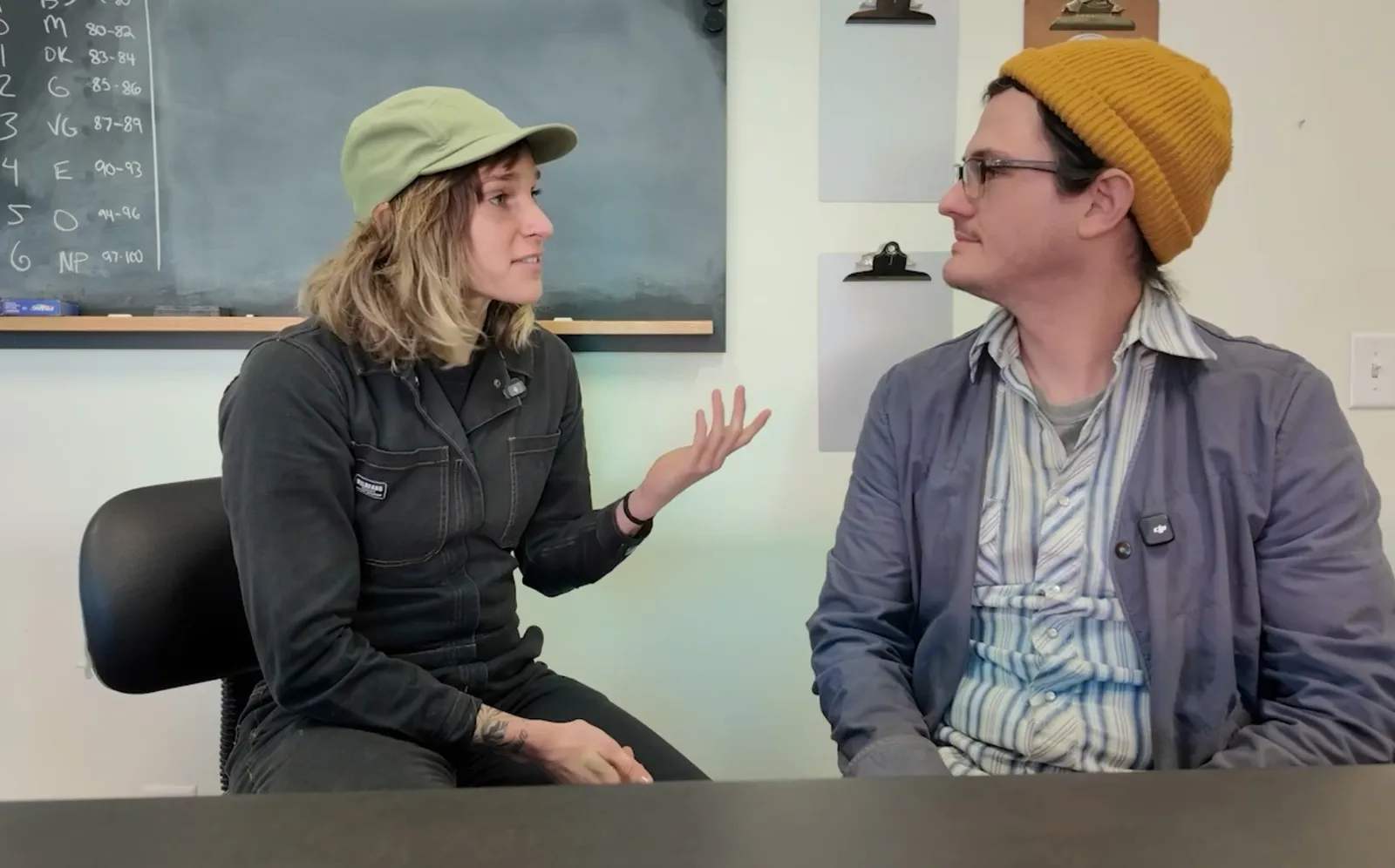
We worked with coffee roaster and writer Kat Melheim on a series of conversations with people shaping the coffee industry. Kat chose the subjects and topics herself and had full editorial freedom in pursuing them.
In this installment, Kat spoke with Brett Donahue, Eastern roasting supervisor at Counter Culture Coffee, based in Durham, North Carolina. The company marked its 30th anniversary in 2025 and has developed detailed systems for buying, roasting, and quality control at a large scale. Donahue has spent 15 years there, overseeing roasting that supplies Counter Culture’s sizable wholesale and retail footprint along the East Coast.
The discussion covers how a large US specialty roaster holds quality and consistency steady—both for its own operation and for the producers and sourcing partners it works with.
The full video is available below, followed by a transcript of the conversation.
This transcript has been edited for length and clarity.
Kat Melheim: Would you introduce yourself and describe your role at Counter Culture?
Brett Donahue: I’m Brett Donahue, Eastern roasting supervisor at our Durham headquarters. My responsibilities include managing a team of roasters and the roasting machines, along with ordering a large volume of coffee. Counter Culture reached 30 years in 2025, and I’ve been here for 15 of them. Over that period I’ve watched a great deal of change, growth, and projects reach completion.
What has changed during those 15 years, and how has your job evolved?
When I joined, I was simply looking for work in coffee. I had had enough of barista work, and I knew Counter Culture was a few hours from where I was living, so I applied for a production position, decided to go for it, and relocated. My first two years were spent as a shipper and a bagger, which meant learning about all the customers we served along the Eastern Seaboard and absorbing the company’s guiding principles on the production side—freshness, consistency, quality, and so on.
After that, I happened to be around when a roaster apprenticeship opened up. I applied, was fortunate to get it, and I’ve worked in the roasting department ever since.
How does Counter Culture think about coffee today, from green to roasted and from theory to practice?
I can only speak to the buying team’s approach secondhand, but there is a strong emphasis on keeping a diverse supply of coffee, where possible from long-term partnerships. We look for coffees that are clean, naturally sweet, nuanced, and generally have potential for a lasting relationship. We also aim to maintain sustainability and to support projects that raise cup scores, improve consistency, and strengthen the supply chain overall.
Could you walk through the practical side—what happens from the point a coffee enters Counter Culture’s awareness until it’s in a bag?
Our buying and sourcing team typically receives an arrival sample, checks its quality, and makes a late decision about which product it will go into or at what ratio it will be blended. I receive that information and make sure those coffees come in at the right time for the right products.
Once coffees reach the US, I bring them over from our external warehouse. That requires some judgment about what we’ll need as volume fluctuates. Anyone in food understands there are seasonal and daily swings. We try to bring in just enough coffee to get through the week without a large surplus. I usually order about two to three truckloads a week, continually replenishing what we hold in the green warehouse.
A great deal of communication goes to the roasting department about which bags to pull, which lots to watch, how blends are constructed, and how to program silos to release blends in the correct ratios. Roasters also examine the product closely, checking that it smells right and tastes good. In essence, this is the quality-control loop at the end of each roast cycle.
What does that QC loop involve? Do you cup every batch?
At our volume, we don’t cup every batch. We do send samples of the full product mix to our QC and buying team, which creates a feedback loop. That helps them decide, for example, whether a coffee too acidic for one product should move to another. If a coffee tastes light and underdeveloped, we hear about it fairly quickly.
We also keep a layer of QC inside the roasting department. The Agtron [coffee roast analyzer machine] is essential and very useful. It removes a degree of bias from the process. I might believe I have the perfect recipe or profile for a given coffee, but the coffee changes over time, and machines behave differently over time as well.
The Agtron gives us immediate feedback: I put certain inputs into this coffee, and this is what actually comes out—which is causally tied to what the customer tastes. Shades of brown can seem arbitrary, but the lightness or darkness of a coffee is connected in various ways to body, sweetness, and acidity. It’s a strong way to catch a batch that may have drifted out of profile.
With 30 years of data, I imagine much of that is well established.
Yes, there are many reference points. Each coffee has its own Agtron target. We also try to work QC in reverse: if we hit the right Agtron but the coffee doesn’t taste right, we have to decide what to do. Do we extend certain phases of the roast? Slow it down? Reduce batch size so we can shape the curve more precisely?
The Agtron is really valuable for us. It also gives roasters a moment of satisfaction—that sense of “I did it right.” You add knowledge to the process, work consistently, or try something new and get a good result. There’s a sensory payoff too—that first puff of aromatics.
It helps roasters see that they occupy a unique hinge point in the company. The whole supply chain matters, but we have this brief window in which we can affect change for the better. That honors the work of the many people who came before and the customers beyond us.
As the roaster, you’re that critical hinge point—perhaps 10, 12, 15 minutes. You can either ruin it for everyone or make it great for everyone.
Yes, you really do have this point of leverage where you can make an impact. That’s a heavy responsibility, but it also carries a lot of agency. It’s something I’ve always valued about working in roasting.
How do you think about roast levels across Counter Culture’s product line?
Our coffees generally land at specific, standardized roast levels. Big Trouble is very much a medium roast. Fast Forward we’d call medium-light. Forty-Six is our darkest roast. It isn’t actually a French roast—technically it’s a Vienna roast, because it only reaches the first couple of pops in second crack. But that’s enough to bring it into that rich, chocolatey, smoky range.
We work with those basic industry categories—dark, medium, medium-light—but the Agtron is far more specific than that. That’s what we use to define roast level at a granular level.
Has Counter Culture’s roasting approach changed during your time there?
Quite a bit. I mentioned that we used to roast components only for blending, but our approach has really shifted as new people have come through the department, bringing new ideas, experience from other roasteries, or simply not knowing how to roast. As we teach people internally, they start to learn and revise things, or they learn different lessons than we might have.
The roasting team has done a lot to codify where we stand philosophically. The machines also drive much of what we do. Learning to roast single origins on the Loring personally helped me rethink many of my roasting methods. I would stall batches or have batches that were completely uncontrollable. Honestly, it took some newer people in the department who had less bias and had spent less time roasting on Probats. New voices and new eyes in the department have been really helpful, and they’ve made it a more collaborative environment.
I’d also say some of our current coffee buyers were roasters years ago, and they did a great deal to build the foundation we’re on now. Many people at Counter Culture have had a really positive impact on this department.
How does the roasting team grow? Do you bring people in from packaging, or hire roasters directly?
We’ve done both. We’ve hired internally, and generally there are a couple of people in production who look across the floor and think, “What are they doing down there? That looks difficult or cool or something.” Right now the department has two people who started in production and were promoted into roasting, and that works very, very well. We’ve also hired a few people who have roasted at other companies in this area.
You have four or five roasting machines and seven people in the roasting department. How is the schedule configured week by week?
It depends on our start time. A couple of people are here very early in the morning getting things going, and from that point we can define fairly well how many pounds we can produce. We try not to roast a lot of excess coffee, but generally every day now reaches a level of capacity. If we start at 6 a.m. and run until 6 p.m., that’s sufficient to produce the needed pounds.
Some of it is known, some can be calculated, but much of it is simply knowing what the hourly time on the floor needs to be to get things out. We can also get creative with shifts. If we don’t have people to stay late, we can have one person roast on the largest machine rather than spending a lot of time on the smallest machine. We look flexibly at which machines create the most impact.
What does a typical day in the roastery look like, from 6 a.m. to 6 p.m.?
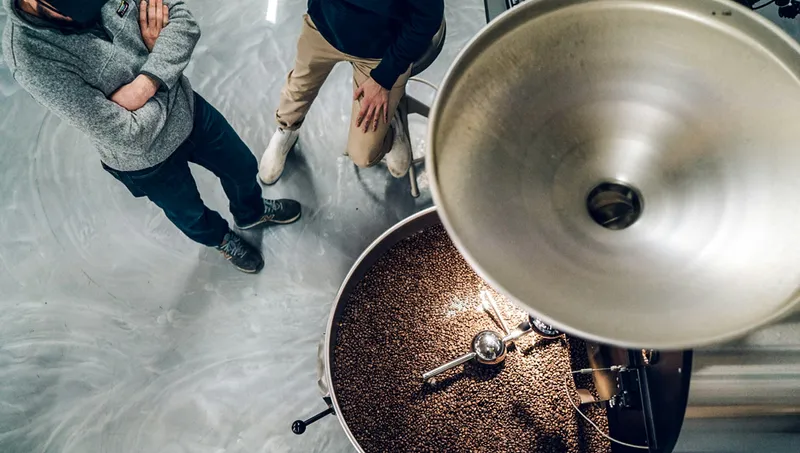
The morning crew arrives and assesses the day’s numbers while the machines warm up. After the machines have had a good saturation period, they start the roast list, generally with the darkest roasts first and then moving progressively lighter. That works well for us.
Currently we place many of our single origins on the Loring, because that machine has unique qualities that can bring out the high notes in coffees. We certainly put single origins on the other machines at times as well.
Once the machines are running and dark roasts are underway, a couple of other people come in and start to backfill. That’s when silo loading begins, green movement starts, and blend changeups begin. As lunchtime approaches, the first shift starts to leave or move onto auxiliary tasks—warehouse upkeep and that sort of thing. The later crew steps onto the roasters.
How do breaks work? Do people stagger their lunches?
We found that if everyone shuts down for a break at the same time, we lose a sizable chunk of the day. Generally, one person moves from roaster to roaster giving people breaks, so only one person is out on break at a time.
Fifteen years in, Donahue has watched Counter Culture grow without losing what made it an innovator in the first place. Tools like the Agtron remove the risk of roaster bias. Long-term sourcing relationships keep quality consistent and preserve the vision for ethical sourcing. New voices in the department challenge old assumptions. According to Donahue, it’s that combination that keeps a 30-year-old roaster from settling into “the way we’ve always done it.”