Kyle Ramage on Building a Roastery Around Competition Coffees
In a conversation with Kat Melheim, Kyle Ramage explains how barista competitions shaped Black & White Coffee Roasters’ green buying, roasting style and pre-roast blending—and why the business was built from the coffees backward.
By Riley Turner9 min read
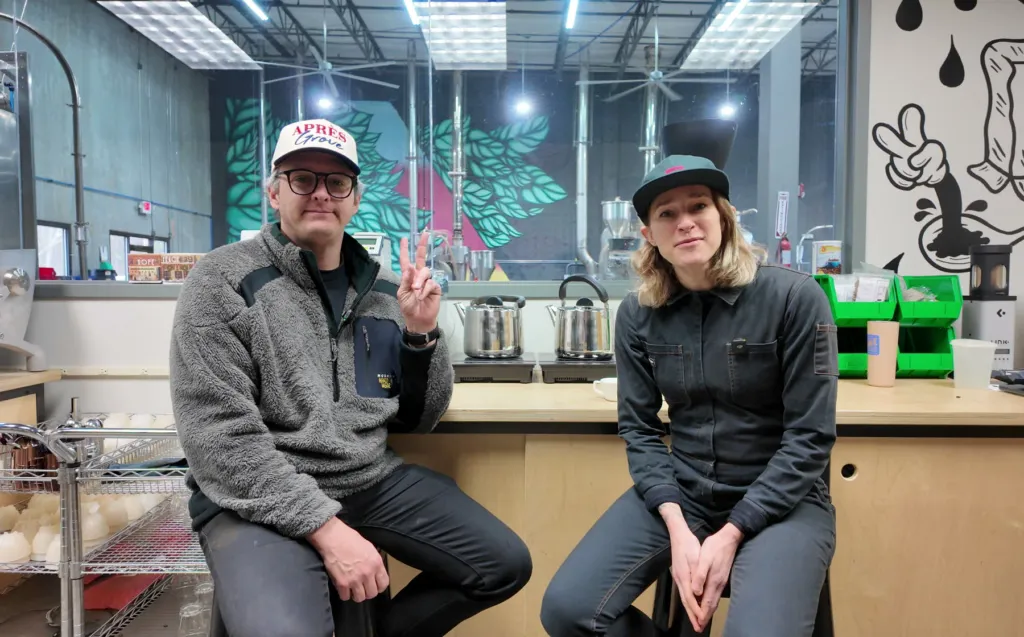
Kat Melheim, a roaster and communicator, sat down with Kyle Ramage, co-founder of Black & White Coffee Roasters in Raleigh, North Carolina, to discuss how competition coffees and global barista relationships shaped the company. Melheim, who has worked at Black & White in various roasting roles, brought her firsthand experience to the conversation.
Below is an edited transcript of their discussion.
Kat Melheim: Can you give a quick background on yourself and when Black & White started?
Kyle Ramage: We launched in 2017. The competition circuit gave us closer ties to producers than most coffee professionals typically have. We’d cross paths at trade shows and gain access to their coffees. We kept encountering remarkable people with exceptional coffees, largely because the competition scene draws the best from around the world.
What stands out is seeing different perspectives approach the same idea from different angles. I wasn’t only cupping with American buyers—I was cupping with Japanese buyers and with competitors from across Europe and Asia. That global outlook strongly informed what became the Black & White approach.
What was the catalyst that turned Black & White into a reality?
The World Barista Championship in Seattle was a major moment. Charles Babinski placed second, and Sasa Sestic won. I was representing Mahlkönig as the show technician for all the grinders. I ended up tasting with Maxwell Colonna-Dashwood, the Ona team, Charles and the Go Get Em Tiger crew, and Kalle Freese, who was at Sudden. So many talented people converged at that particular moment. It really advanced many of the ideas that became Black & White.
So you gained a global perspective on what was at the forefront of the coffee industry?
Definitely. They all gather in one building, which is remarkable. You can learn a lot just by attending the competitions and seeing what these people are doing.
Let’s talk about your roasting philosophy and green buying approach.
Green buying was heavily influenced by competition. We had access to coffees that leaned more toward competition style, and that’s where many of our direct relationships were—with producers like Naguo or those incredible coffees from Panama.
Honestly, we did it backward. It wouldn’t be the logical progression if you were planning it out. We didn’t devise a business plan and then execute it. We thought of the coffees we wanted to bring in and then built a business around them.
Black & White isn’t only competition coffees—though some very specialized roasters focus exclusively on that. Hydrangea Coffee Roasters is probably one. Every coffee I’ve had from them has been a stunner. But we had these relationships and access to coffees that were on the edge for a lot of people.
In 2017, anaerobic coffees didn’t really exist yet. When I competed, I used a washed coffee. Then I used a honey-processed coffee from Naguo. My year was the first time you started seeing anaerobics show up—some 90+ coffees, some Jamison Savage coffees. The next year, it was mostly anaerobic from there on out.
So these were pretty avant-garde coffees at the time. How did that shape your roasting philosophy?
It didn’t come from “this is my purest expression of coffee,” or anything like that. It was more like, “Okay, we have these really interesting, expressive coffees. Now how do we roast them to be as expressive as possible while making sure they’re palatable and drinkable?”
We’re definitely not the lightest roasters on the planet. Some people will say we roast so light, others will say we roast so dark. And I’m like, hey, stop. It’s fine. It doesn’t matter.
It’s a range.
Exactly. Roasting is very dependent on your water, your machines, the coffees you have access to. We’ve used a lot of high-fermentation coffees, and when those are roasted quite light, they can come across as vinegary or sour or spiky or rough to me.
Flavor movement is really important to us. We try to roast in order to make a coffee as expressive as possible, from hot to cold. I love when a coffee is one way when it’s hot and different when it’s cold or cool—when it’s moving around as it cools. That experience morphing is something I really value.
That largely comes from my other tasting background—beer and spirits, mostly American corn-based spirits like bourbon and rye. I want all those experiences to be similar. Very aromatic, one way when it’s first poured, and then changing again as it’s aerating or cooling or warming.
How does your roasting approach accomplish those goals?
The intent is always to make the coffee as complex as possible. We design roasting profiles to be all sensory-based. We have some ideas—we move coffees relatively fast compared to some roasters. For filter roasts, we’re probably on the low side of middle in terms of speed. We’re not doing five-minute roasts, we’re not doing 12-minute roasts. More like nine-and-a-half to 11 minutes, depending on our goal for the coffee.
Temperature-wise, we’re probably on the low side of middle for global specialty coffee. For Loring temperature probes—which won’t equate to anything else, so these numbers don’t matter for anyone not roasting on a Loring—on the low side we’re around 406°F, and on the high side, for a very dark roast, would be around 440°F.
Was choosing Loring roasters an intentional decision?
That was one of the few things we did very intentionally. I was consulting for a company that we ended up acquiring to make Black & White—Back Alley Coffee Roasters in Wake Forest. The owner asked, “If money was no object, what would you purchase?” I said I’d probably buy a Loring.
I’d seen this video series that the Nordic Barista Cup put out. Roasters who were my heroes at the time—Tim Wendelboe, Klaus from Coffee Collective, and others—roasted the same Kenyan coffee. They all unanimously said the Loring-roasted version was the best one. Tim explained what he believed this roasting technology was doing to the coffee and why it worked for what he wanted. I was like, “Wow, I want that roaster.” I had no idea how much they cost or how to roast coffee at that point, honestly.
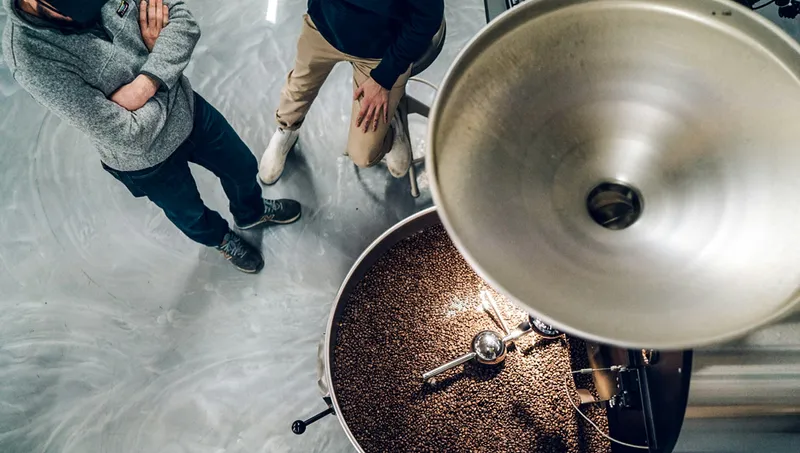
We ended up purchasing that company, and the Loring decision has been kept intentional. As you can see behind us, this is the unofficial East Coast Loring showroom. Still waiting on them to send us the One Cup, that tiny little one.
They look cute.
They said no multiple times. It’s fine. But the Loring is quite a quick roaster. It’s challenging to work with if you’re a very visual learner, because the outside of the coffee looks quite light, but the inside is more developed than you might expect. The best way I’ve heard it described is “fluid air”—it works like a liquid. It’s basically an air sous vide inside. The inside and outside end up very similar, which is cool.
Loring was on purpose, but we had to learn how to roast on them. Before this, I only roasted on drum roasters, where a fast roast is like 12 minutes. That’s as quick as you can go. A 12-minute roast on a Loring usually isn’t great for filter coffee. We had to figure out batch sizes, what works for us as a just-in-time facility. We don’t roast and then take orders—we roast what we need for orders based on hopeful math.
Walk me through your typical roasting process from start to finish.
We’re a relatively small facility, so it’s quite simple. Orders come in, we aggregate them, print labels, roast the coffee, let it cool depending on the coffee, bag it, ship it. Pretty straightforward.
The interesting part is we try to be as dynamic as possible with our roasting schedule based on what coffees we have and what we’re going for. We’ll look at previous roasts, talk about what we’re looking for, taste them, adjust. It’s very iterative.
How do you approach quality control and consistency?
We taste everything. Multiple times. We have a cupping table where we’ll cup coffees blind to check consistency. We also do a lot of comparative tasting—comparing current roasts to previous ones, or comparing how a coffee performs in different brew methods.
The Loring helps with consistency because once you dial in a profile, it’s very repeatable. But we’re constantly adjusting based on what we’re tasting. If a coffee isn’t expressing the way we want, we’ll change the profile.
You mentioned earlier that Black & White does pre-roast blending. Can you talk about that approach?
Pre-roast blending is interesting because it’s not super common in specialty coffee. Most people do post-roast blending—roast each component separately, then blend them after. We’ll roast multiple coffees together as one batch.
The reason we do it is for a few reasons. One, it can create more complexity and integration in the final cup. The coffees develop together, interact during the roast. Two, it can help with consistency—minor variations in individual coffees get averaged out. Three, it’s more efficient for us operationally.
It does require more planning and precision in green buying. You need to think about how coffees will work together from the start. But when it works, it creates something you can’t achieve with post-roast blending.
How do you think about developing coffee across different brew methods—filter versus espresso?
We oddly do both, but I’ll call it filter roasting. That’s what the Europeans would say anyway. I just roast coffee.
But seriously, we primarily think about how coffee will perform as filter. Most of our customers are brewing it that way. If someone wants to pull it as espresso, that’s cool too. Some of our coffees work great as espresso, even though they weren’t specifically roasted for it.
The Loring’s even development helps with that versatility. Because the inside and outside of the bean are developed similarly, the coffees tend to work across different brew methods better than they might on a drum roaster where you might have more gradient in development.
Time for rapid-fire questions. First, coffee: art or science?
Neither. I think if you don’t apply the scientific method to life, your life’s going to be really challenging. So it is scientific. But also artistic. But it’s not art. I have a very high bar for what art is. There’s a piece over there created by a person who is an artist who intended to evoke emotion and feeling through his chosen method. That’s art.
Coffee is an artistic expression, but it’s not art because that’s not its principal goal. The principal goal is to make money, because we all have to eat. So both and neither.
Drip or espresso?
Drip.
When you’re roasting, do you listen to music or podcasts?
Music.
Light or dark roast?
Light. But we’re releasing the best decaf I’ve ever tasted in my entire life next week—a Wilton Benitez thermal shock Castillo that’s actually 100% decaffeinated, or 99-point-whatever legally decaffeinated. It’s incredible.
Hot and fast roasting, or low and slow?
Hot.
High development time ratio, or low?
Low ratio.
Pre-roast blend or post-roast blend?
Pre.
What are the main takeaways you’d want people to understand about Black & White’s approach? The main takeaways I’ve gotten are that Black & White’s approach really heavily focuses on the green coffee, on the flavors available, on a global perspective and global calibration with other roasters and producers. Pre-roast blending. What else would you add?
Competition is so baked into everything we do. It’s so obvious once we start talking about it, but we’re probably the company that’s been impacted most by the World Brewers Cup competition in terms of how much it’s proliferated into the whole entity. Maybe some smaller roasters in Europe, or Rosso up in Canada, would be more influenced, but competition has infiltrated its way into every little nook and cranny of Black & White.
That same super-fanatical, quality-focused approach you see in barista competition is lived out in different ways throughout our entire company. It’s a competition mindset applied differently, but it’s definitely worked for us throughout the years.