A Brooklyn Roasting Hub Where Small Coffee Businesses Get Their Start
How a shared Red Hook roasting facility helped independent coffee companies like Parlor and FAL Coffee find their footing without building their own roasteries first.
By Quinn Ross9 min read
Finding Parlor Coffee
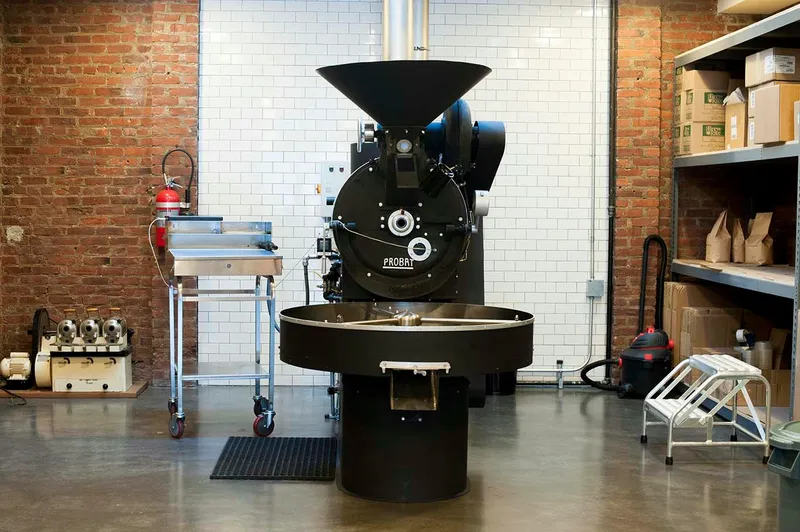
On my first attempt to visit Parlor Coffee, I walked right by it. The quiet Fort Greene street near the Brooklyn Navy Yard gives almost no hint that a coffee roastery operates there. Once you pass the dark cherry wood facade set against red brick, you step into a space dedicated entirely to the coffees Parlor roasts. Inside, the only seating is a four-person wooden bench; a glass coffee table in front of it can be rolled away when pallets of beans arrive. Along the wall, sacks of Nicaraguan green coffee wait to be roasted, and from the counter—where visitors can join cuppings or try a Chemex-brewed Parlor coffee—you get a clear view of the black cast-iron Probat roaster.
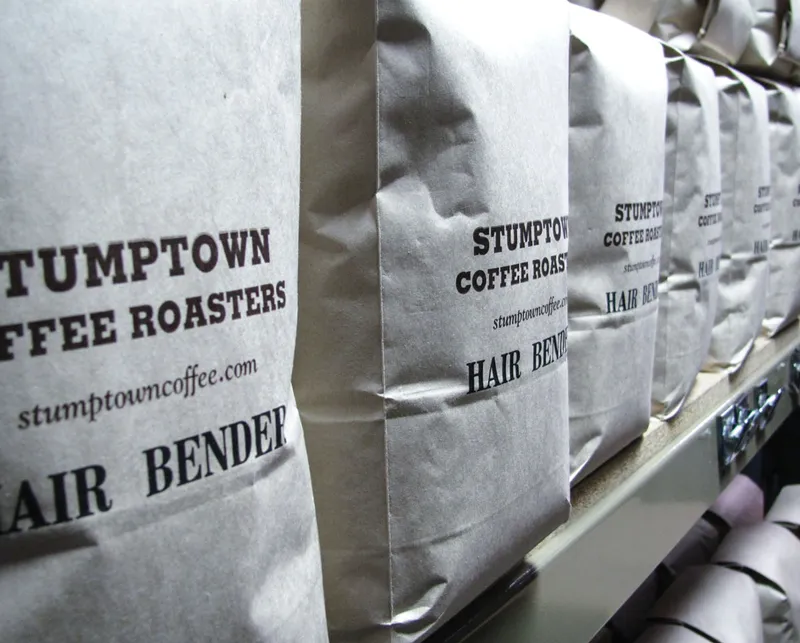
The calm of Sunday roasting and cupping seems to fit the owner, Dillon Edwards, who adjusts brewing equipment and converses in a soft, deliberate tone. “It doesn’t necessarily conflict with my personality,” Edwards says. He moved to New York in 2009 to work for Stumptown when that company was opening its first New York location. There he dealt with the demanding customers at the Ace Hotel, and later, after moving to Blue Bottle, with the constant weekend lines at its Williamsburg shop.
Edwards has a talent for becoming part of a neighborhood, which is notable in New York’s crowded coffee scene. The roastery and tasting room sit between an auto repair yard and a medical supplies warehouse; on days when the roastery is closed—now every day except Sunday and Wednesday—the auto shop workers keep an eye on the building. In five years, the area will probably have several upscale apartment complexes and more foot traffic from the Navy Yard, but for now most new visitors come specifically for Parlor.
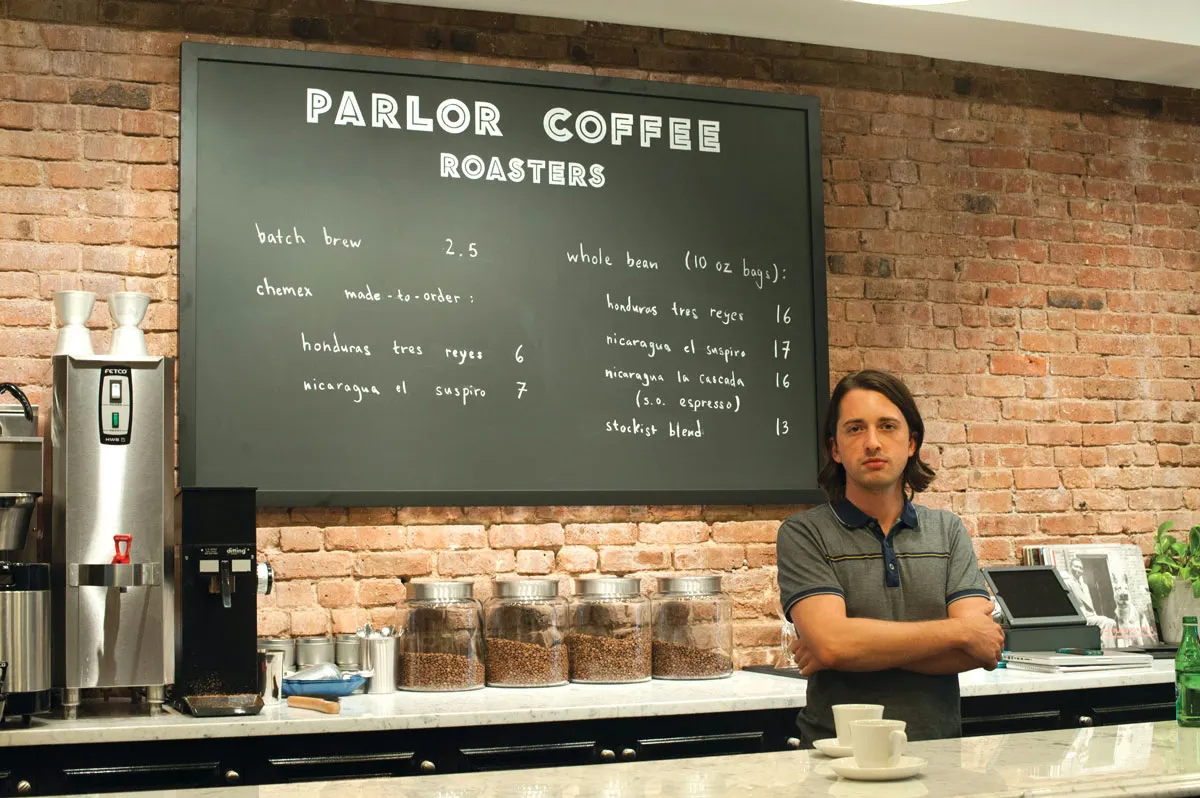
Dillion Edwards in Parlor Coffee’s new location in Fort Greene.
The combination of a microroastery and a café is not new to New York. Café Grumpy started roasting at its own Brooklyn facilities in 2009, the same year Stumptown opened its East Coast roastery in Red Hook. What is new is a small group of independent microroasters, Parlor among them, that entered the market without first establishing a retail presence. Pulley Collective, a new roasting facility on Red Hook’s waterfront a mile from Stumptown, has helped these newcomers.
“Why hasn’t anybody done this?” This is the question Mierisch says he asks himself whenever he has an idea he has an idea he thinks can be turned into a business plan.
The Pulley Collective Model
Steve Mierisch conceived and built Pulley. He found the space in a refitted brick warehouse on Red Hook’s Pier 41 and signed the lease in the fall of 2012. The concept is to offer roasting capacity through weekly time-shares at $850 for a half-day slot. That is a moderate cost when you consider that it covers everything from labeling machines and storage to the energy needed to run the two roasters. Beyond the infrastructure, Mierisch hoped that when the roasters started up in 2013, the facility would bring the specialty coffee community together in an environment of experimentation and growth.
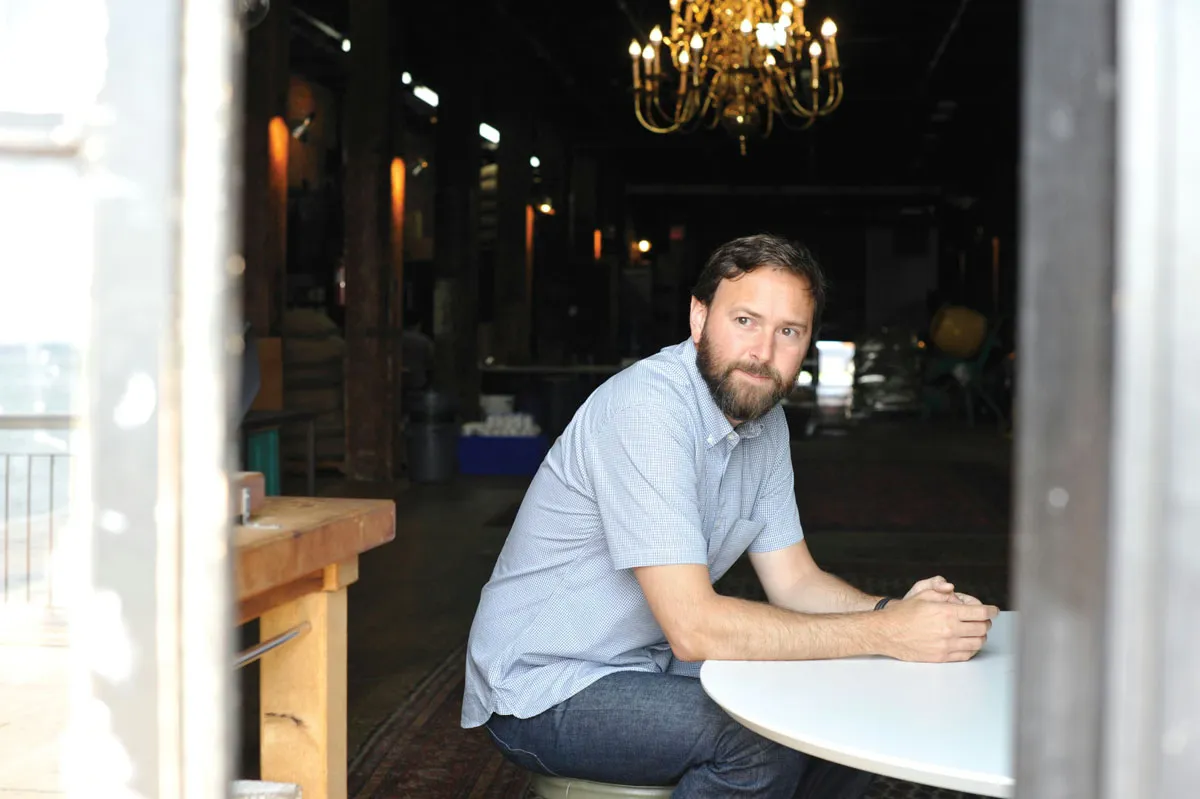
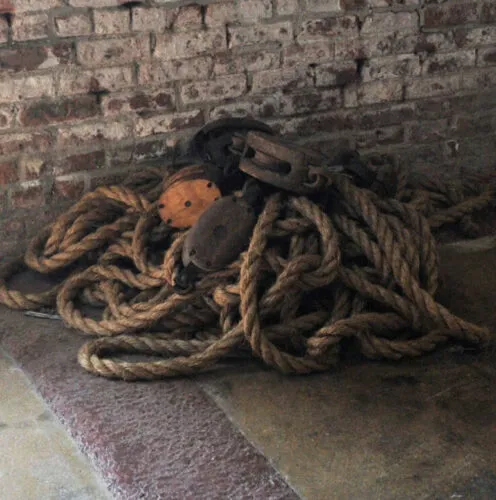
The window at the far end of the warehouse opens to the late afternoon sun. The collective looks out at the Statue of Liberty across New York Bay. The roastery occupies one long warehouse space with sturdy wood supports spaced far apart—supports that once allowed cargo, including coffee beans, to be stored there when the building was part of Red Hook’s shipping industry last century. A few domestic touches warm the space: two faded oriental rugs lie in the center of the room, and a chandelier with electric candles is anchored to the ground by nautical rope and held up by—what else—a pulley.
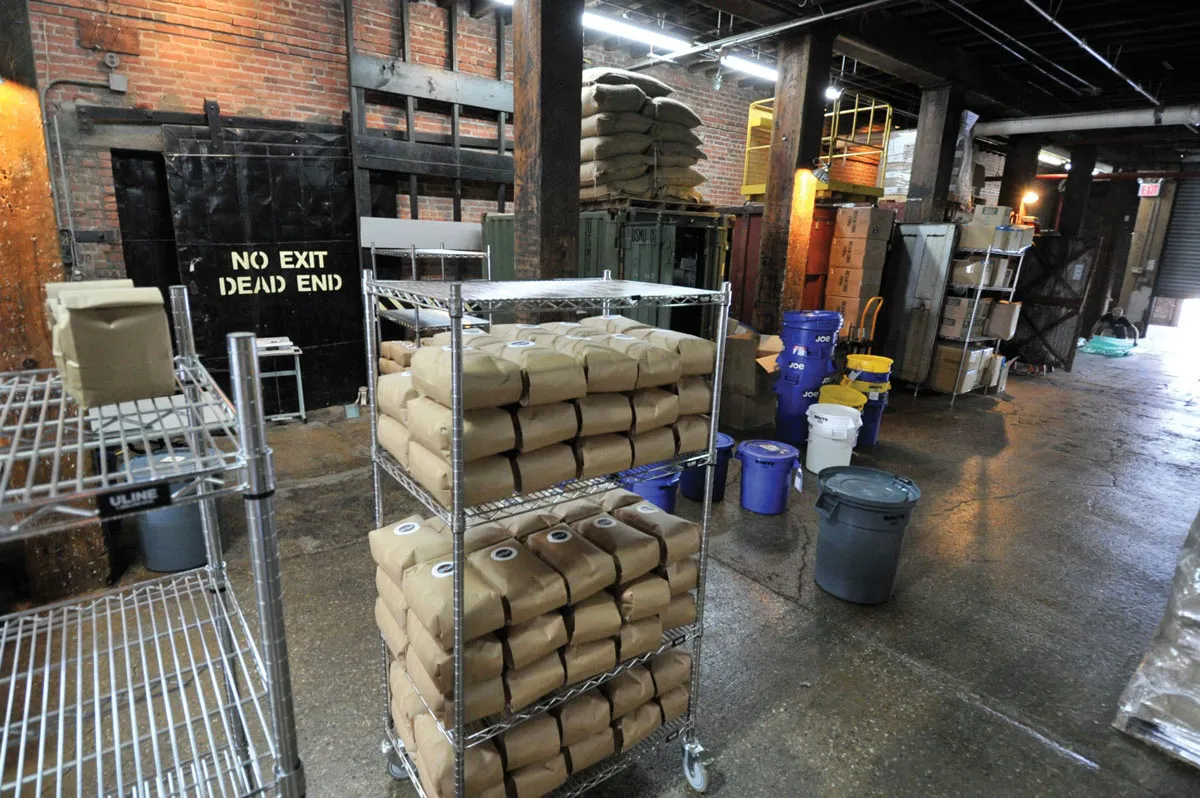
Inside Pulley Collective.
Sacks of green coffee wait for the roasters, stacked on pallets, lined up against walls, and leaning on posts. A red Diedrich stands on one side, with a twelve-kilogram capacity that maxes out at just under seventy-eight pounds an hour. On another side is the Loring roaster, a hulking stainless steel machine. Steve sits in the lab; behind him along a wooden counter are drip systems and a La Marzocco GB5 espresso machine, where roasters can test cups before committing to a roasting profile. At the end sits a San Franciscan table-top roaster that produces one-pound sample lots.
Mierisch has bigger plans and hopes to bring independent educators into the space to teach everyone from beginning home roasters to veteran baristas.
“Why hasn’t anybody done this?” This is the question Mierisch says he asks himself whenever he has an idea he thinks can be turned into a business plan. Previously, roasting options in the region were limited, involving outlays of hundreds of thousands of dollars to lease and build a space, then source and buy roasters. The only alternative for an operation looking to jump into roasting was to “toll roast” by arranging deals with established roasters for any excess capacity. Mierisch had a large list of contacts in New York’s coffee scene, mostly through his five years establishing East Coast operations for Intelligentsia. The big names were on the verge of expanding, and they needed somewhere to roast.
Joe Coffee was operating nine stores in New York and Philadelphia and had just started dabbling with roasting under Ed Kaufmann. For that, Joe relied on equipment at Dallis Bros, a venerable coffee roaster that has operated in Queens since 1913. But roasting on Dallis’ schedule could meet only a portion of Joe’s demand, and the rest of the coffee under Joe’s brand was outsourced through roasters like Ecco Caffe in California.
Dallis was also contracted to roast for Ninth Street Espresso, the company that kicked off New York’s fixation on specialty coffee. At the time, Ninth Street had grown to four locations and was looking to take over control of its own roasting operations. Mierisch anchored Pulley with these two outfits, leaving space for smaller operations like Parlor.
Parlor’s Path to Red Hook
Edwards was roasting Parlor’s beans at night in an “undisclosed location” while setting up an espresso counter in the most Williamsburg location imaginable: a small counter in the back of a dude-forward, retro barbershop called Persons of Interest. Edwards spent time at Blue Bottle after Stumptown and a stint in Berlin with the task of launching a coffee window within a planned Freeman’s Sporting Club, a hip suit shop chain that also offered barber services. Freeman’s ended up dropping the collaboration, but for Edwards the aesthetic appeal of bringing upscale coffee into a space where gentlemen came for grooming was too perfect. Edwards arranged a plan with Persons of Interest, raised some cash and set up his Kees van der Westen Speedster to pull shots for freshly shorn Brooklynites.
At the same time, Parlor was building out its Fort Green location and sourcing a suitable roaster. It wasn’t happening fast enough. As Parlor built its business, demand had outstripped his capacity. Toll-roasting meant irregular hours and kept Edwards from coming up with the reliable production numbers he needed to build his wholesale portfolio. Edwards got wind of Pulley Collective and worked out a short-term deal to move to the Red Hook warehouse, roasting half a day once a week.
“The coffees back then were in their own way quite beautiful,” Edwards says, reminiscing about his roasts at Pulley. At the time, another Stumptown alumnus, Aleco Chigounis, was sourcing for Coffee Shrub and set Parlor up with beans from Pedregal in Colombia for its first lots. Grown on the mountainous terrain in the southwest of the country, the coffee produced notes of brown sugar that Edwards felt would work well on the Speedster. As Parlor roasted in Pulley and built its coffee portfolio, it could put the final touches on its roasting location in Fort Greene.
Edwards estimates that at Pulley, Parlor turned over a little more than 1,000 pounds during its once-weekly slot. Parlor’s head roaster David Stallings, also formerly of Blue Bottle, would show up at the pier, put on some music, and run beans through the Diedrich and Loring at a steady pace until quitting time. Working on the Probat at the current location, Parlor’s capacity dropped to 800 pounds a day, but allowed Stallings and his assistants to work any day of the week, giving Parlor more space for growth. Pulley’s community of roasters was replaced by the excitement of sharing the coffee directly with customers. Now on Sundays, Stallings quietly works in the back with the Probat while Edwards runs through the afternoon cupping.
“For the most part Pulley was having fun neighbors that you brush shoulders with and say ‘Hey Joe,’ or more like, ‘Hey Ed Kaufmann from Joe,’” says Edwards. Everyone sees Pulley differently. Mierisch views it as a collaborative space, where roasters could talk shop. The Loring especially had a ‘learning curve,’ as the ability to automate temperature and humidity during roasting was a new experience for many of Pulley’s roasters who had worked on manual machines.
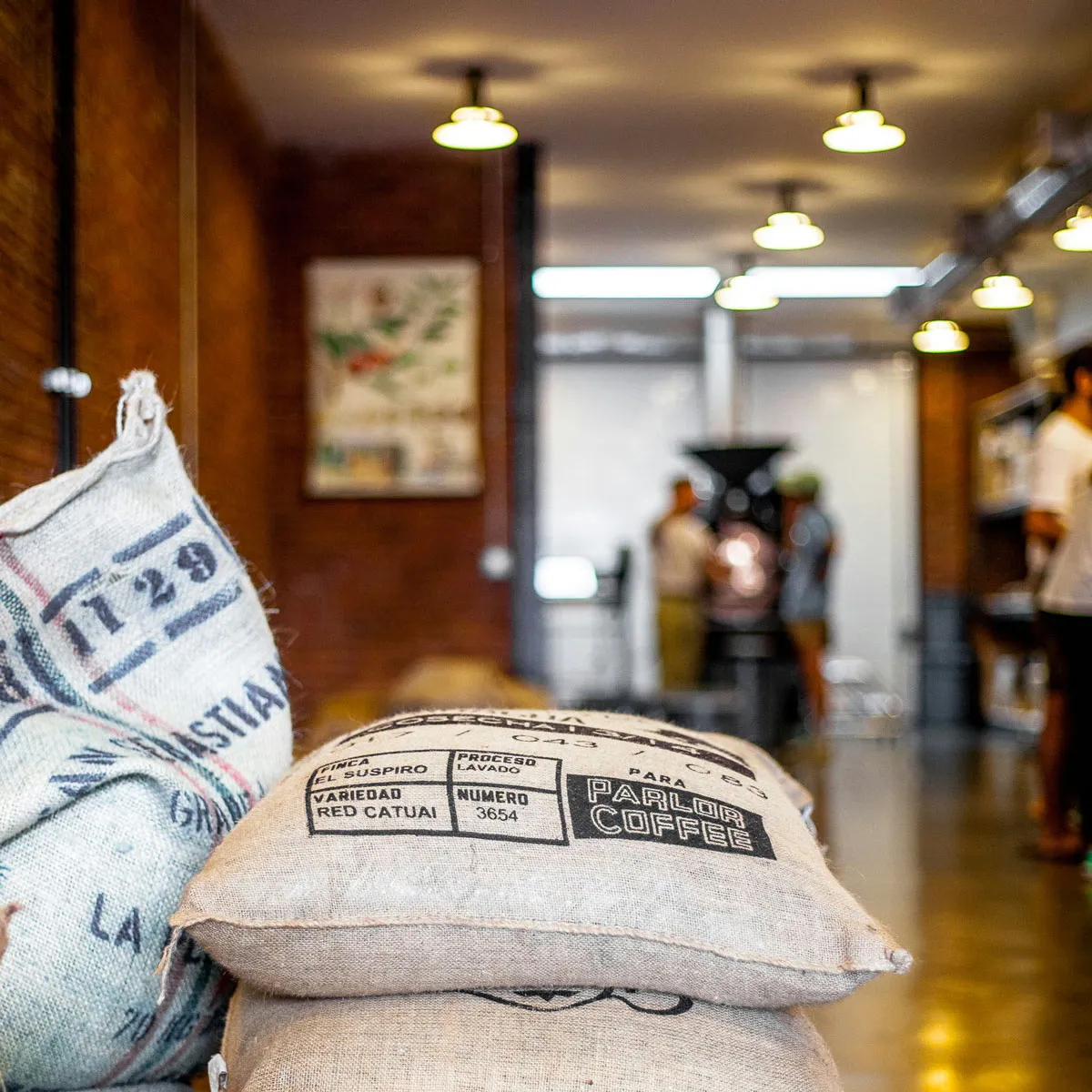
Parlor Coffee.
FAL Coffee and the Community
John Moore, who was also using Pulley to build a roasting operation from the ground up, has his own read of the atmosphere. “It’s like playing sports with your friends,” Moore tells me near the brewing lab at Pulley. “You want to win, but you don’t want to hurt anybody.”
Moore, formerly of Dallis Brothers, slogged through the process of finding square footage for roasting and navigating the Department of Buildings process, and a slot at Pulley gave him time to develop a portfolio of coffees to showcase to wholesale clients.
“From the very inception we’ve been thinking about the value of this integrated business model,” he says, referring to roasting at Pulley. Moore’s new undertaking, FAL Coffee, draws much of its beans straight from two farms located in Brazil’s coffee-seeded State of Minas Gerais that together have 565 acres in production. There are also milling operations up the road, where Moore’s team can visit and cup coffee.
“If we need to do something extraordinary, he’s always been accommodating,” Moore says about Steve Mierisch. As a part of Pulley Collective, FAL Coffee is now roasting for wholesale clients and will be opening up online for retail clients soon under the Nobletree label. At least one café is set to open in 2015. “This has enabled us to get out of the gate,” he says. “Even though the city has other ideas.”
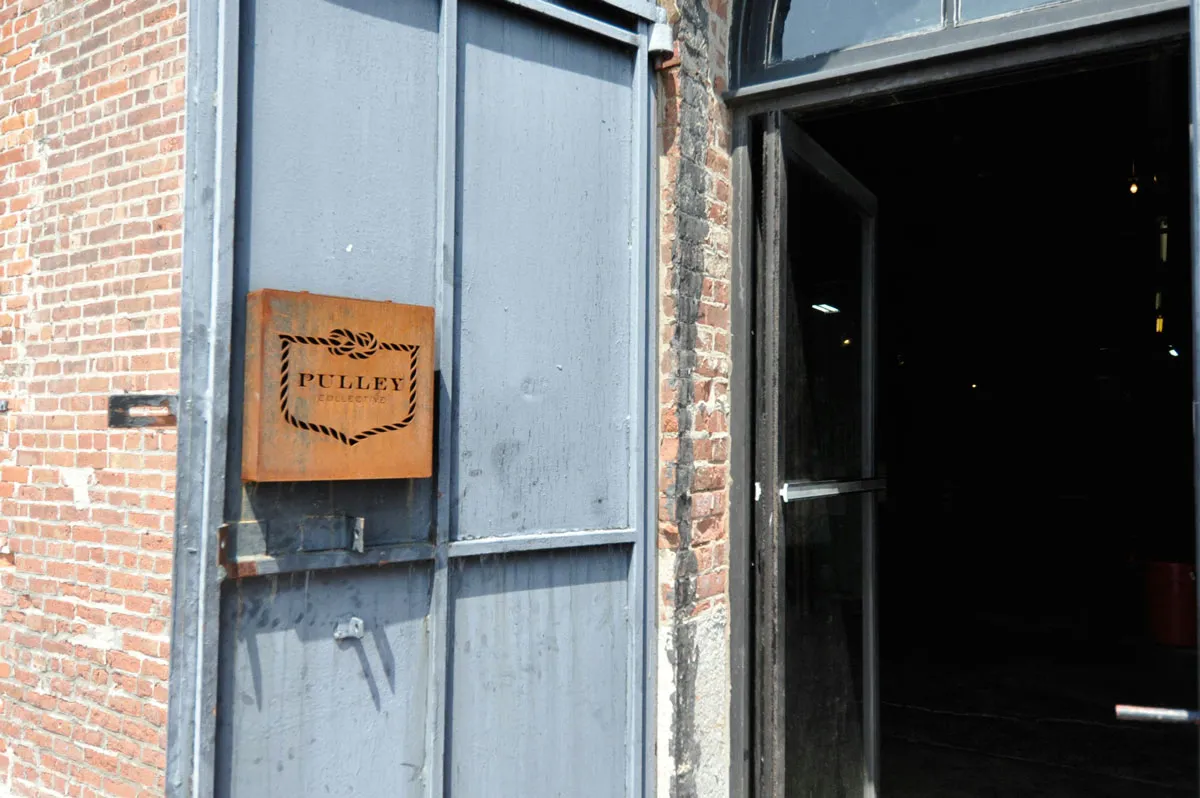
The front door to Pulley Collective.
Tasting Room and Education
Parlor’s roastery plays a similar function for the uninitiated. “Let’s take the focus away from espresso and put it on drip coffee,” Edwards says about his tasting room. “And let’s make the coffee so delicious that even the most unexpected experience—someone who’s used to having a huge latte with sugar in it—will walk away going ‘I’m engaged, I want to know more about coffee.’” That includes coffees sourced from Mierisch’s family farm in Nicaragua.
Mierisch hopes Pulley Collective serves both as a “neutral space” for healthy competition between the members and for education. Hurricane Sandy disrupted plans for a Cup of Excellence auction, but Mierisch still pulled off a cupping of quality Honduran ACE farmers. Still, Mierisch has bigger plans and hopes to bring independent educators into the space to teach everyone from beginning home roasters to veteran baristas. Pulley Collective exists to be everyone’s next step into specialty coffee.
Even in his new roasting space, Edwards is still looking to push forward and differentiate himself. When I mention John Moore’s venture, Edwards immediately presses me for intel on the build-out of the roastery, which he’s heard will be huge. As much as ever, in specialty coffee everyone is a friend who also wants to win.