From Toast to a Full Menu: How One Café Built Its Kitchen Systems
A Salt Lake City café started with coffee and toast, then gradually assembled a food program—bringing in trained staff, reworking its layout, and turning tight quarters into an advantage.
By Rowan Hayes5 min read
When the Rose Establishment first opened its doors in Salt Lake City in 2010, the menu was limited to coffee and tea brewed to order, plus baked goods brought in from a local bakery. Manager Cody Kirkland recalls that the brew-to-order approach puzzled local customers: “Customers were like, ‘What the hell do you mean you brew coffee to order? You don’t have it ready for me?'”
Pour-overs alone weren’t enough to keep the café going, so the Rose took its first step into food with toast—cinnamon sugar or avocado—that baristas assembled in between making drinks.
That toast offering eventually expanded into salads and quinoa bowls, still put together by baristas between drink orders. “We kept growing and growing with what we were doing with food,” Kirkland says.
What follows is a detailed look, with photographs, at how the Rose Establishment carried out a successful food program. If you have thought about adding food to your own menu, this guide can help you design and build systems suited to your space.
How a Food Program Took Shape
The café’s evolution came in stages: it added a convection oven and brought on someone to bake in-house, then purchased a proper commercial oven and hired a trained pastry chef. The next step was bringing in Cori Norton as the café’s first food manager.
Norton’s formal training was limited, but she felt sure she could streamline the food prep workflow. “When I came on, it took them just a week to prep chili. Each task was assigned to a different day of the week since baristas were still doing all the prep work,” Norton says.
Norton oversaw the food and pastry programs at the Rose for a year and a half before moving on to gain experience in other professional kitchens around Salt Lake.
While at Rye, she got to know Alicia Pacheco, a formally trained pastry chef. The short version: the two connected, Norton found her way back to the Rose, and Pacheco came aboard in January of this year. Norton is now the Rose’s chef, and Pacheco heads the pastry program.
A Place for Everything
Along with matching the right people to the right training, the Rose has changed its equipment and layout. The biggest shift was installing wooden, modular shelving. The adjustable units separate the kitchen workspace from customer seating—a boundary that had previously been unclear—and give both the front and back of house somewhere to store things.
Norton says getting the layout right was essential to efficiency. “We lost kitchen space by putting the boxes in, so we had to rearrange storage and add shelves above the prep tables,” she says. “We did a lot of measuring to see if staff could fit back there, to make sure two people could be standing in the pathway and actually walk by each other.”
Behind the shelving wall, the bakery and food teams each have their own designated prep areas. Because the quarters are tight, finding room to work can be difficult, so communication matters when making sure everyone has the space and time to finish prep. The close quarters also bring benefits, such as encouraging shared use of equipment and ingredients.
Pacheco says sharing equipment is challenging for baking but good for pushing her creativity: “We all want to do really creative things, and since we don’t have certain aspects of a normal kitchen, we have to be creative to come up with the dishes.”
The sections below break down the Rose Establishment’s various kitchen, prep, and barista areas and explain how each one was designed to maximize efficiency and support a creative, exciting menu.
Front of House
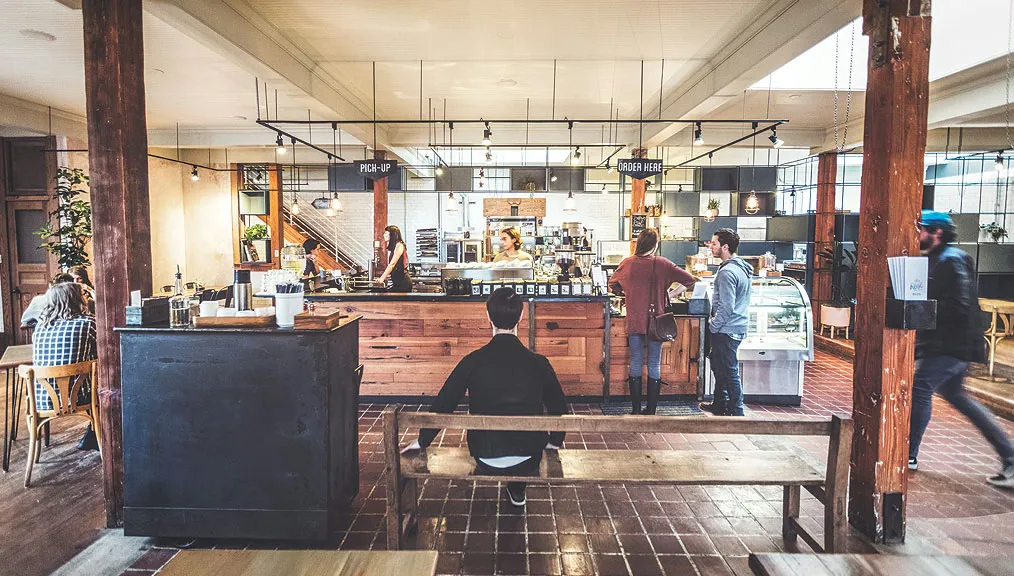
Condiments as a Barrier: A bench and condiment station form a partition between two support beams, steering foot traffic toward the register. Keeping condiments away from the pick-up area helps prevent customers from bunching up.
Baristas in Front: Orders are placed and collected at the bar, where baristas make drinks, field menu questions, and ferry items from the kitchen.
Modular Wall: A grid of wooden cube shelves acts as a wall between the kitchen and the café seating, and doubles as storage for front and back of house (the boxes face both directions). Open gaps were deliberately left in the shelving to let in daylight from the skylights above. “That’s important for the whole space at the Rose,” says Kirkland. “To keep it feeling open.”
Prep Station
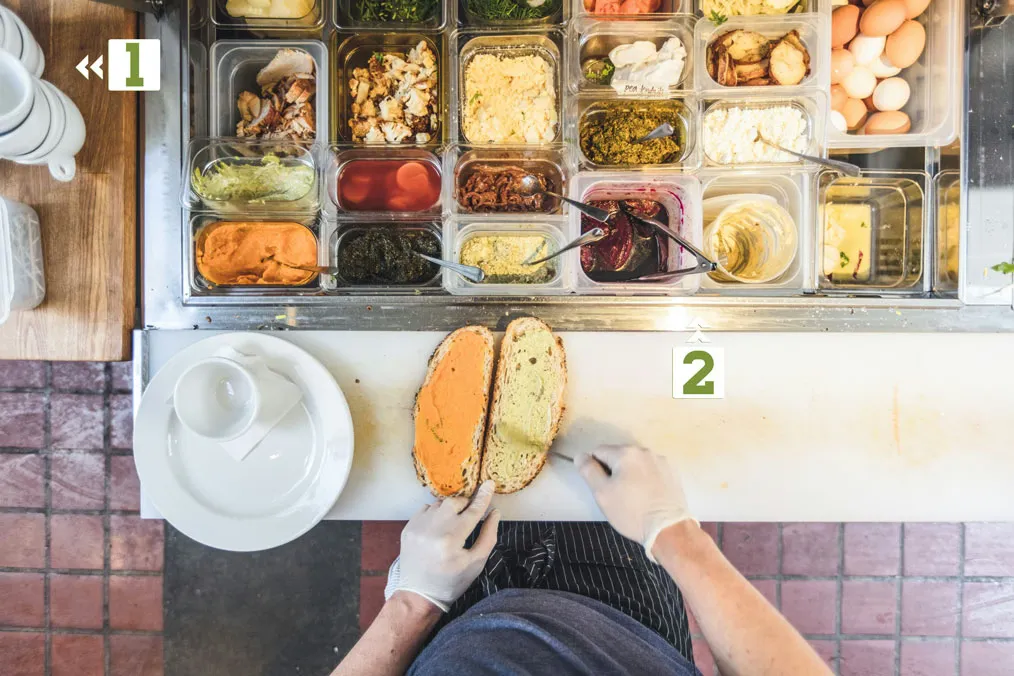
1) Soup Crock: Just outside the frame sits one of the Rose’s soup crocks, used to hot-hold gravy and hollandaise for brunch specials (the crocks also hold soups, of course). Pacheco and Norton worked together to add dishes like Biscuits & Gravy to the menu; Pacheco already had a cheddar-and-herb biscuit in the bakery, so Norton created a gravy to go with it.
2) Mise en Place: Most of the ingredients the menu calls for are portioned into the flip-top refrigerated table. Norton reuses many ingredients—house-made pickled vegetables, roasted potatoes, soft-boiled turmeric-brined eggs—to get the most out of limited fridge space.
On the Line
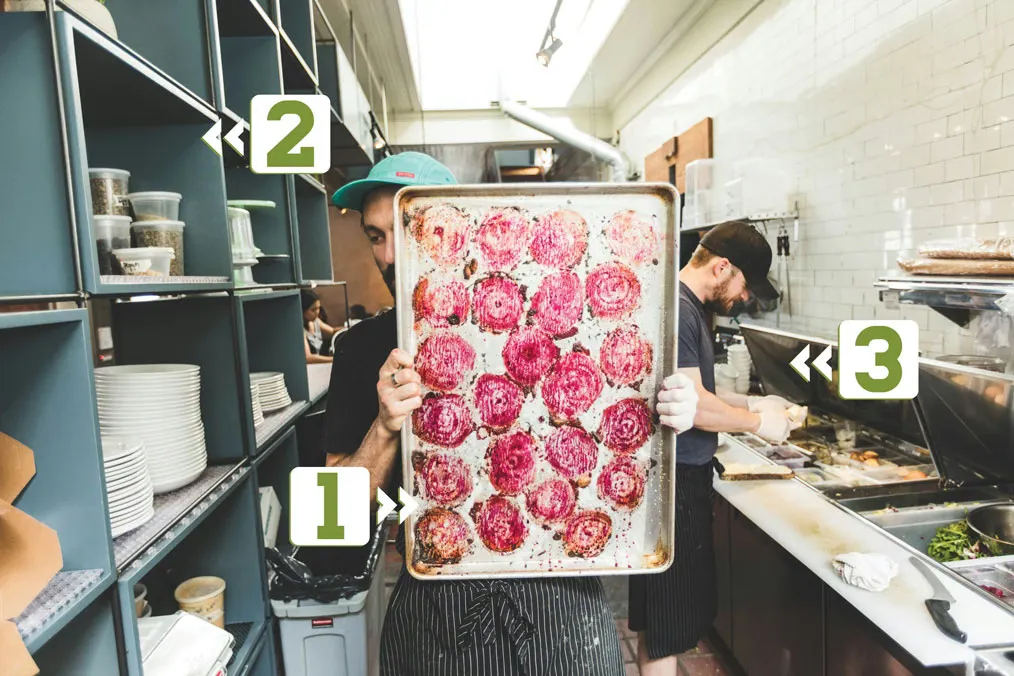
1) Beets Me: Casey holds a sheet pan covered with beets (the beets are marinated in the shop’s leftover batch brew coffee). The Rose has no commercial stove, so much of the roasting happens in the oven, while simmering is done on portable induction burners.
2) Two-Faced Storage: Another view of the Rose’s modular shelf units. Back-of-house shelves near the line hold plates, dry ingredients, and to-go boxes.
3) Line Logistics: Nate works the line, where every brunch and lunch dish is assembled to order.
Open Shelves
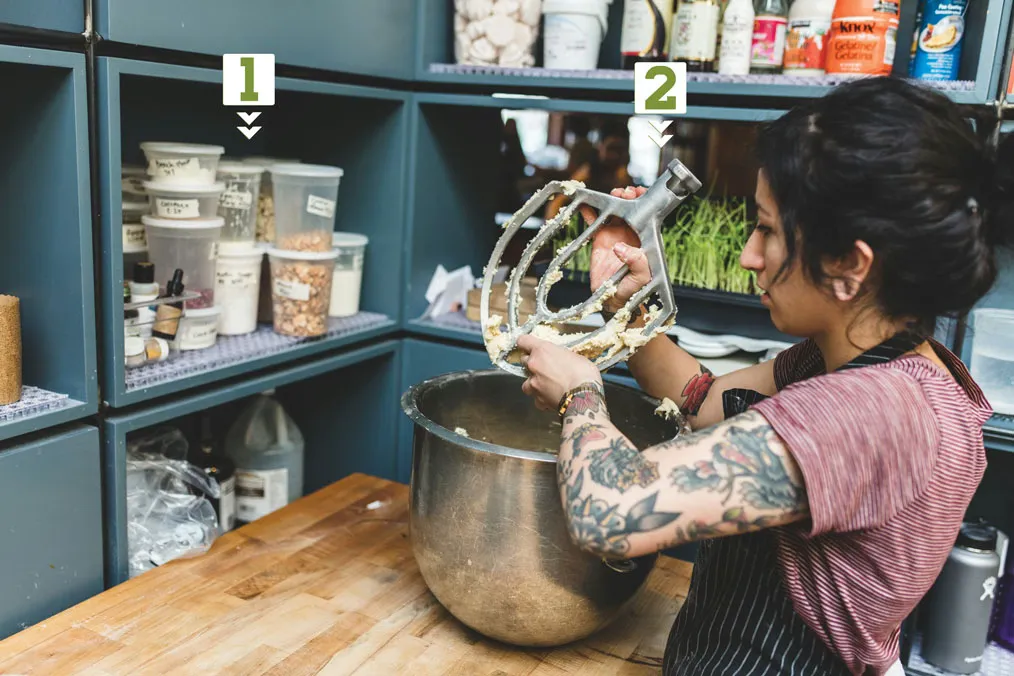
1) Sweetly Sequestered: Shelves in the bakery prep area hold some of Pacheco’s specialty bakery ingredients, including cocktail bitters, extracts, and candied flowers.
2) Pea Shoots, Pea Scores: Beyond letting in light, the open shelves make it easy to communicate with baristas and food runners and keep the tight workspace from feeling claustrophobic. They also offer a good spot for the plants Norton grows as ingredients and garnishes, including pea shoots, sprouts, and microgreens.
Extra Storage
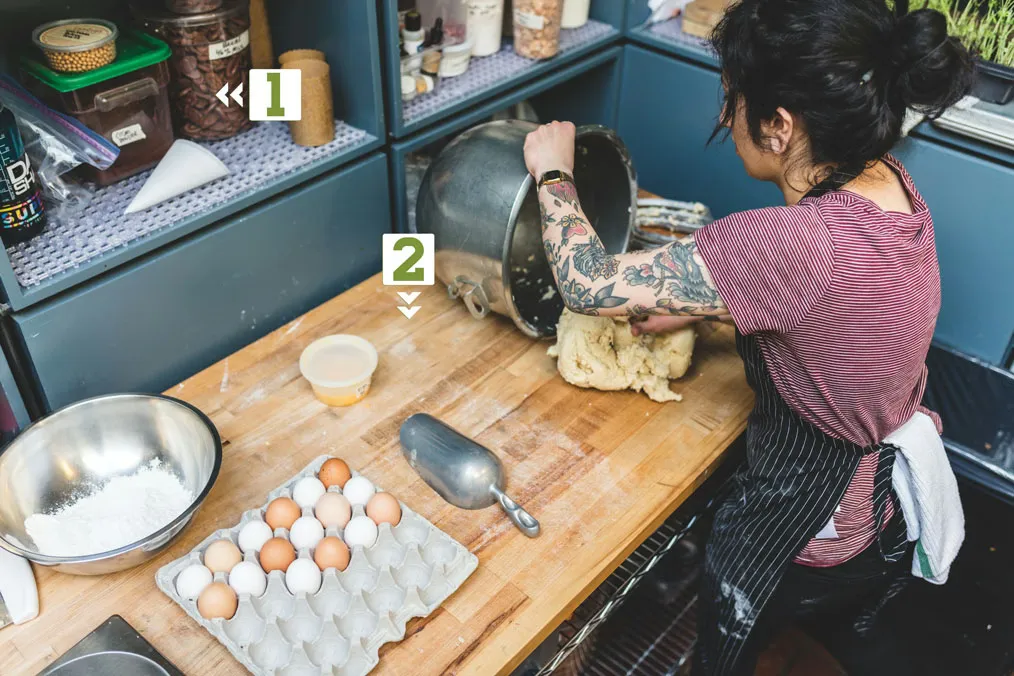
1) Local Flavor: The blue shelves hold all sorts of things, including local chocolate from Amano and Solstice used in baked goods and mochas.
2) Roll with It: Butcher block–topped prep tables can be rolled wherever they’re needed and offer extra storage options.
In View
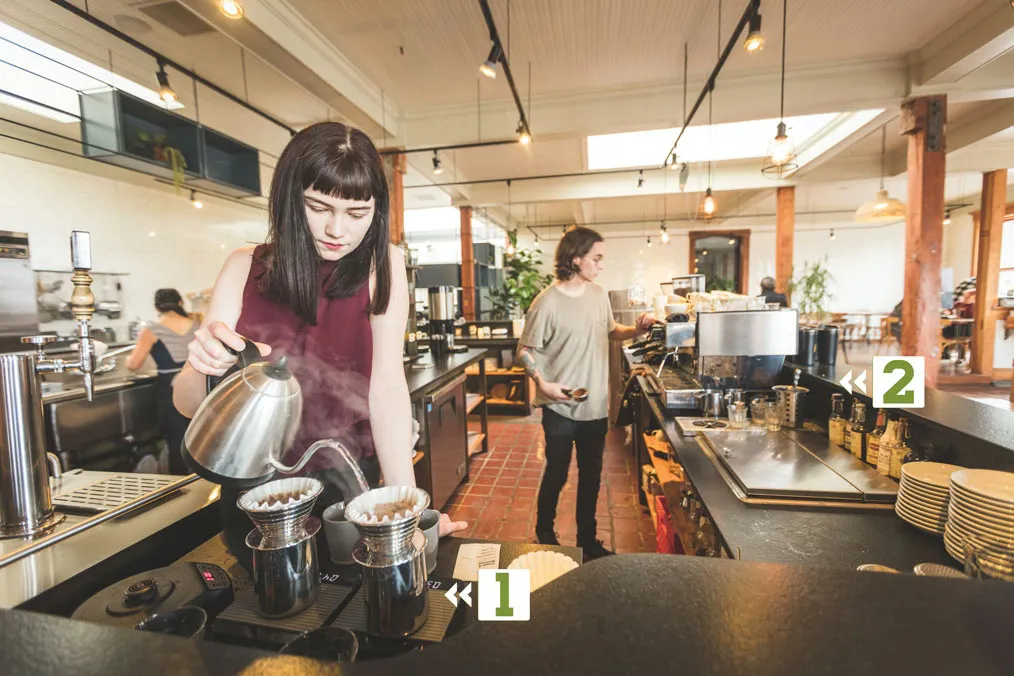
1) Duck, Duck, Gooseneck: A digital Bonavita variable temperature kettle sits alongside a pair of Kalita Wave drippers on the manual brew bar. The electric kettle leaves the induction burners free for kitchen use.
2) Innovative Ingredients: Drink prep is still the most visible activity behind the bar at the Rose. A rotating list of signature drinks features house-made bitters, sodas, and syrups—many of them made by repurposing ingredients from the food menu.