Six Coffee Campaigns That Break the Mold—and the Psychology Behind Them
Tired of '100% Arabica' and 'freshly roasted' clichés? These six coffee ads show how education, reciprocity, problem-solving, social proof, customer-focused language, and benefit-driven messaging can cut through the noise.
By Dakota Young4 min read
When Coffee Ads All Sound the Same
According to William Ukers’ book All About Coffee, one of the earliest coffee advertisements was a 1587 manuscript by Abd al-Kadir called “Argument in Favor of the Legitimate Use of Coffee.” The first English-language coffee ad appeared in 1652, when Pasqua Rosée distributed a handbill for his London coffee house.
Centuries later, coffee marketing is ubiquitous—though now it arrives via TikTok clips and Facebook promotions rather than printed pamphlets. Yet the language used to sell coffee has barely evolved.
Consider this 1930s sign for Freihofer Baking Company’s ground coffee delivery service:
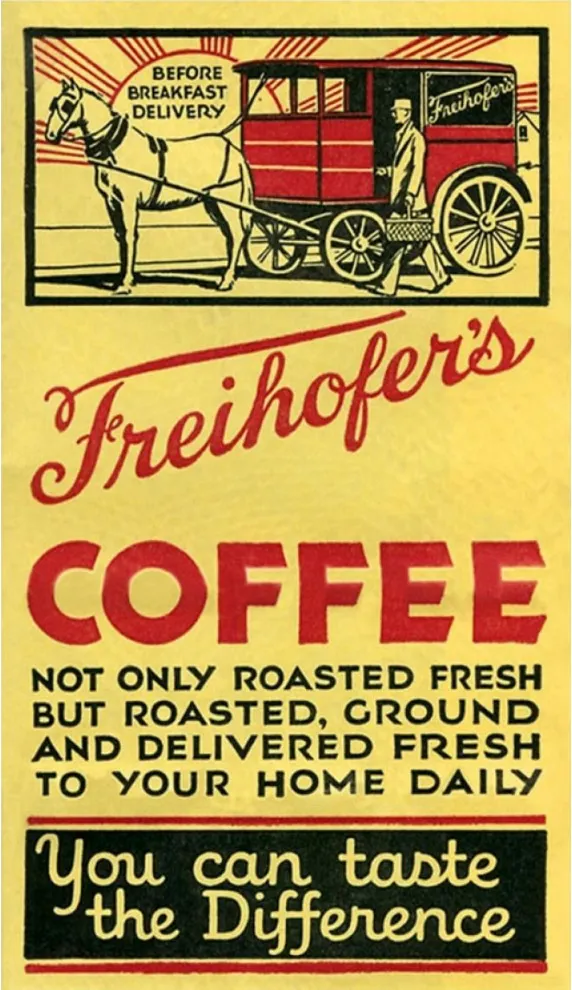
It could easily be mistaken for a modern coffee subscription pitch.
The same phrases keep resurfacing:
- “We only serve the freshest coffee…”
- “We travel to the best coffee farms across the globe…”
- “Roasted in small batches by an expert team…”
- “Never run out of coffee again…”
With competition in specialty coffee intensifying, a great product alone isn’t enough. Branding and advertising naturally become differentiators—but differentiation is hard when everyone repeats the same recycled messages.
Below, we break down six coffee ads that work, and why, to help you create fresh, effective campaigns without falling back on tired marketing phrases.
Nguyen Coffee Supply: Educate First, Then Create Urgency
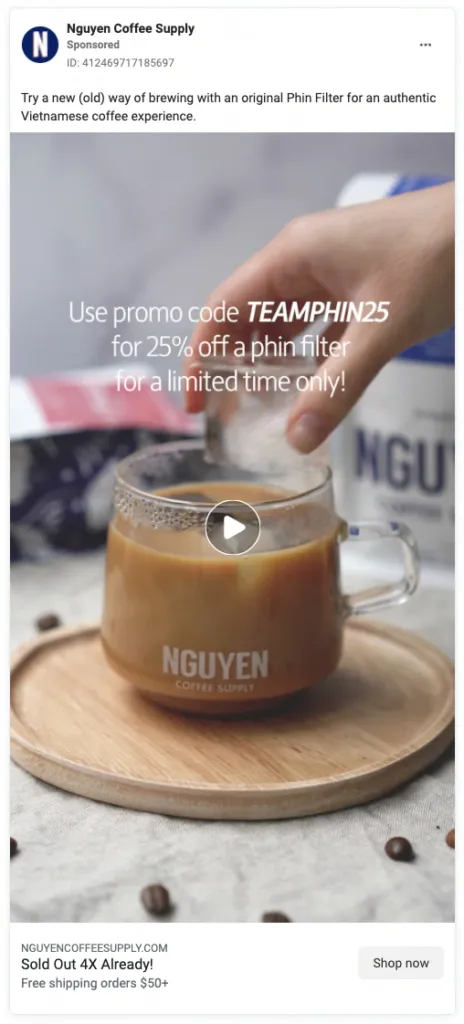
“100% Arabica” is one of coffee marketing’s most frequent phrases. Technically, it just means the product contains no robusta beans—but somewhere along the way, customers started equating it with “quality.”
Yet robusta beans have improved considerably in recent decades, and specialty-grade robusta can be genuinely delicious.
Nguyen Coffee Supply uses advertising to counter these unfounded perceptions, teaching viewers about the product, brewing method, and origin.
While the video prioritizes education, the link copy—“Sold Out 4X Already!”—introduces urgency. Customers learn the coffee has repeatedly sold out and may need to act quickly if they want to try it.
Partners Coffee: The Power of Reciprocity
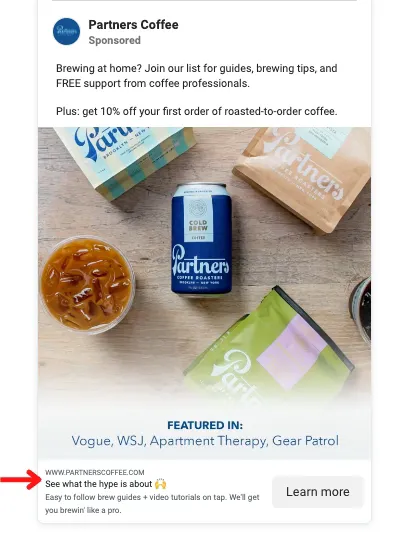
In advertising, reciprocity is the idea that customers feel compelled to return a company’s kind gesture with a purchase.
Partners Coffee offers newsletter subscribers free brewing resources and access to coffee experts for support, plus a 10% off coupon to sweeten the deal.
By giving two generous gifts—free coffee resources and an order discount—Partners Coffee increases the likelihood that customers will reciprocate with a purchase.
Notice how Partners uses its headline and text space. The copy reinforces why customers should sign up by emphasizing how Partners will help them brew like an expert in no time.
Bellwether Coffee: Identify the Problem, Present the Solution
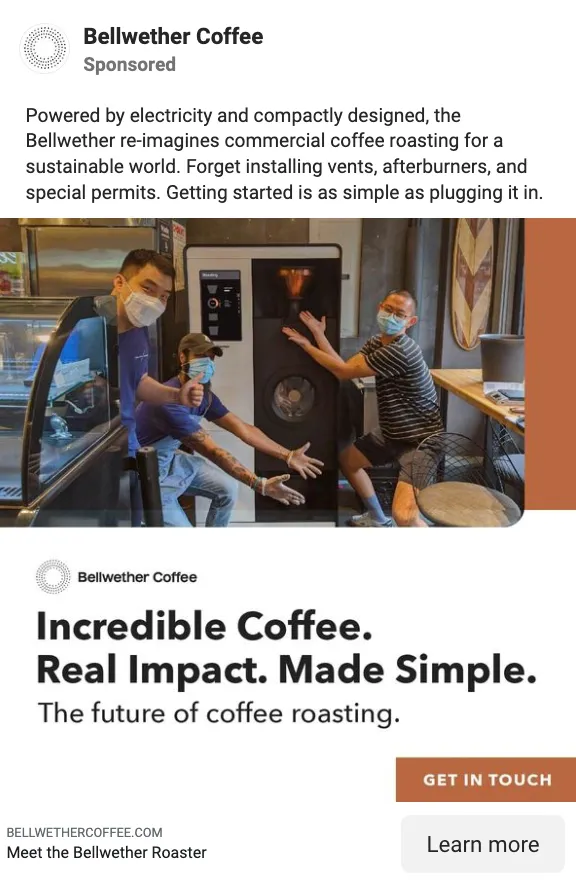
One of advertising’s most basic and powerful tactics is showing how your product or company solves a customer’s problem.
Coffee roasting is complex. Beyond understanding the chemical reactions inside the bean and how to adjust equipment accordingly, a roaster must grasp an entire business and supply process to succeed. Mastering coffee roasting takes substantial time and resources before the first bag of beans can be sold.
Bellwether’s ad communicates why its product solves common roasting problems—including hefty equipment requirements, lengthy training times, and potentially harmful environmental effects. These solutions may appeal to customers who lack the time or space for traditional coffee roasting.
Cometeer: Let Customers Do the Talking
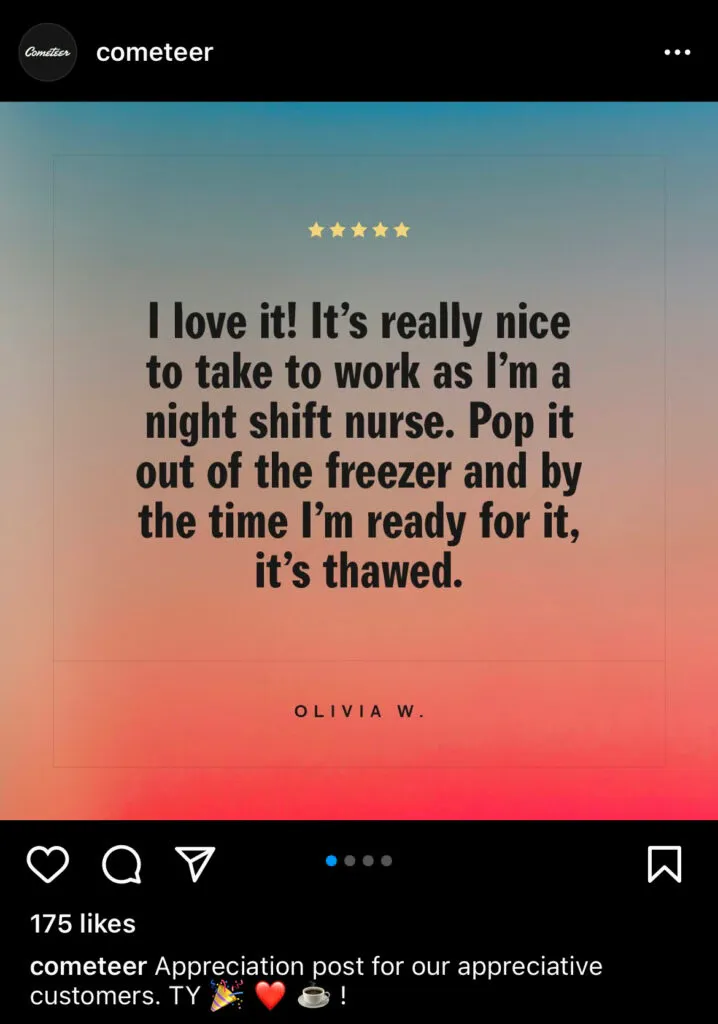
Social proof is a term coined by Robert Cialdini, author of Influence: The Psychology of Persuasion. It refers to looking at others’ behavior to determine the correct course of action in a given situation.
In essence, if we see others doing something in an uncertain situation, we believe it’s the right thing to do. So if we see customers leaving 5-star reviews for a coffee subscription, we’re more inclined to purchase it.
Which statement is easier to believe?
Coffee Company: “Our lightning-fast shipping gets coffee to your door in 24 hours.”
Subscription Customer: “I was thrilled with how fast Company A got the coffee to my doorstep. I was brewing my coffee within 24 hours of ordering!”
Cometeer’s ad works not because of its novel product concept but because of its customer testimonials. These reviews demonstrate Cometeer’s value through social proof from existing customers.
Stumptown Coffee Roasters: Talk About “You,” Not “We”
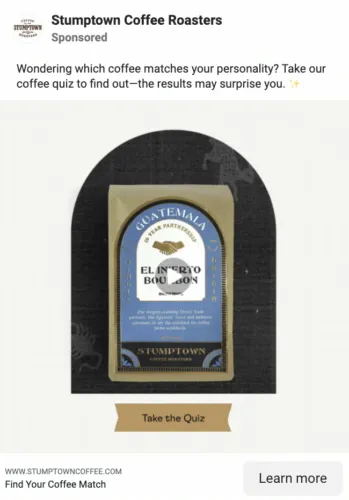
You might think an advertisement is the perfect place to talk about yourself. It isn’t.
Save the “we” talk for your website’s “About” page. Let ads showcase the “how” or the “why” behind your coffee.
Stumptown Coffee Roasters could easily have said, “Look at how many different coffees we sell!” Instead, they used customer-centric language and focused the ad on matching the coffee selection to the customer’s personality.
When devising an ad for your coffee company, avoid shining the spotlight on yourself. Show the value or benefit a customer will receive from your coffee.
For example, rather than saying, “We spend hours on coffee quality control each week,” try something like “Coffee excellence you can rely on for a great morning, every morning.”
Loring: Benefits Over Features

One of the most common advertising mistakes is focusing on a product’s features. Feature-focused ads won’t convince customers to buy—they want to know what benefits those features deliver.
Loring’s ad succinctly and powerfully answers “Why buy an S15 Falcon roaster?” without diving into nitty-gritty details like its vacuum elevator or touchscreen automation.
Through its design and copy, Loring’s ad quickly communicates that this roaster helps customers roast coffee efficiently and consistently.
Stand Out With Your Coffee Ads
Even after more than a century of industry innovation and growth, coffee advertising remains stale. The brands above show how to get your message in front of consumers through creative copy and effective tactics. With so much room for ingenuity while still being strategic, crafting a distinct brand voice—and marketing that supports a cohesive vision—can help you stand out in an often crowded and homogeneous market.
Photo by Jojo Yuen on Unsplash