Beyond the Snob Stereotype: Building Genuine Hospitality in Coffee Shops
The dismissive barista is a handy scapegoat. The real obstacle in many cafés is indifference, not expertise, and the fix starts with who you hire.
By Harper Bailey6 min read

The Persistent Myth of the Snobby Barista
You've likely encountered the caricature: the barista who sighs at your order, the one who treats coffee knowledge as a gatekeeping tool, the listicles and social media posts that paint specialty coffee as a haven for condescension. This trope has become one of the most recognizable exports of the coffee world—and one of the most convenient distractions.
Back in September 2012, even Time magazine weighed in, describing baristas as people who see coffee as "not just a hot beverage to drink in the morning, but as a way of life, an attitude toward the world, a spiritual direction and, most importantly, a passionate political statement about how to strive for a better world." The article then added, "Which is why everybody wants to kill them."
It's easy to believe, after reading enough of this content, that the main threat to independent cafés is a barista who sneers at anyone who doesn't know Yirgacheffe from a hole in the ground. But that's a comforting fiction—one that lets us avoid a more pervasive problem.
The Real Issue: Apathy, Not Elitism
How often have you actually seen the eye-rolling, condescending behavior described in those articles? In my experience, poor service in a café rarely comes from a cartoonish snob. More often, it's someone behind the counter who is simply disengaged—going through the motions, lacking knowledge about the products, and, worst of all, not caring about the people they're serving.
That indifference is the true dividing line between a café with a culture of hospitality and one without. Baristas who genuinely care about their customers make all the difference. It sounds obvious, and it is. So why do so many businesses struggle with it?
Coffee knowledge, experience, and barista skills are great, but if you aren't a friendly, customer-focused person, I'm not going to hire you. Period.
Perhaps customer-service-oriented people are hard to find, or perhaps customer service is difficult to teach to someone who lacks a natural inclination for it. I've taught hundreds of customer service classes over the years, and I've often wondered whether the success of those classes depended on the students' innate tendencies or on my ability to instill hospitality through the material. That question is unsettling, because if the answer is that predisposition matters most, then how do you cultivate a culture of hospitality in a café?
Hiring for Hospitality First
The fact that you're even asking that question is a good sign—it shows you care about your customers and your service level. The answer begins with a foundational step: hire for customer service first. Coffee knowledge, experience, and barista skills are valuable, but they come second. I can train someone to pull espresso shots, steam milk, and pour latte art; that's a relatively straightforward task. What's much harder is training someone to focus on people and genuinely care about them. Customer service skills can be learned, but they're infinitely easier to acquire if the person is already service-oriented—a people person. So the first step in creating a culture of hospitality is to hire people who are already on board with the idea of hospitality, because they will be trainable in ways others are not.
Coffee knowledge only goes so far, though, in a café environment. We sell a lot more than coffee.
Beyond Coffee: Product Knowledge and Customer Connection
Once you have staff who are open to hospitality, the rest falls into place more easily. Certainly, they need coffee knowledge, product knowledge, and—vitally—knowledge of their customers.
This emphasis on service doesn't mean coffee takes a backseat. Without understanding coffee—its story, its origins, how to treat it properly—you'll fail your customers. I want all my staff to know enough about coffee to answer questions in a simple, digestible way. We train baristas on coffee history, cultivation, harvesting, and processing. When a customer asks why a coffee is washed and what that means, they should get a succinct answer that respects them as an adult while acknowledging that most Americans don't know the intricacies of green coffee production. Delivering that requires more than rudimentary training, so we invest significantly in coffee education.
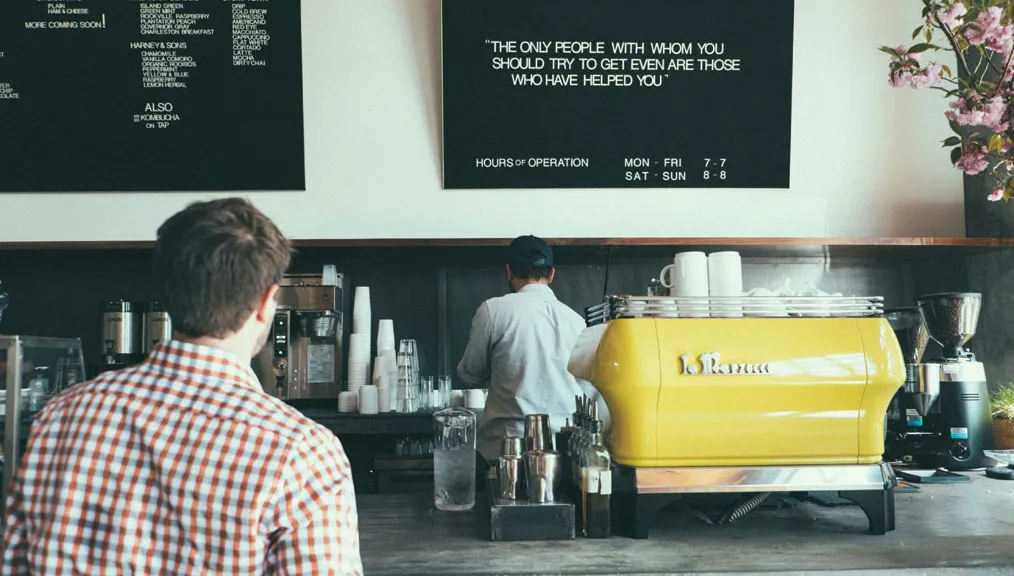
(Photo credit: Jonathan Grado/Flickr. Photo at top: Ababsulutum.)
But coffee knowledge has limits in a café. We sell espresso drinks, pastries, baked goods, retail items, and more. All of these contribute to our business, so staff must know them well. They need to know drink recipes: how we make a mocha, what flavor profile our signature espresso blend has (bright, sweet citrus with a rounded body, if you're curious), what the figgy buckwheat scone tastes like and which coffee pairs with it. They should be able to sell all our products from personal experience—they've tasted them. Empowerment to do that comes from leadership. I cultivate it by encouraging it, because I want the customer experience to be excellent.
Consider two responses to the question, "What does your espresso taste like?" and decide which barista you'd rather buy from.
"It's, uhh, like a concentrated coffee, I guess? It's super strong. I never drink those."
"Good question! Our espresso today is our St. John's Blend, a mix of three coffees from Central America and Africa. It has a citrus flavor, almost like sweet lemon, and a syrupy body. It's strong, but if you're a fan of espresso, it's killer."
Both baristas signaled that espresso is for a particular type of customer, but one sold it. The first knew so little that I'd hesitate to order anything from them. The second knew so much about that one item that I'd feel confident ordering anything.
Knowing Customers by Name
Beyond product knowledge, a hospitable barista needs to know their customers, starting with names. We love to laugh at the misspelled names on Starbucks cups, but my time working there showed me the company's deep commitment to hospitality. Writing names on cups is the start of that commitment, and while it sometimes leads to inaccurate transcriptions, most of the time it makes people feel welcomed.
That connective interaction across the counter can make or break a customer's experience. It's a moment where we communicate that this person is more than a transaction—more than their order and the money we make. They're a human being, and we care. Interestingly, when we treat customers relationally rather than transactionally, we create an environment so attractive they're more likely to return and spend.
Fifty dollars of kindness, offered in a time of need, turned into a lifelong customer who couldn't wait to share us with her friends and family. We became "her coffee shop."
Almost ten years ago, at a café in Folsom, California, I was on an opening shift with Anna, one of my lead baristas. It was early on a Saturday, so we were slow. A minivan pulled up, and a woman walked in barely holding it together—clearly distraught. She ordered upwards of fifty dollars' worth of drinks and baked goods. As we started putting it together, Anna asked, "Is everything okay? Are you having a rough morning?"
The answer came through sobs: she was on her way to her brother's funeral, her first time in our shop, and her whole family was waiting in the car. His death had been unexpected, and she didn't know what to do or say.
To this day, I get choked up remembering Anna's response: "Oh, wow. It sounds like you're dealing with enough today. Please don't worry about paying for these drinks and pastries. We'd like to take care of it for you."
With those few sentences, a transaction became a connection, and that connection became a relationship. We had never seen this woman before, but afterward she came in multiple times a week, every week. That fifty dollars of kindness, offered in a time of need, turned into a lifelong customer who eagerly shared us with friends and family. We became "her coffee shop."
Why? Because we had a barista who cared about her customers.
Rewriting the Story
The narrative about snobby baristas and bad service may linger in our industry, perhaps forever. First impressions are hard to shake, and our industry is still making plenty of them. But you don't have to be part of that story. You can write your own story in your café for your customers today. You can make someone's day and begin creating a culture of hospitality one customer at a time.
The only way to change the story is to rewrite it ourselves.