Leon Bedoya and the Daily Work of Pricing Colombian Coffee
A look at the co-op buyer who grades growers' beans, sets their payments and carries news between farms and the institutions that govern the trade.
By Casey Adams9 min read
On an April day in 2013, a friend left me at the coffee purchasing warehouse of the De los Andes Cooperativa — Cooperandes — in Ciudad Bolivar, Antioquia, Colombia. A man in jeans and a polo shirt rose to meet me. He introduced himself with a joke about his name: “I'm Leon, but don't worry, I'm a tame one!” The laugh that followed sat comfortably alongside his professionalism. His handshake was as firm as any businessman's, and he told me to put away my pen and paper and take a seat at his desk. A desk lamp lit the black Formica countertop, where a heap of green coffee lay waiting to be sorted for defects. “You'll only learn what goes into buying Colombian coffee if you try it for yourself,” he said as I settled into his chair.
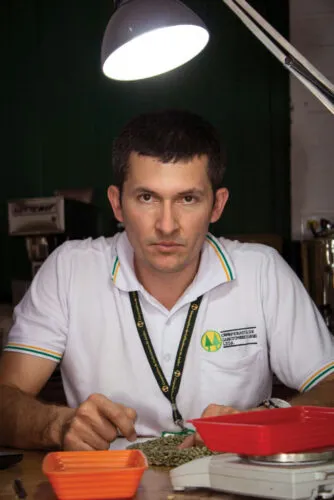
Leon Bedoya at his desk at one of De los Andes Cooperativa's warehouses in Antioquia, Colombia.
At Cooperandes, Leon buys dry parchment coffee from growers in the region. In practice the role reaches much further: it involves the social, agricultural and environmental realities of the area's coffee culture, Colombia's national coffee policies, international certification bodies and commodity futures on New York's Intercontinental Exchange “C” market. His desk offers a rare vantage point from which the financial and agricultural ends of the industry can be watched at once.
Cooperandes is one of four producer cooperatives in Antioquia, Colombia's largest coffee-growing department. All of them work closely with the National Coffee Growers Federation, known by its Spanish acronym FNC — a guild of elected representatives that, at least in theory, speaks for the country's more than half a million coffee-growing families by administering government subsidies, marketing Colombian coffee abroad and leading various development programs. The FNC also regulates coffee exports and sets out how exporters should operate; Antioquia's co-ops are among Colombia's largest exporters.
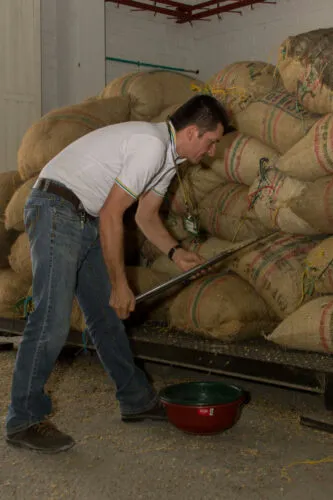
Equipped with an ordinary desktop computer and a few distinctive tools — among them a well-worn hollow metal sampling spear — Leon stands at one of the coffee world's gates. During my stay in Bolivar he was my tutor in the Colombian coffee trade. He follows the rules of Cooperandes and the FNC, yet the exact price a producer receives rests literally in his hands: he inspects the green beans for defects and on that basis adds a premium or applies a penalty for quality. The receipt he produces shapes a family's budget. He brings news of good and bad prices. He passes producers' concerns on to the coffee organizations and gathers data for the co-op and the FNC — a kind of coffee Hermes moving between the growers' world and the coffee Olympus.
 Among the FNC policies most relevant to Leon's work is the purchase guarantee. Acting in one of its many capacities as an exporter, the FNC promises to buy 100 percent of any producer's coffee — whatever its quality — every day of the year. It provides the financing that lets co-ops carry out that guarantee (an independent middleman would not be bound by the FNC's promise). Price varies with the quality of the coffee — and Leon's job shows how exacting Colombia is on that point — but a stable, transparent market for every Colombian grower on every day of the year is something coffee producers elsewhere in the world, outside Brazil, can only dream of.
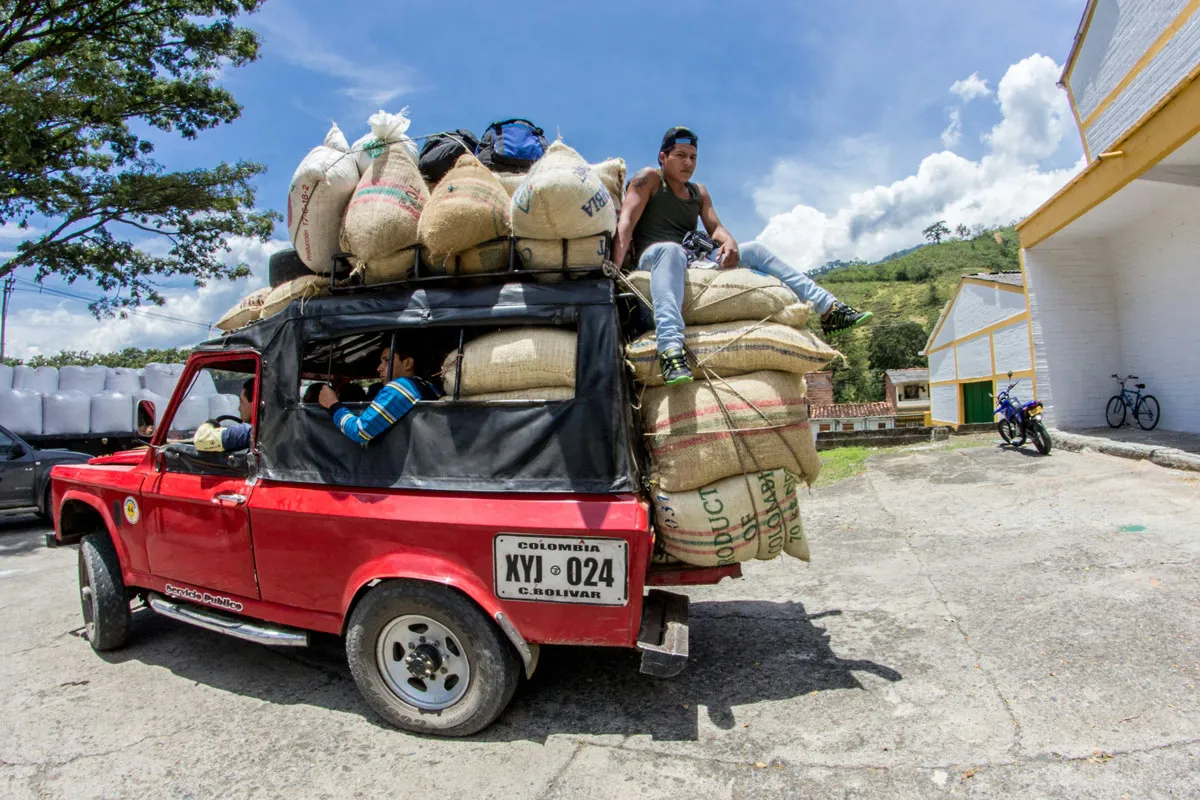
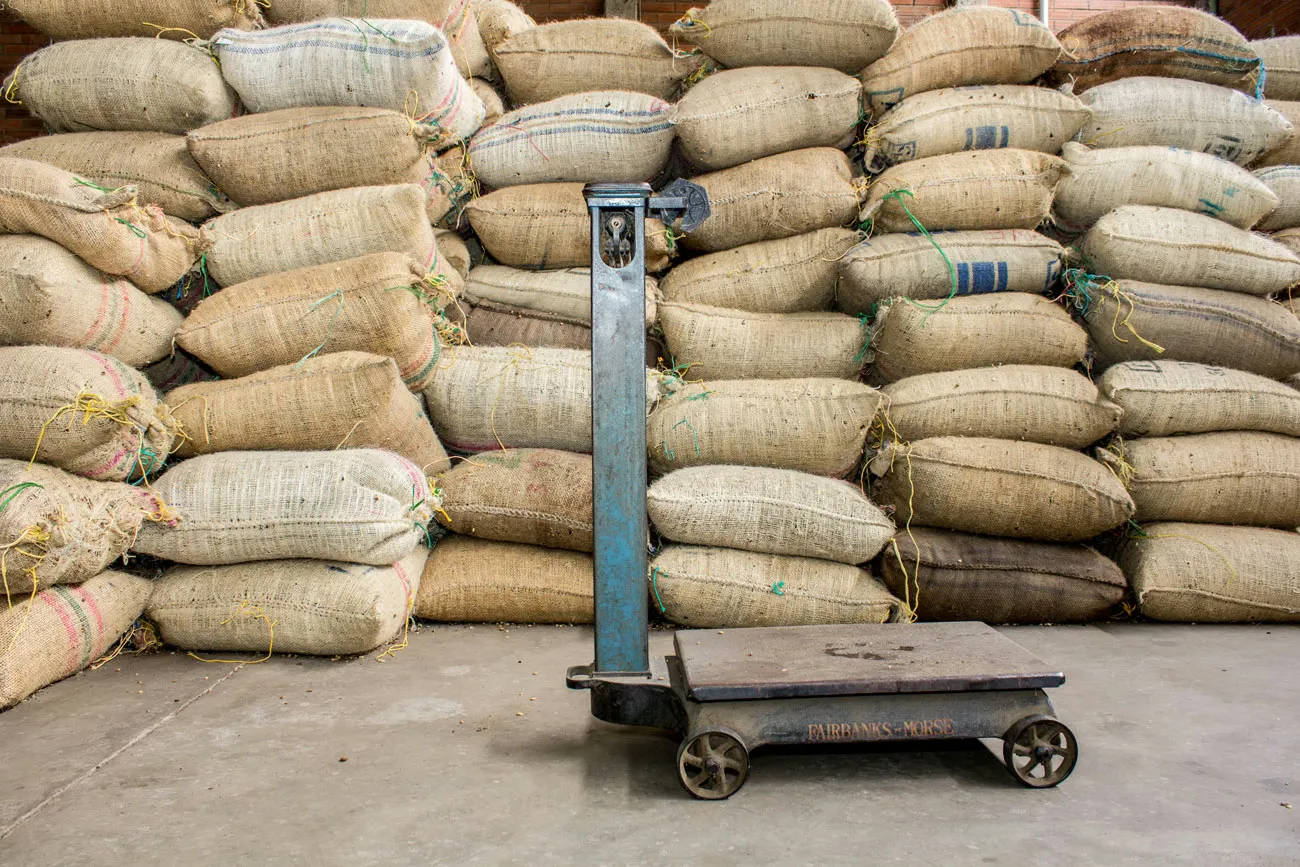
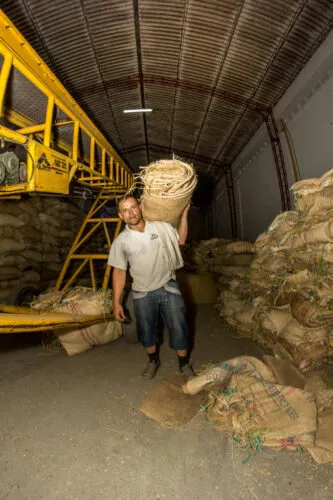
Coffee arrives at the warehouse by Jeep, truck and car, packed onto buses, slung over the backs of mules and sometimes carried in by the producers themselves. A delivery can weigh a kilogram or 30,000 kilograms, Leon says. Once it reaches the warehouse, the co-op's strongmen lift the sacks off the vehicle and onto the scales, then off the scales and into a designated section. After weighing, Leon's job is to thrust the sampling spear into each sack and draw beans from every bag. The beans pulled from the bags are blended into a quarter-kilo sample.
“This is where we evaluate the quality of the coffee, to reward producers if it's excellent quality coffee or reduce the price according to the exact percentage of defects. . . . After analyzing the coffee, we verify if the producer is enrolled in any special program of verification or certification. We proceed to store this coffee in the appropriate bay so that there's a traceable chain of custody. For every kilo that a producer turns over to the co-op we generate a receipt. This helps us have better traceability for the product so that we know how many kilos a producer sold, the value of each kilo, and the total value the producer was paid for that coffee,” he says. “We do the same process for every producer, whether for one, ten, or 100 kilos of coffee.”
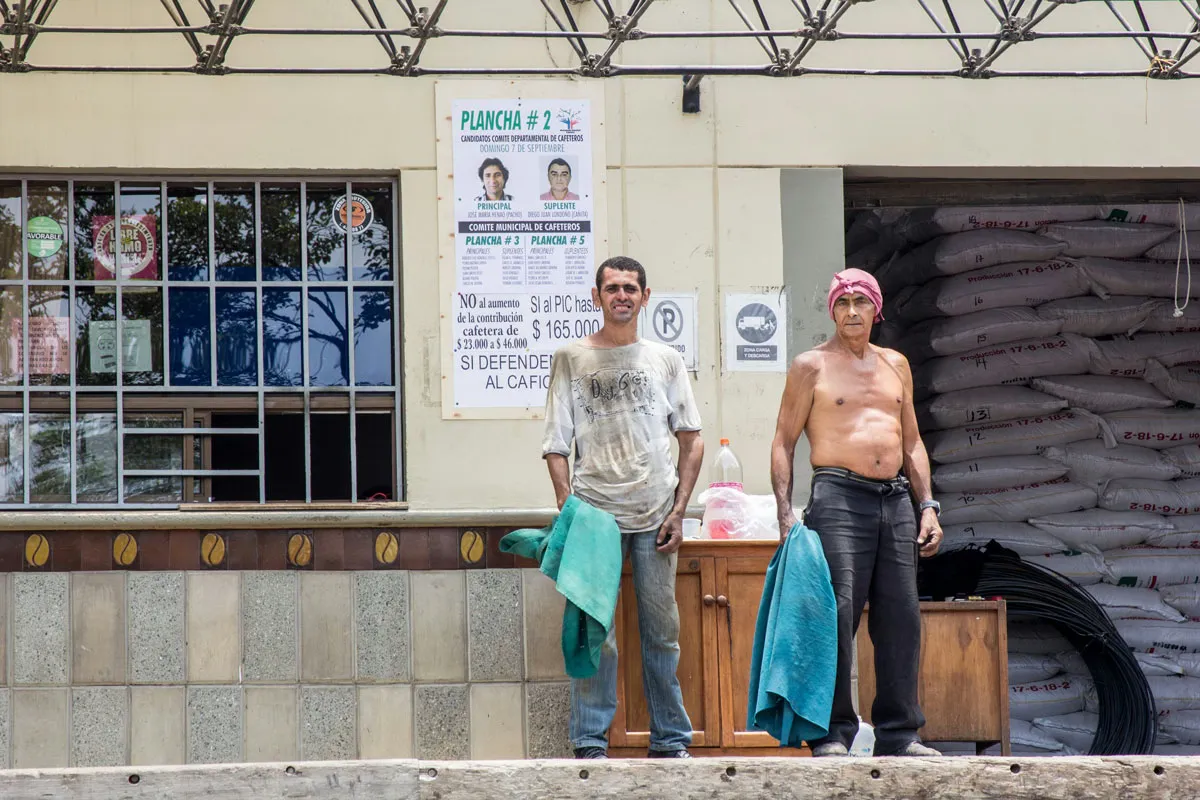 He says “we,” though he alone performs all the work he describes. Many other Leons across Antioquia fill the same role, and his pride in belonging to the co-op family leads him to speak consistently in the collective tense. That pride also comes from his place in the coffee business. “Producers are carrying on with their cultural labors, because producing coffee is a question of culture. If producers don't have the culture of coffee growing, then they aren't caficultores,” he says, using the Spanish word — really the perfect word — for coffee growers. “Coffee is a way of life that takes years to learn.
Producers have to like the work; if they don't they can't call themselves caficultores. They have to understand that it's a perennial crop, one that takes at least two years to produce a harvest; they have to understand the months of patience necessary. It's a cultural question. One of patience, one of passion.”
He was raised with that passion. “My father is a caficultor; he's been a caficultor his whole life. His farm gave us our education. We're five siblings, two women and three men. Both my parents are still alive, and my dad spends every day still going up to the farm, doing little jobs there. When I have free time I help him; it's something we grew up with and from which we've lived. It's something that deserves to be loved and we're all very proud of it.”
Antioquia holds both extremes of Colombian coffee production, from large estates to tiny plots. Cooperandes' general manager Juan Rendon says that 600 of the co-op's 3,600 landholding members — the largest and the smallest among them — fall under the immediate jurisdiction of Ciudad Bolivar and Leon. He receives heavyweight local estate owners and humble farmers tending small family plots alike.
 Co-op buyers stay current on official mandates from the co-op and the FNC and understand how global factors such as international markets affect the price and the pace at which coffee leaves the warehouse. At the same time, regular direct contact keeps them attuned to what is actually happening on the farms — an advantage that administrators higher up in the co-op and the Federation do not have.
“We have to interact with producers in a very friendly way so that they feel happy to be selling to us and proud to be here, in the co-op. It's my job to make them feel well taken care of. They tell us stories of their farms, how production is going, if trees are affected by any insect or disease attack, like broca or roya,” says Leon, using the Spanish terms for the coffee berry borer beetle and leaf rust. “They ask us what we recommend to treat the problems, and we send them to the co-op's technical assistants so that they can help them troubleshoot, so that they can have a good, quality harvest.”
Many co-ops and exporters have begun teaching producers to cup, so that growers can see for themselves how defects and good farm management show up in the cup — though it may take a generation before producers with cupping experience become the norm. While that change unfolds slowly, Leon helps shorten the coffee learning curve. A brochure may state that over-fermentation degrades quality, but buyers can confirm such points from firsthand experience and explain them in plain language.
Their role goes beyond agricultural advice. “We practically become emotional advisors, comparable to a psychologist or something!” Leon says. “Everyone tells stories of their families, problems they had out in the fields, with workers on the farm, or beautiful experiences working in the mountains where they were born. Culturally, that's where producers are rooted, where they've raised their children. Some have sent their kids to university with coffee.”
 That relationship carries an inherent tension. Once coffee crosses the buyer's desk, it no longer belongs to the people who grew it; it belongs to those who will sell it. The moment always brings some anxiety for producers. They want a high price, but they are also desperately hoping the quality will at least allow them to break even — something coffee very often fails to do.
They do not show it. Producers walk into the co-op with confident bravado, declaring, “Just you wait! This will be the best coffee you've graded all day—zero defects!” while often holding their breath that the quality will at least be on par. Complaining and groaning while the buyer evaluates the sample is a required producer pastime, like the banter of haggling in a bazaar. Producers will feign disgust and cry, “But that's not a defect! You're trying to rob me blind!” and then be quietly pleased that their coffee earned the price it did. Leon enjoys the game. “Buying coffee is an art that you learn, and I like to interact with people. I like the daily dialogue. I like sharing my days with producers,” he says.
“The price has to be fair and objective. The producer has to be able to make enough to tend to the farm and have some sort of profit. It depends on the time of year he sells his coffee, because there are times when the price drops really low, and that kind of economy affects everyone.” At the time of my visit, coffees arriving at the warehouse could earn $1.46 per pound, a level Leon says the farmers were happy with. A year earlier, they could bring in less than seventy-five cents per pound. “Many producers wanted to close their farms, sell their properties, move onto something else,” says Leon. “But now that there's been a rally in prices, they're calm, back to work, happy.
 The Leons of Colombia's buying warehouses serve as butlers at the threshold between producers and global markets. They are the front-of-office faces, building the company's name through their personalities and genuine friendships with producers, and the back-of-office record keepers, logging data that over time yields a farm profile showing how production levels, the timing of peak harvest and market swings connect.
Buyers are also the front line for putting into practice new co-op initiatives devised in response to purchasing trends among international roasters. Leon, in his white monogrammed polo shirt, is about to change how this part of Colombia grows coffee.
Co-ops typically do not taste an individual producer's coffee before buying it, because everything is blended at the central mill before being hulled and sorted for export. Yet the search for the highest-quality coffees cannot rest on physical analysis of the beans alone; coffees must be cupped to reveal their attributes. The co-op has seen what is commonplace in first-world cafés: specialty roasters will pay for micro-lots that show something special.
Leon's branch is the first Cooperandes warehouse to cup its producers' coffees. That gives the co-op a chance to identify micro-lots it can sell at a premium, and it gives producers the chance to earn additional premiums, learn what their coffee actually tastes like and see how it measures against international standards.
“Grading based on sensory analysis motivates the producer to be even more attentive to quality, and it lets us be even more confident selling to our buyers. We can be even surer that the coffee Cooperandes exports has all the attributes of coffee grown here in the mountains of the Andes region of Antioquia,” Leon says.
As Leon cups samples and awards premiums, he is an emissary of quality, spreading the message that better coffee pays better. His cupping desk is proof that consumer demands can shape the market and in time do reach all the way to producer organizations and their members.