When Coffee and Cannabis Share the Same Table
From Amsterdam's long-standing coffeeshops to a Raleigh hemp bar, businesses are blending caffeine and cannabis—and redefining what a social hangout can look like.
By Reese Ross7 min read
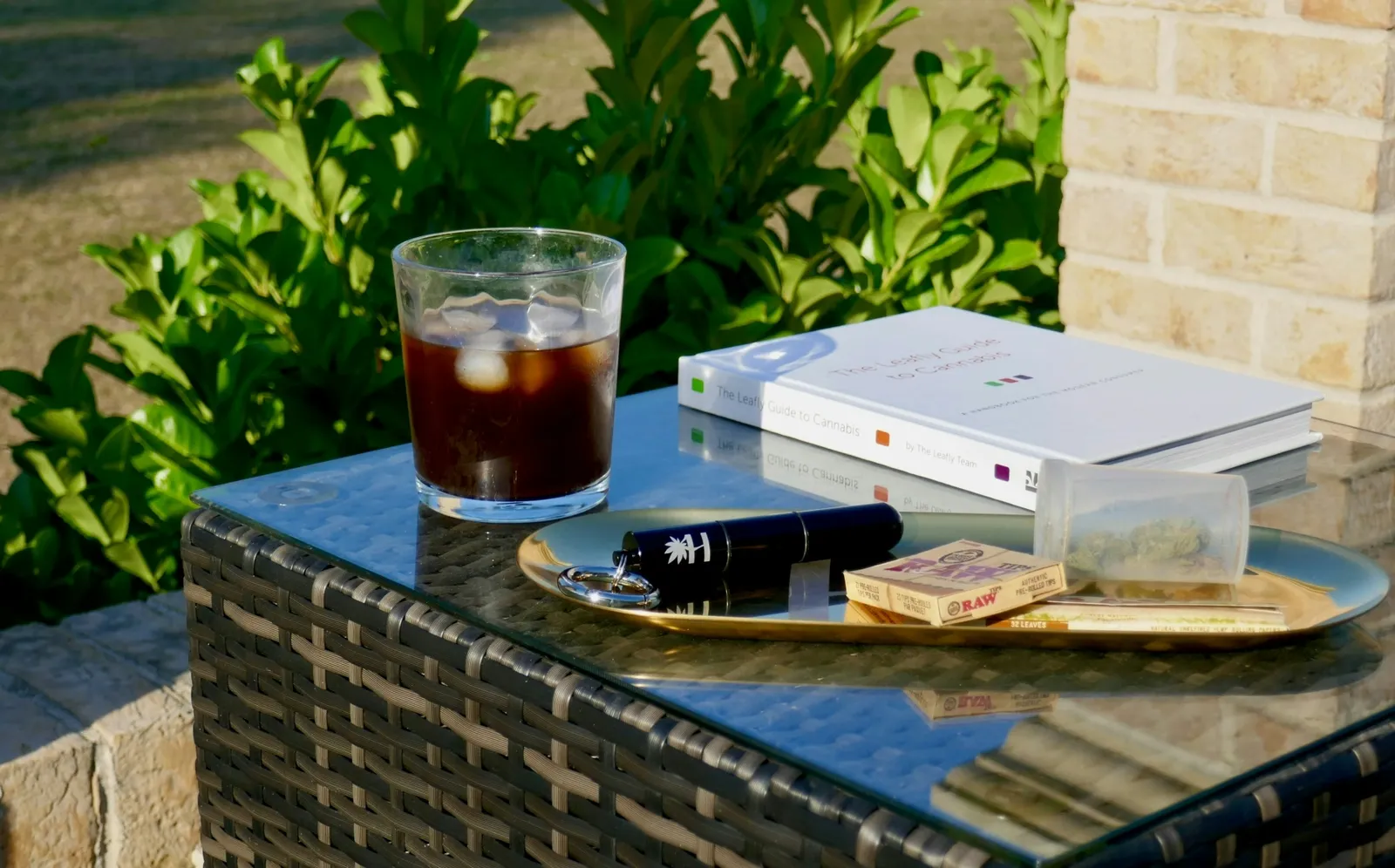
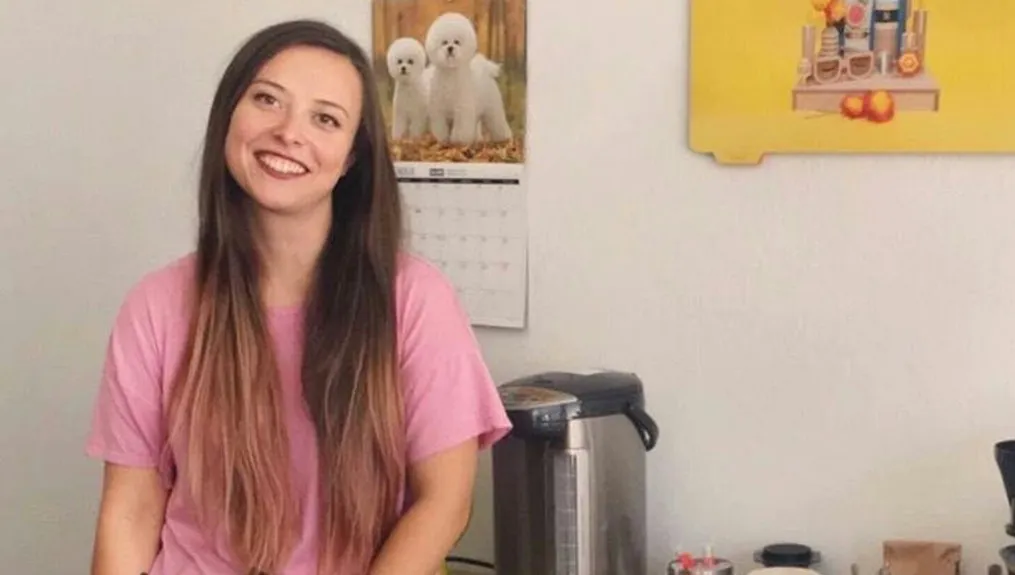
Most mornings, Ashley Keenan adds cannabis to her coffee.
The Canada-based journalist and content strategist doesn’t stick to one method. Some days, she pours a flavorless THC emulsion—packaged to resemble a sugar sachet for convenience—into her mug. On other days, she squeezes CBD-infused honey from a pre-measured straw into her tea.
Keenan has used cannabis medicinally for close to a decade. “Cannabis helps treat my chronic pain and neuropathy and keeps me off prescription medications with a laundry list of side effects,” she says. She is hardly alone: many people turn to products containing tetrahydrocannabinol (THC) or cannabidiol (CBD) to address pain, mental health, and everyday stress.
Coffee and cannabis share more than a casual connection. Both contain compounds that exert wide-ranging effects on the brain and body—and while coffee won’t make you “high,” overconsumption can leave you jittery. Each industry also has what might be termed “conventional” and “specialty” tiers, with cultivated strains and noticeable differences in quality and traceability.
Coffee has long been the more widely consumed of the two, but a walk through New York City, Seattle, or Las Vegas makes clear that recreational cannabis use is increasingly common. As of 2024, 24 U.S. states, the District of Columbia, and two U.S. territories permit recreational consumption. (At the federal level, cannabis remains a regulated Schedule I drug.) Internationally, Canada, Thailand, and Uruguay have legalized commercial cannabis sales nationwide—though Thailand may reverse that decision—and many other countries have legalized or decriminalized recreational use.
This growing acceptance has led some coffeehouses to experiment with serving both products, but pairing cannabis and coffee is not new. In Amsterdam, “coffeeshops” have sold cannabis alongside coffee since the 1970s. In the U.S., CBD-infused drinks began appearing on cafe menus in the mid-2010s, and shifting regulations continue to reshape the cannabis beverage market.
Coffee’s second wave turned cafes into an informal emblem of leisure. Now, cannabis’ rising popularity is likely to influence how people engage with—and what they consume in—the classic “third place.”
Not Your Average Amsterdam Coffeeshop
In the Netherlands, a “coffeehouse” (koffiehuis) is not the same as a “coffeeshop.” The former sells coffee and light fare; the latter is an establishment where visitors can purchase and smoke weed or hash and eat cannabis-infused edibles.
The term “coffeeshop” originally served as a cover for cannabis sales before decriminalization in 1976. The Dutch government permits the roughly 560 remaining licensed coffeeshops to sell cannabis products under strict conditions—such as limits on noise and on the total amount of cannabis on the premises. Commercial cannabis is otherwise illegal nationwide.
Abraxas Coffeeshop in Amsterdam also offers coffee and other non-alcoholic beverages. “Both our cannabis and drink menu reflect our high standards for quality,” says Abraxas CEO Kaya Ardic. From soft drinks to cannabis strains, Abraxas sources from local vendors whenever possible. While some strains come from Thailand and the U.S., “we’re focused on working with Dutch growers,” Ardic says.
Ardic’s parents founded Abraxas in 1992; the original location is just a one-minute walk from its current site in the city center. “My mom and dad put up a bar and invited all the artists in the neighborhood. It was like an art exhibition and cafe in one,” he says. Over the years, Ardic encouraged his father to learn more about sourcing and storing cannabis, and eventually his parents passed on the baton.
At Ardic’s iteration of Abraxas, “All our drinks come in nice glasses, but you’re allowed to light up a joint and enjoy a spliff.” Of the interior—designed by his mother to look “a bit witchy”—he says, “It doesn’t feel like a dark hole with loud music. We have an open atmosphere and natural light, good vibes and happy music.”
Consequently, visitors are often taken aback that smoking indoors is permitted. “Nine out of 10 times when people come in, they ask, ‘But where do I smoke this?’ And we say, ‘Right here.’ And they say, ‘No way, that’s ridiculous,’” Ardic laughs. “We’re a very attractive shop for first-timers,” he says, many of whom learn about the place by word of mouth.
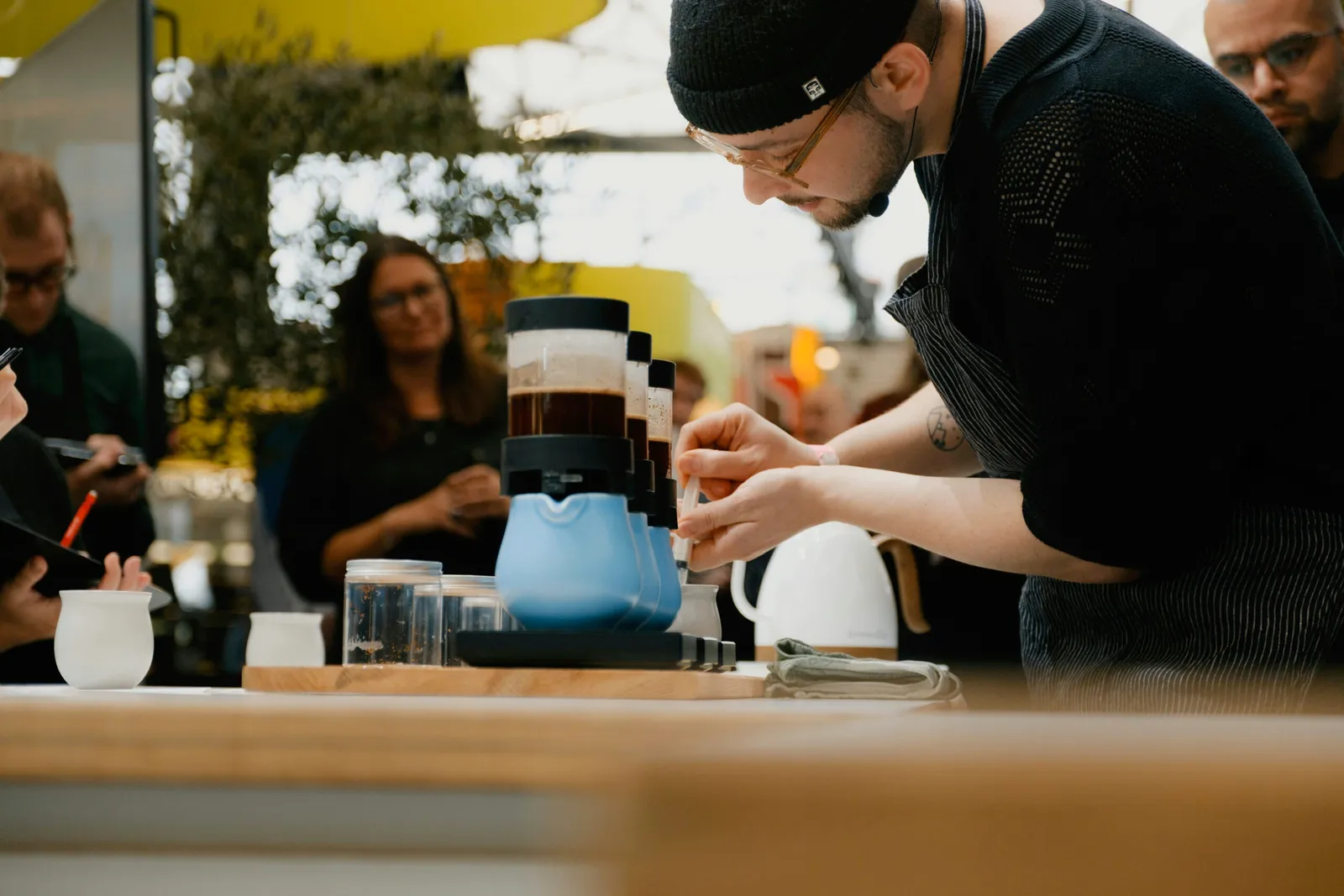
The coffeeshop does not neglect its coffee, either. Ardic says Valentina, one of the bar managers, “is doing wizardry with the coffee machine.” Her efforts inspired the rest of the team to start a friendly latte art competition, and customers frequently post photos of their espresso drinks on Instagram.
How people choose to combine cannabis (which can act as both a stimulant and a depressant) and caffeine (a stimulant) varies greatly from person to person. While animal studies have examined the interaction between caffeine and THC, human research remains scarce, leaving many to rely on anecdotal accounts.
“If you smoke something more relaxing, like an indica,” Ardic says, referring to a strain associated with calming effects, “and drink a coffee, I think it would balance out.”
Dispensary Meets Cafe
Eric Stahl of Modern Apotheca, a dispensary in Raleigh, North Carolina, believes coffee and cannabis can complement each other. “As an avid user of both, I find that caffeine helps counteract the sleepiness often associated with cannabis,” he wrote in an email.
His wife, Corey Stahl, uses cannabis to manage an autoimmune condition. That was one of the couple’s motivations for opening The Burnt Pot Cafe, which is the only Alcohol Business Control-certified private hemp bar in North Carolina. Customers must be 21 or older to partake. “This designation allows us to serve infused beverages in a controlled and compliant environment, setting us apart as pioneers in the industry,” Stahl writes. The Pleasure Med dispensary in West Hollywood has a similar concept: its Irie Restaurant offers a private dining room where cannabis consumption is permitted.
For those who prefer not to sit in a smoke-filled cafe, edibles provide an alternative. In the U.S., the THC potency of products sold by licensed dispensaries is regulated by individual states; however, the 2018 U.S. Farm Bill made it possible for commercial businesses such as liquor stores to sell low-dose, hemp-infused beverages even in states where cannabis is not recreationally legal, like North Carolina.
State-level regulations are actively evolving. For now, such businesses must operate within a strict regulatory environment, which includes ensuring products meet the Farm Bill’s legal threshold of less than 0.3% THC—a hotly debated provision that has been extended through at least 2026.
A decade ago, businesses that wanted to experiment with substances like CBD had to add CBD oil directly into brewed coffee; the oil would float on the surface without mixing, muting the effects. Today, The Burnt Pot’s menu features “cannaccinos” (hot drinks) and “PotTails” (cold drinks) with THC- and/or CBD-infused syrups and spirits as the base. The Stahls contract-manufacture a ready-to-drink, hemp-infused seltzer called PotTails, also used to create seasonal variations on Starbucks drinks.
Stahl says The Burnt Pot’s community focus is central to its success. “While the dispensary is consultative-driven and focused on education, it doesn’t lend itself to a ‘hangout and chill’ environment,” he says. The cafe, by contrast, “is a space to gather, share experiences, and explore the world of hemp together.” The Burnt Pot hosts events such as comedy shows, trivia nights, and specialty art classes like “Puff, Puff, Paint.”
Keenan understands the need for such a space. She has been reporting on cannabis since 2018, when recreational cannabis was legalized in Canada, but says consumption still faces considerable stigma. Although medical use has been legal in Canada for more than 20 years, “it can feel like cannabis consumers are still stuck in alleyways and dark corners. If it remains hidden, it remains taboo.”
Keenan used to visit a Toronto cafe called the Hot Box, which allowed customers to consume cannabis products alongside coffee and tea and play board games. However, the establishment was sold after cannabis was legalized. “When I was at the Hot Box, I felt so normal,” Keenan says. “I think there would be a lot less stigma if infused beverages were allowed in restaurants and cafes.”
A New Take on Leisure
Legal cannabis is attracting more interest, but its complicated history deserves attention. As Christina Cassidy, a sociologist and cannabis educator known as The Canncierge, wrote on Instagram in 2022, “The weed INDUSTRY sprung from the CULTURE, not the other way around. Folks new to our subculture, welcome! But please remember, respect and advocate for those who’ve been shamed, jailed, and maligned for their membership, unknowingly building the underpinnings of the access we enjoy.”
Historically, cannabis use has been disproportionately criminalized in Black communities, even though Black and white people partake at similar rates. Today, it is easier than ever to walk into a well-organized, beautifully designed dispensary on a whim—a luxury experience that can feel jarring when many people of color are still imprisoned for possession.
Though more work is needed to make the cannabis industry (not to mention the coffee industry) more racially equitable, decriminalization is slowly changing the tide. It is also making cannabis available to the formerly skeptical.
If regulations loosen and adoption rates continue to rise, we may well see more cafes offering cannabis edibles in the pastry cabinet or hemp-infused drinks in the grab-and-go cooler.
Beyond building common ground for the cannabis and coffee industries, this could help enthusiasts of both find community. “To be able to have an infused drink with dinner while your partner has a beer? Sipping an infused coffee in a cafe?” says Keenan. “That would be bliss.”