The Consistency Game: Rethinking Tamping for Better Espresso
Why repeatable pressure beats perfect technique—and how to make tamping a non-issue in your espresso routine.
By Elliot Lewis4 min read
“I will never be able to do this well,” I confessed to my trainer, fully aware that my words hardly inspired confidence. The task in front of me felt genuinely intimidating: take a lump of metal, press it into a bed of coffee grounds, and do it so precisely that the espresso would extract evenly, beautifully, and quickly—then repeat that exact motion over and over.
She slid something across the counter. “Here, try this.” It was an analog bathroom scale. For the next ten minutes, I practiced tamping on that scale until applying exactly thirty pounds of pressure became second nature. Thirty pounds was the magic number: any lighter and the espresso tasted watery; any heavier and the machine seemed to dispense ink fit for a fountain pen.
A whirlwind of research, anecdotal evidence, and a desire to be different has led to a sort of Wild West approach to tamping in our industry.
In the years since that day, a whirlwind of research, anecdotal evidence, and a desire to be different has led to a sort of Wild West approach to tamping in our industry. Practices vary enormously—some baristas don’t tamp at all, others tamp quite firmly, and many rely on a specific device. Espresso machine manufacturers promote their equipment’s ability to produce excellent espresso without tamping, while new tamper makers regularly appear, claiming their tools work so well that you barely need an espresso machine. Hyperbole? Perhaps, but only slightly.
For a café owner, manager, or barista, this glut of conflicting information might tempt you to repeat the old refrain: “I am never going to be able to do this effectively.” But take heart—you will be able to.
Tamping, like grinding and dosing before it, demands consistency. However you choose to tamp, as long as you execute it consistently, you can produce excellent espresso. I’ll share some general truths about the goals and pitfalls, and then explain how I like to do it. Whatever method you adopt, just be consistent.
Tamping properly dosed loose grounds into a solid puck does two important things: it slows the water passing through the coffee, allowing more contact time (and thus more extraction), and it creates uniform density throughout the coffee bed, ensuring even extraction.
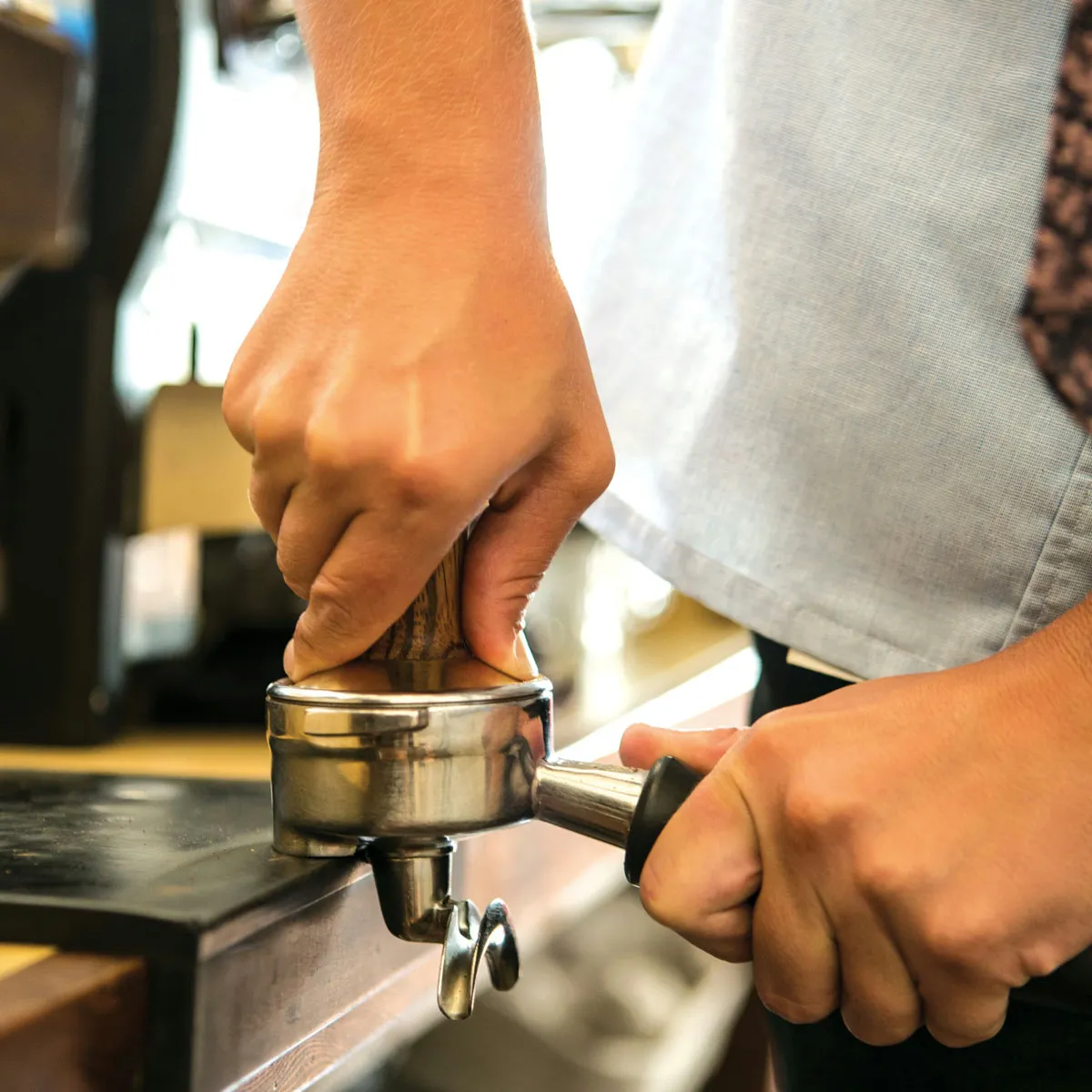
I hold my tamper the way I would hold a flashlight or a doorknob. Then I rotate my entire arm so that the flat base of the tamper is parallel with the counter. This forces me to use my whole arm in the tamping motion rather than just my wrist (which can happen if you grip the tamper like a rubber stamp). It’s far more ergonomic and lets me tamp with consistent pressure without straining my wrist. While thirty pounds is a good standard, I don’t insist on it during training. The exact pressure matters less than the consistency.
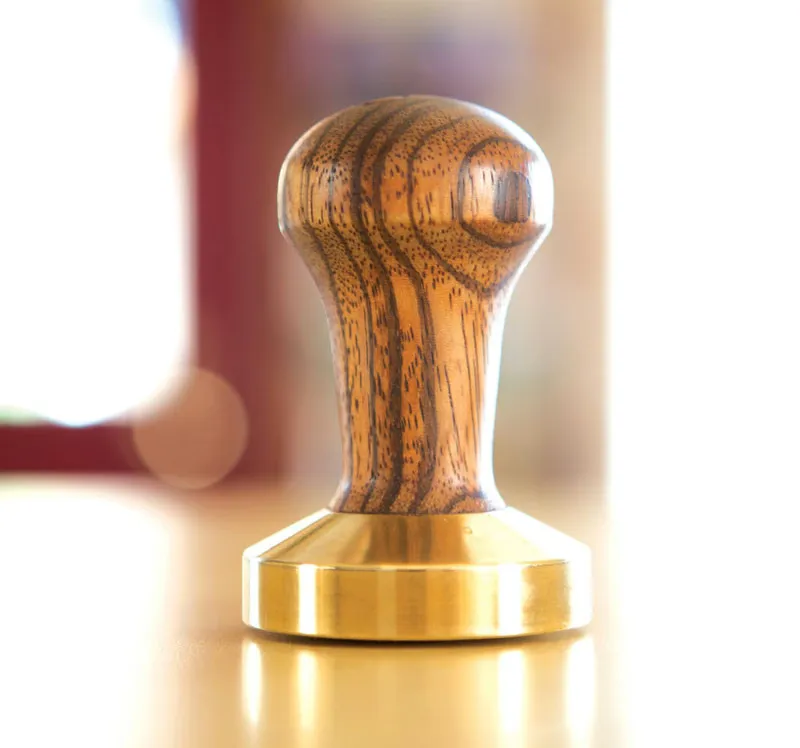
The actual tamping process involves a single, level press straight down into the coffee bed. There’s no need to press twice, twist, or tap the portafilter with the tamper. All those extras introduce more variables that might ruin the shot. This matters because when I evaluate my espresso, I want to manipulate as few variables as possible to reach an excellent shot. The more things I change, the longer it takes to get there.
You can alter how quickly your espresso shots pull by changing your tamping force. This is not recommended, as it is nearly impossible to reproduce with machine-like consistency. For instance, if your espresso is pulling too quickly, we know extraction is low, and you could be producing a watery shot with unpleasant flavors. You might just tamp the next shot much harder, and it would pull slower. Problem solved, right? Not really. How much harder did you tamp? Can you tamp with exactly that much pressure for the rest of the day?
Instead, adjust your grind size to address the issue. Your grinder is designed to allow minute, repeatable adjustments that make consistent changes to your espresso. Your arm—however nice it may be—is not a precision pressure applicator and cannot make tiny adjustments with the same consistency as a machine.
By tamping consistently—as best you can, and this is a skill that develops—you can virtually eliminate tamping as a variable in your espresso-making process. A firm, level tamp with roughly the same pressure each time should yield reasonably consistent results. When something goes wrong with how shots are pulling, I can safely adjust the grind without worrying too much that another factor is altering my extraction.
Effective tamping is attainable, not scary or out of reach for most baristas. When we remove some of the rigidity and “flair bartending” movements from the process, it fits much more naturally into the steps of creating amazing espresso. You, like thousands of baristas around the world, will confidently be able to say, “I am absolutely going to be able to do this effectively.”