When Espresso Training Teaches the Wrong Lesson
A barista trainee's shot reveals how informal knowledge can override careful extraction practice—and what proper pump engagement actually looks like.
By Morgan Wood4 min read
The trainer—confident in her method—let out a heavy sigh and started over.
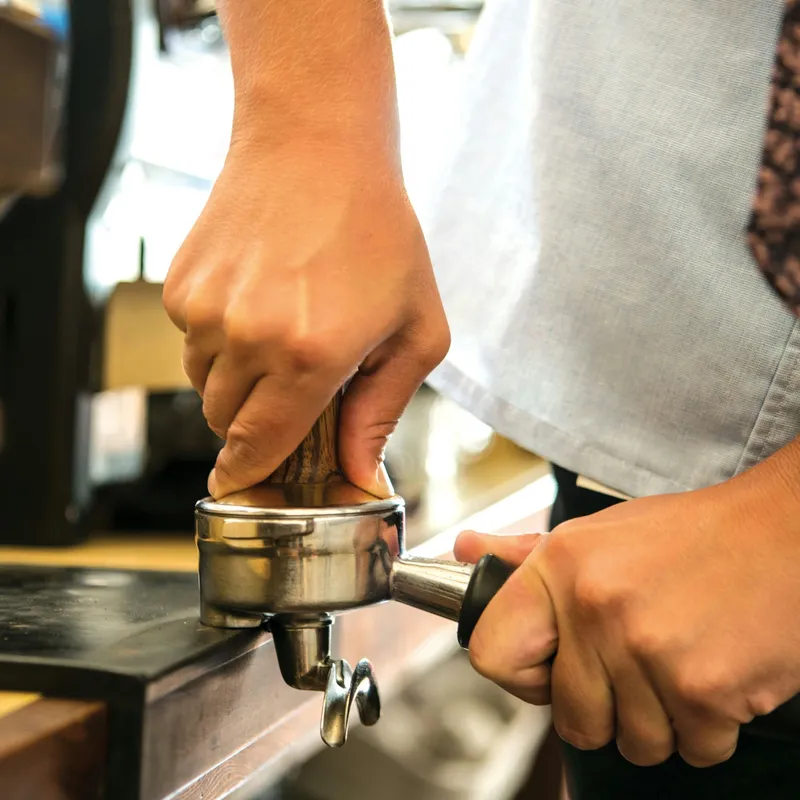
“No. You dose the coffee like this, then you tamp it, then you hit the side of the portafilter with the tamper like this, and then you put the portafilter into the machine.”
The trainee looked young enough to still be in high school. He appeared overwhelmed but gave it another try. This attempt seemed to go more smoothly, and he managed to lock the portafilter into the small single-group espresso machine. He pressed the button. Right away, a milky liquid the color of orange juice came rushing out of the portafilter spouts.
“Perfect!” his trainer said. “That’s exactly what we want. When you push the button, it should come out fast and kind of spurty like that. That’s called crema. The whole thing doesn’t take more than ten or twelve seconds to happen.”
After about ten seconds, two one-ounce shot glasses were full, the boy pressed the button again, and the flow stopped. He looked genuinely pleased with himself. He picked up one of the glasses, poured it into another cup, and looked at his trainer expectantly.
“Sure, you can try it,” she said.
He took a sip and his face twisted in disgust. “It’s terrible,” he said.
“Yeah, it’s pretty gross. I don’t know why some people order it straight like that. It needs milk and sugar for me to even think of drinking it. Well, I’ve taught you everything, and you seem to have it down. So from now on, if anyone needs an espresso, I’m going to have you make it. OK?”
“OK!” he said. He was ready.
I ordered a sandwich and sat down. I would have no coffee today.

Looking back on that episode, I often think about what it illustrates. It isn’t so much a case of training gone wrong as an example of misinformation taking hold. During my time at Starbucks, we made a point of watching for “tribal knowledge”—those subtle bits of information passed from barista to barista with no source or authority behind them except, “This is how we do it.” “This is how we do it.” It’s such a dangerous sentence, especially when it replaces watchful attentiveness as the primary method for assessing espresso extraction.
Which brings us to espresso extraction.
For months, this column has discussed proper coffee storage, good grinding, accurate dosing, and consistent tamping. The final step with this well-prepared portafilter is to lock it into the espresso machine’s grouphead and engage the pump. The result should be beautiful espresso. It should be delicious and it should not need milk and sugar, though it will be just as tasty with those.
But what does “engage the pump” mean? I put my portafilter into the espresso machine, and . . . what? That depends on your espresso machine. In general, there are three types of commercial espresso machines used today. The super-automatic (you push a button and it grinds, doses, tamps, and extracts the coffee for you), the automatic (you push a button after inserting your portafilter, and the machine dispenses a pre-determined amount of water before shutting the pump off), and the semi-automatic (you push a button after inserting your portafilter, to engage the pump, then push that same button again when you want to stop the shot). I’m going to be talking primarily about the semi-automatic machine, but almost everything I say applies to the automatic (sometimes called “volumetric”) as well.
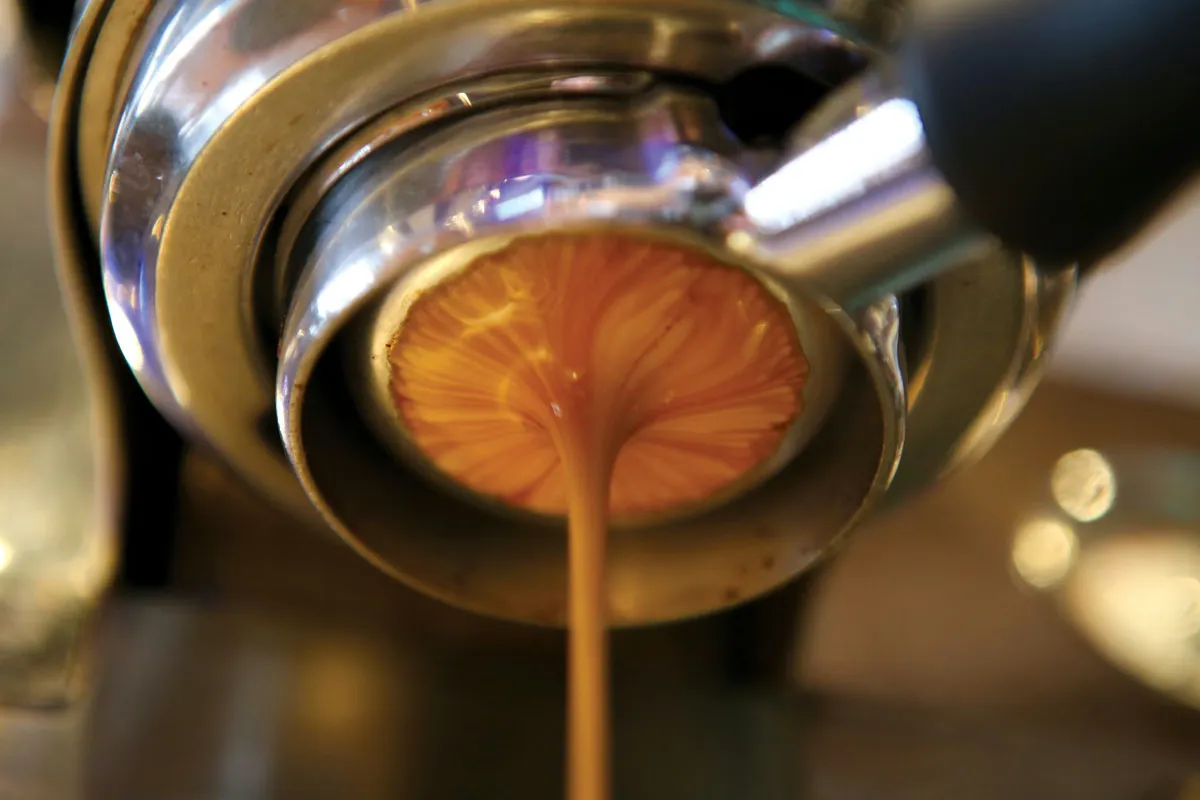
When the portafilter is locked into the grouphead, a button is pushed to engage the pump, and several things start happening, most of which you can’t see. Pressure begins to force water of approximately 200 degrees through the bed of coffee you’ve so carefully dosed and tamped, and the soluble materials inside the ground coffee begin to dissolve to make espresso.
After a few seconds, the first furtive drops of coffee should start to drip out of the spouts of the portafilter, and slowly develop into thin streams of dark, amber-colored liquid. Over the next twenty to thirty seconds, those dark streams streak with honey-colored striping, and eventually lighten and become almost translucent.
Historically, baristas have used those color changes to identify when the espresso is thoroughly extracted and the shot is complete. When the striping (like a tiger tail!) begins to fade away, you should press the button to turn off the pump and the flow of water.
When you turn off the pump, the resulting beverage should be about two ounces in volume, with a creamy head on top, called crema. The crema will vary in color and viscosity from coffee to coffee, but it should completely cover the top of the espresso.
And that’s it! You’ve made espresso. Now you can taste it, and assess it. Aspects of it that you don’t like can be adjusted in all the ways we’ve spoken about in previous entries in this series. Next month, we’ll look into alternative strategies to produce even more consistent shots, using additional tools like scales.