New Analysis Maps Coffee Value Chain, Challenges Consumer-Focused Solutions
A 74-page report commissioned by three sustainability groups examines how money moves through the coffee supply chain, revealing that extra consumer spending does not automatically reach producers and that family labor is often unaccounted for.
By Cameron Evans6 min read
Calls for consumers to pay more for coffee have become a familiar response to the low wages earned by farmers. Many producers do not bring in enough to cover their costs, effectively growing coffee at a loss.
But whether higher prices at the checkout would actually put more money in farmers’ pockets is a question at the heart of a new report, “The Grounds for Sharing: A study of value distribution in the coffee industry,” released on Tuesday, June 18th.
“The issue of economic viability is constantly discussed in the coffee sector, specifically focusing on producers,” said Andrea Olivar, the strategy and quality director for Latin America at Solidaridad Network.
Olivar was part of a group, alongside the Sustainable Trade Initiative (IDH) and the Global Coffee Platform (GCP), that commissioned the study through the Solidaridad Network. According to the report, the aim was “to estimate the distribution of value, costs, taxes, and net profit margins along coffee value chains, from coffee farmers to end-consumers.”
Olivar said the 74-page report tries to answer “if there was really enough value in the supply chain to make a profit and for farmers to have an income that is economically viable.”
“We wanted to have an objective view rather than assuming because this is what the coffee sector has been doing for a long time,” she said.
The study, which took 18 months to complete, examines the German coffee consumption market and four coffee-producing countries—Brazil, Colombia, Ethiopia, and Vietnam—to understand how value is distributed as coffee moves from producer to importer to roaster to retailer.
The three groups launched the report’s release in a global webinar on Tuesday. For those who missed it, here are the key findings:
One: There is enough value in the coffee industry, but that value is consolidated at the consumption end
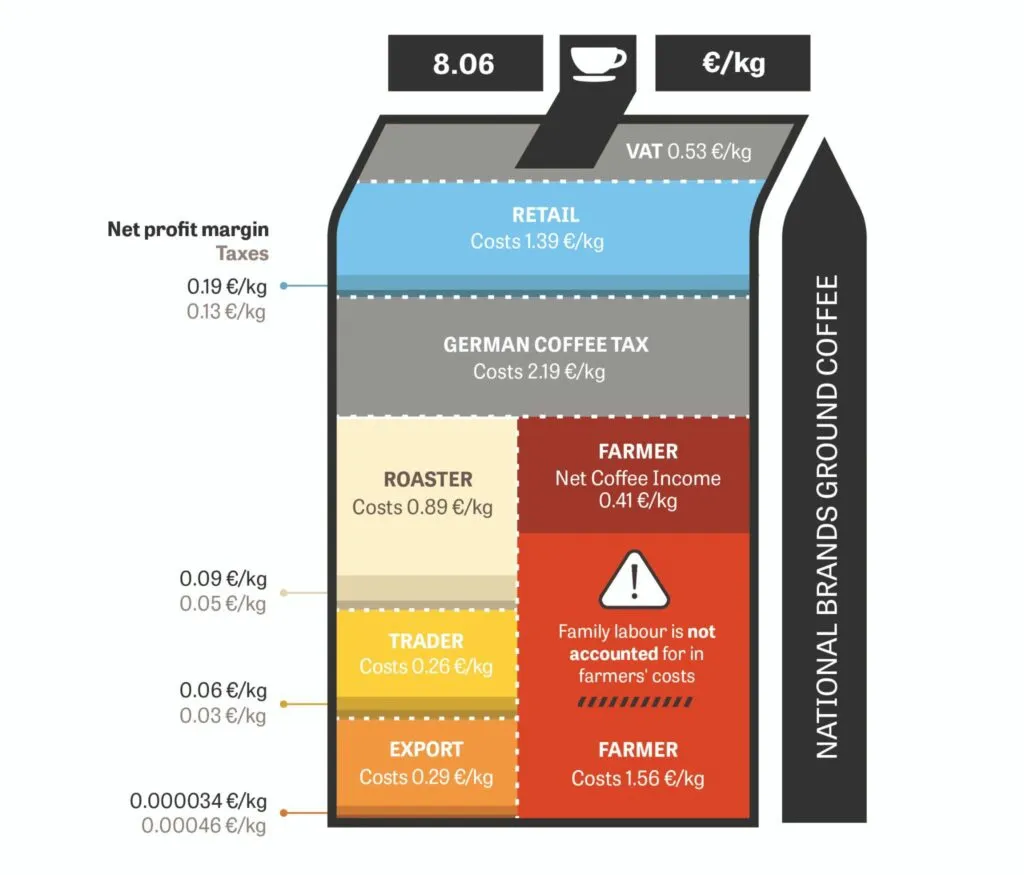
One of the main objectives of this report was to break down how value is distributed when looking at a kilogram of coffee. The report, which used “publicly available data from the German coffee market,” according to a press release, breaks down the value of a kilogram of coffee by percentage:
Charts courtesy of Solidaridad Network
Across all formats, around 20% of the value of coffee remains with producers, based on farmgate prices (the actual amount a farmer is paid versus freight on board, or FOB, which is the price a buyer pays to an exporter and can include other transport-related costs).
This percentage appears higher than some earlier estimates (a common figure is around 10%), but that does not mean farmers are earning more than previously thought. “We have determined that some producers are making a profit, but the majority are not,” Olivar said. “Basically, they are contributing to the supply chain without making a profit margin.”
Roasters and retailers account for 21% and 22% of coffee’s value, respectively, while the remaining ~35% is distributed among taxes (nearly 30%), exporting, and transport costs.
“The study highlights that there is an overall profit to be made on all aggregate coffee products for the German market,” the report reads. “What is very clear for each of those, however, is that the added value concentrates in the downward part of the chain (from importer to retailer) and is limited at the farmer level.” In short, there is money in coffee—it just stays at the consumption end of the chain.
Two: We’re undervaluing family labor
The study also breaks down the value each supply chain sector takes relative to its profit. For every kilogram of coffee, farmers net an average of €.41 (44 cents USD). But that number is likely not as straightforward as it seems.
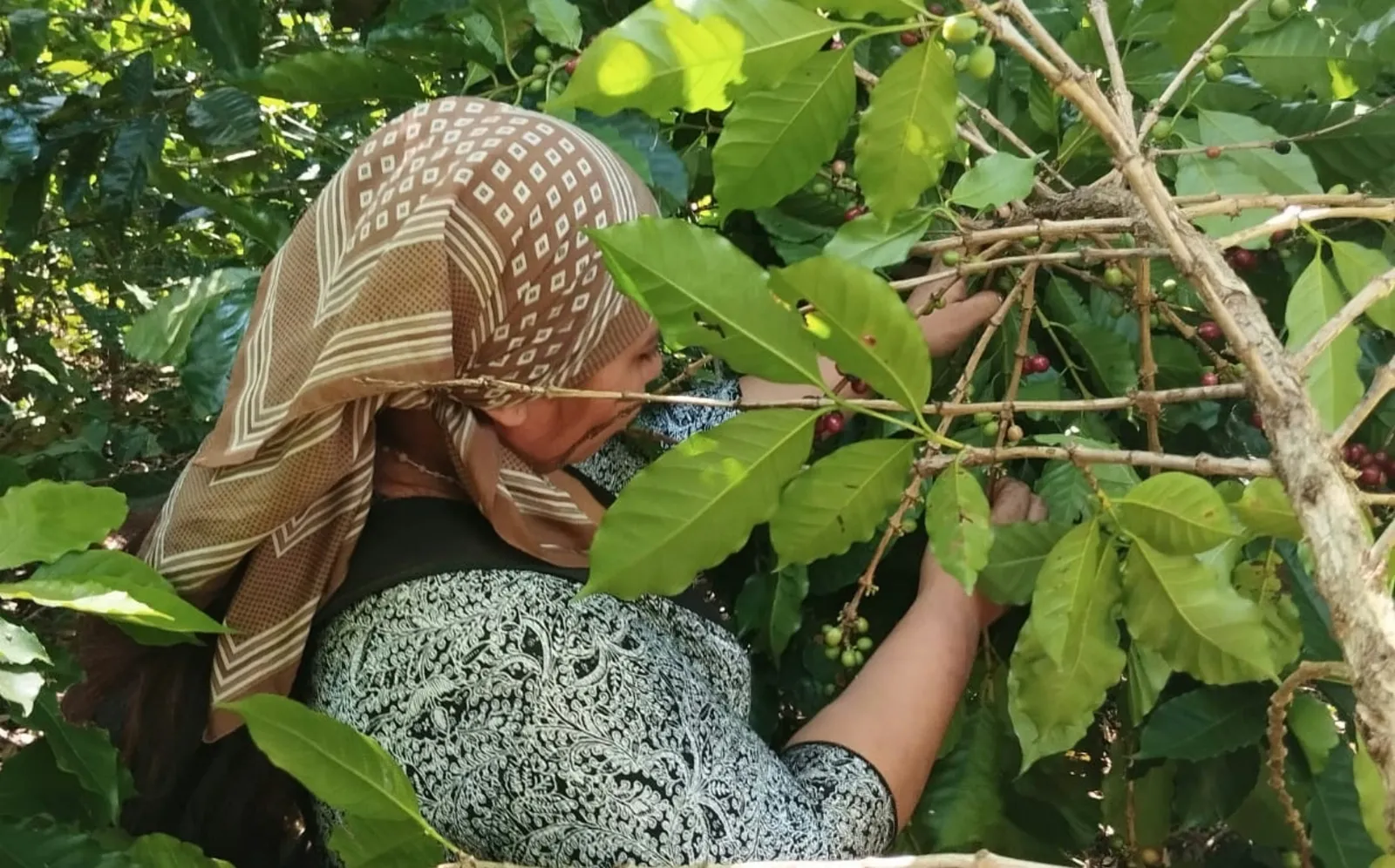
One huge hurdle the study identified is family labor: many smallholder farms operate with the help of family members, and that labor is hardly ever accounted for when discussing income—spouses, children, and siblings might be working on a farm, and the report identified that this labor often goes unpaid.
“If this is your income and you deduct the cost [to produce coffee], then the net income seems quite positive, but you’re not including the main cost,” Olivar said, referring to family labor.
Three: When we increase value on the consumption end, that value does not trickle down to farmers
The report examined coffee broadly but also broke down value distribution by certain types of coffee, such as ground versus whole bean versus coffees with specific certifications. Perhaps the most significant differences in value distribution appeared in the coffee capsule sector.
Although capsules account for a small percentage of the coffee consumption sector in Germany, retailers stand to make a significant profit from them. Where retailers might make a few cents per kilogram of coffee sold as whole bean or ground coffee, they make an average of €7.52 in profit per kilogram sold as capsules.
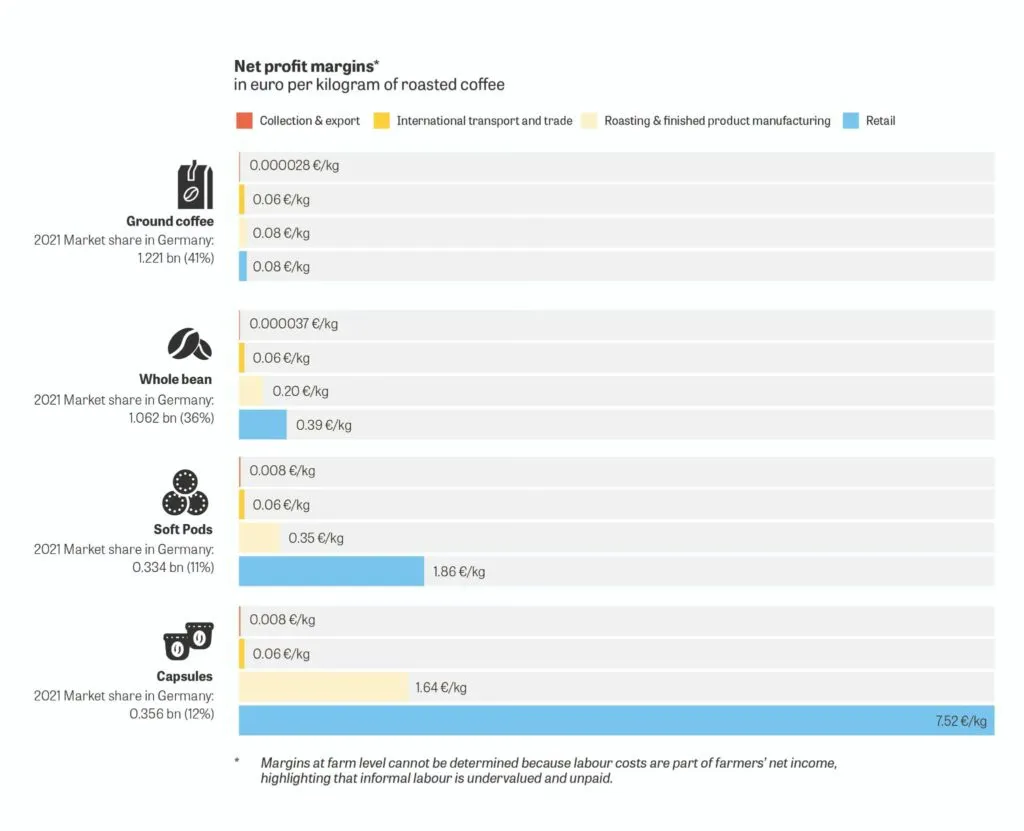
That value creation, however, does not flow from retailer to producer. “A producer will hardly ever profit from that differentiation of that value in the market,” Olivar said.
“Estimates on capsules underline that there is an asymmetry between the high share of value accruing to the Retail and Roasting stages compared to the low share of value accruing to the Coffee cultivation stage,” the report states.
“I think that’s a key finding: that it doesn’t matter which product you’re selling in the end as a producer—I’m not going to be paid more if you’re selling capsules or if you’re selling ground coffee,” Olivar said. “If we ask today for consumers to pay more, there’s not a mechanism for that trickle down to producers.”
The study suggests that the value generated in the consumer-facing end of the supply chain stays with retailers, which calls into question the premise that compelling consumers to pay more for coffee will translate to higher wages for farmers.
Four: Risk and value look different for actors across the supply chain
Olivar also notes that it is important to contextualize value and profit. For many retailers, coffee beans are not the only things they sell, but for producers, coffee is often the only crop they grow. “[The ability to manage risk is essential for value. If you are a producer, you don’t have that option to manage your risk like other actors in the supply chain.”
“The ability to make margins is enabled through the ability to diversify a portfolio across products and countries,” the report reads. “However, these tools are also not equally accessible across the supply chain. Upstream, there is often less opportunity to diversify.”
Five: Interventions have to be direct
Olivar does not see the findings as conceptual or theoretical; instead, she believes they give the industry a practical data set to work with. “One of the calls for action that we want to ask the industry after the report is launched and validated is to try different mechanisms to see what it will look like if we redistribute value because there is enough value,” she said.
“The problem we have is that there are no mechanisms to trickle that value down.”
“Two key interventions are needed; sector commitments on sourcing practices that enable value redistribution, and supply chain partnerships that design and implement mechanisms for adding, creating, and transferring value,” said Tessa Meulensteen, director of agri-commodities with the IDH. “With the right mechanisms, companies can more easily comply with due diligence and reporting requirements, and ensure a sustainable supply of coffee in the long run.”
It is clear that coffee growing is economically not viable for farmers. The fact that there is value in the sector serves both as a chilling alarm that industry patterns need to change and as a hopeful sign that a pathway to a sustainable industry exists. This report will hopefully serve as a template for future studies and a call to action for downstream agents to begin rethinking how they can actively redistribute value.