Beyond the City Limits: Coffee Shops That Forge Their Own Path Around Portland
How four coffee businesses in Portland's surrounding towns navigate the tension between urban trends and local tastes.
By Alex Williams10 min read
For a moment, consider the distinction between the second and third waves of coffee. First described by Trish Rothgeb in 2003, these categories have since deepened and widened—shaping how coffee is sourced, roasted, and brewed, as well as the visual and verbal language used to present it. Over the following decade, an artisanal, carefully curated coffee aesthetic radiated from cities such as Oslo, Tokyo, and Portland, bringing minimalist interiors, oversized portraits of coffee farmers, and light-roasted single-origin espressos to shops around the globe.
The coffee culture of Portland has served as inspiration to many coffee businesses around the world, in visual, verbal, and gustatory aesthetics.
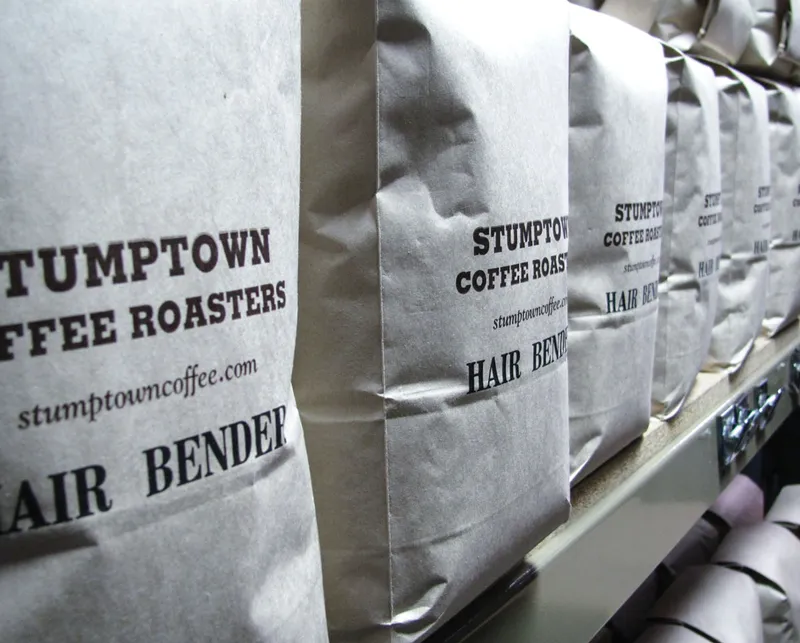
Many people see Portland as the epitome of third-wave coffee; at last count, the city was home to more than sixty roasters, from small operations to large-scale ones. Here you can find the industry giant Stumptown a block away from the scrappy Courier Coffee. You can experience the Nordic style at Heart and the neighborhood warmth of Case Study Coffee. You can even join a walking tour led by the regal Portland native Lora Woodruff, called Third Wave Coffee Tours. It’s a city where you “choose your own white tile,” where the default is a “light-roast Ethiopia or Burundi,” and where “if you want almond syrup you’ll have to bring your own.” Portland’s coffee culture has inspired businesses worldwide in look, language, and flavor. But you already knew that—Portland receives more than its fair share of media attention, doesn’t it?
I was curious: it’s easy to trace Portland’s influence on a place like Kansas City, but what about Portland’s suburbs? Like most city dwellers, Portlanders tend to forget the suburbs exist—and not only when it comes to coffee. Jokes that the Vista Ridge Tunnels (on Highway 26, heading out of Portland) are where flavor goes to die reflect a broader disdain for anything far from the city center, whether it’s a yoga studio or a pizzeria. How do coffee businesses in the suburbs—or even farther out—reflect or resist the “Portland influence”? And is the suburban second-wave stereotype of dark roasts, heavy syrup use, and decor somewhere between Grandma’s house and your eccentric neighbor’s kitchen actually accurate?
Like most city dwellers, Portlanders tend to forget the suburbs exist, and not just in coffee culture.
On behalf of our website—but on a personal mission to broaden my coffee map—I visited four businesses around Portland. I sat and tasted, took photos, asked questions, and listened. More than anything, I found the businesses to be far more diverse than I had expected. That makes sense: they aren’t constrained by serving the same customers, nor do they draw from the same pool of baristas, architects, and products. Instead of finding a group pulled along by the big-city scene, I discovered a kind of counterpoint to Portland, and it pointed to an obvious truth: coffee culture can never be reduced to sameness.
If we take Portland as a stand-in for other large cities, it’s clear that no matter how much suburban coffee companies reflect or resist urban trends, they cannot escape the influence of culture radiating from nearby metropolitan centers. Customer expectations are shaped by it, and so are owners’ expectations. Whether suburban coffee businesses push against those trends—light roasting is an easy example—or embrace them, the reality in the suburbs is different. Second wave, third wave, somewhere in between, or ignoring waves entirely: individuality rules.
HAPPYROCK COFFEE, Gladstone
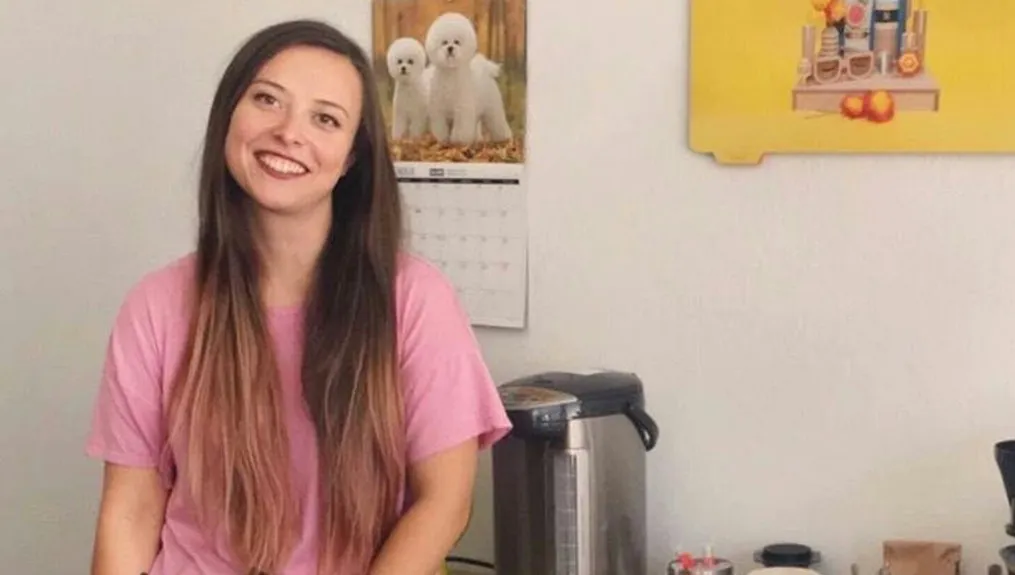
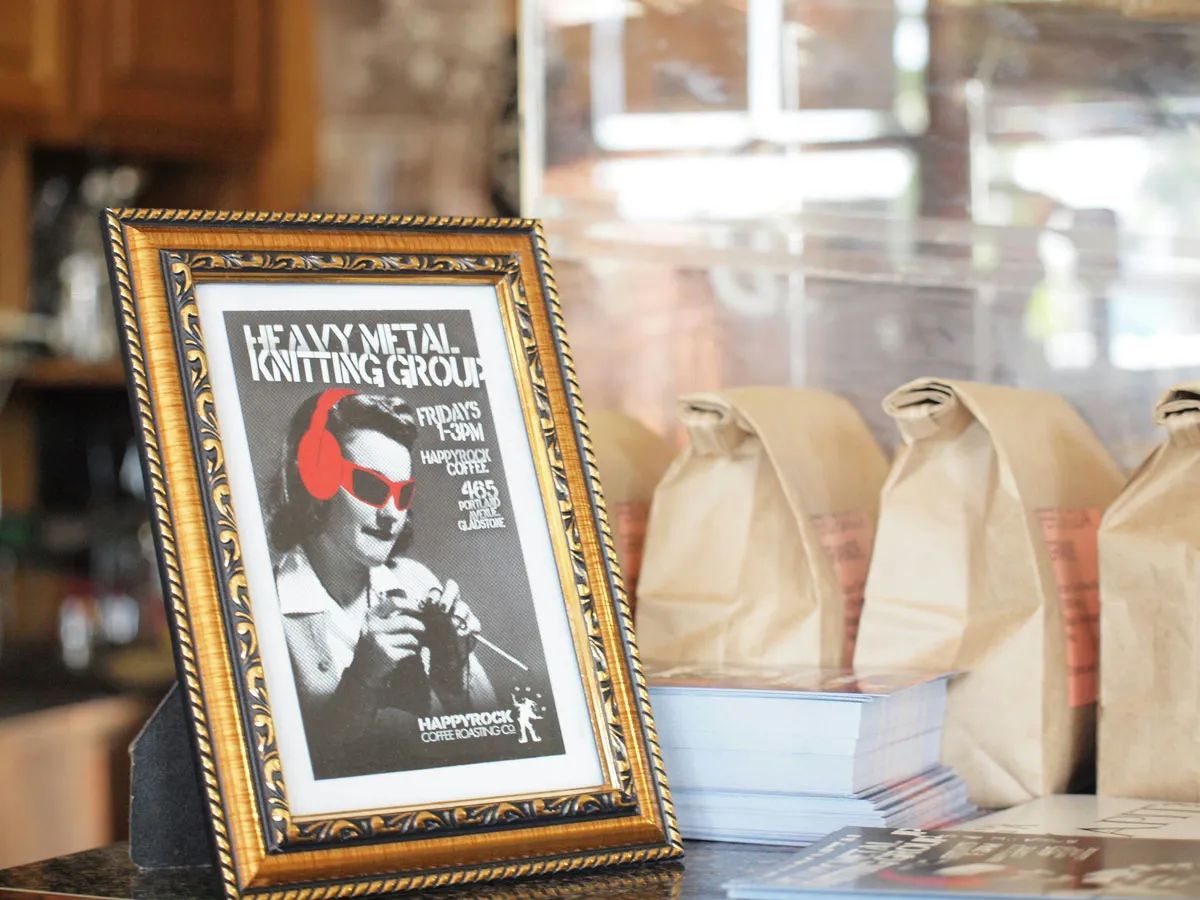
My first thought, after I get past the disco ball and the quartet of knitters (one man, three women, all gossiping energetically), is that Happyrock Coffee is saturated. Saturated with detail—a fantastical painting in lurid reds and purples of a pterodactyl fleeing a spaceship occupies one panel, while the next shows a pirate ship becalmed under a Caribbean sky; a faded teal velvet chair sits beside a sprawling Howdy Doody doll with a lap full of plastic broccoli. It’s also saturated with personality. Lisa Halcom fills the place up: she wears it like a hermit crab wears its shell. Customers who walk in get a direct look, a “Howdy,” and possibly an off-color joke.
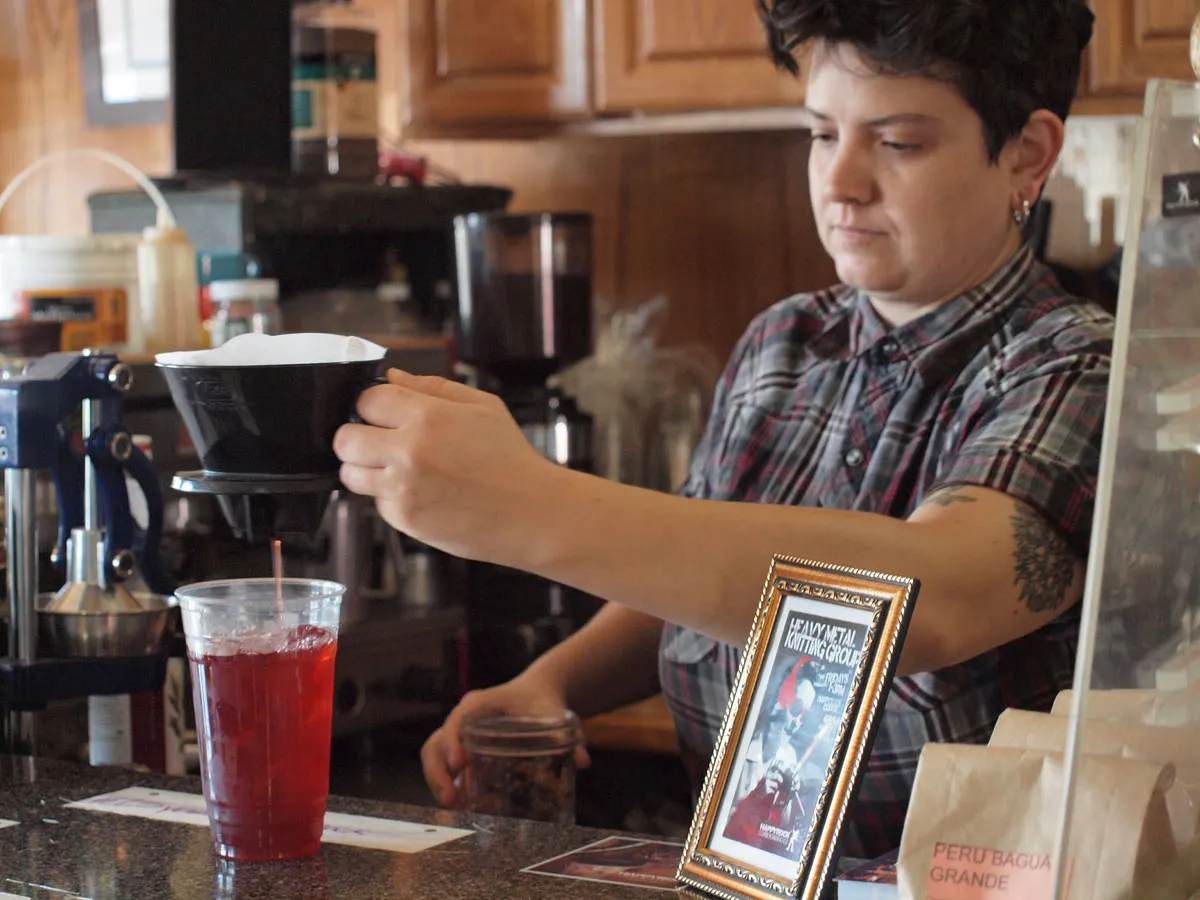
Lisa Halcom at Happyrock Coffee.
Happyrock exemplifies the suburban second wave. Halcom roasts very dark coffees on the Diedrich IR-12 that has taken up nearly a quarter of the shop’s floorspace since it was founded in 1999 (making Happyrock one of the oldest micro-roasters in Oregon), and she proudly uses plenty of Monin syrups in her drinks. The espresso machine is a well-loved Pasquini topped with mismatched ceramic cups. Halcom makes her loose-leaf iced tea as a pour-over, holding the dripping Melitta over a to-go cup full of ice. And her signature drinks are exactly like the shop: bold, adventurous, cluttered.
When I visit, Halcom offers me, in quick succession, house-made chai—sweet and spicy with a creamy finish—a Mexican mocha with espresso whipped cream and a chewy honey drizzle, and coffee I can bite into, a roundhouse kick to the taste buds named the El Chupacabra Blend. When she hands me a house-made chai soda, I have my epiphany: these drinks perfectly complement each other. No subtle mixing here. Halcom makes her personal statement with every glass.
Still, making her statement in her own shop is one thing; securing recognition in the coffee industry is quite another. Despite multiple state and national wins—including making finalist twice in the America’s Best Espresso Competition, placing second in the Oregon State Fair Best Coffee in Oregon championships, and being the only competitor from Oregon to reach the finals in the 2014 Northwest Brewer’s Cup—Halcom is consistently overlooked or slighted in press mentions and has little name recognition in the industry. She has been a dedicated coffee professional her entire adult life, first in Southern California, then in Portland, where she had one of the first mobile espresso bars, and now in Gladstone.
“Being in the suburbs has been really challenging,” says Halcom. “Gladstone used to have a really rich history, but it’s dwindled. The butcher shop, the grocery store, the roller rink—they’re gone.”
“Being in the suburbs has been really challenging,” says Halcom. “Gladstone used to have a really rich history, but it’s dwindled. The butcher shop, the grocery store, the roller rink—they’re gone.” Though not a Gladstone native, Halcom sees herself as carrying on the town’s unique traditions, flipping open a well-worn binder of local history compiled by a regular customer and pointing out where her building stood in the 1910 streetscape. If coffee is about originality, and if modern coffee is about honoring roots, she’s puzzled by her lack of reception. “I don’t understand why Portland doesn’t recognize me: isn’t being unique and friendly to customers what coffee is all about?”
COMPASS COFFEE, Vancouver
Mike McGinness is officially a curmudgeon. That, or a verbose old chef with a love for coffee that, as he explains on his website, is more important to him than life or death.
I step into his roastery and brew bar on a hot day in August, family in tow. As my two-year-old daughter busies herself with the carved chess set (heavy teal and cream pieces the size of her hands), my husband and I belly up to the bar and throw down shots of the Delirium Espresso blend, pulled on an old four-group La Marzocco Linea. The Delirium is a four-part blend mixed post-roasting. Drinking it is actually like biting into a chewy, milk chocolate-covered, peanut butter-filled pretzel. Unusual so near Portland, the bastion of single-origin espressos. When I tell McGinness how tasty it is, he nods. Of course, his face says. I roasted it.
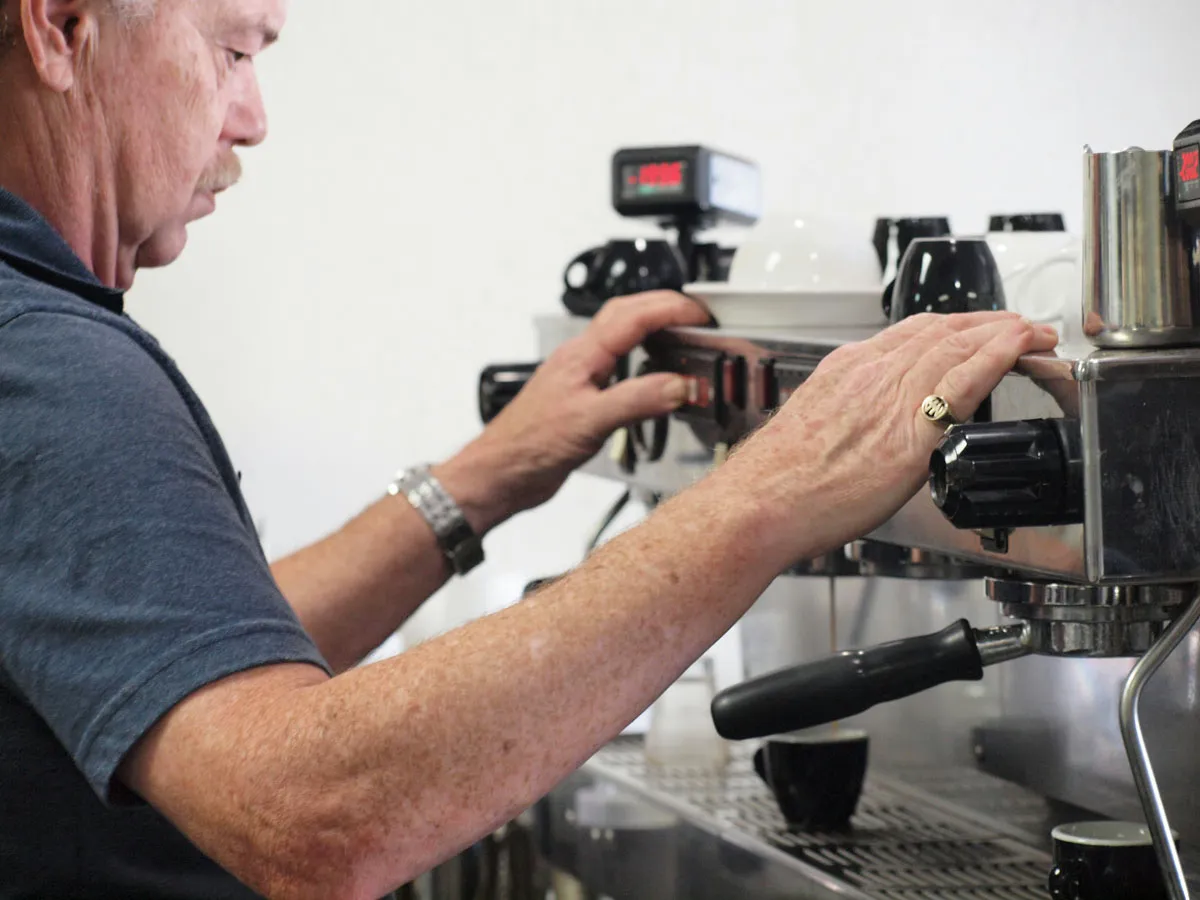
Mike McGinness pulling shots at Compass Coffee.
McGinness bought the business that became Compass Coffee back in 2007, before the stock market crashed and his food sales—over fifty percent of the business—dwindled to numbers like seventeen dollars a day. It was a rough time, especially since he had just established his roasting business and second location two months before. Still, after making it through that rough spot, Mike says his business has grown forty to fifty percent every year, and he’s about to open his third location in downtown Vancouver.
“It’s more a world scene than a Portland scene. I’m not denigrating Portland, but it has little to do with what we are about here.”
Compass Coffee reflects some aspects of “Portland coffee,” with a seasonal single-origin espresso, sustainable coffee sourcing, and house-made syrups and baked goods. But when I mention this, Mike laughs. “My business isn’t impacted much by Portland. I mean, give me a break. It’s more a world scene than a Portland scene. I’m not denigrating Portland, but it has little to do with what we are about here.” And, he adds, “Vancouver is not a suburb of Portland, thank you very much. Vancouver was founded first. You could almost say Portland is a suburb of Vancouver!”
As we drive away, McGinness sits outside smoking Camel Filters and watching the traffic pass. The sun glints on the fourteen-karat gold coffee bean in his ear. Over his head stretches a vinyl sign that reads, “The best espresso in Clark County! Agree or it’s free!”
DAPPER & WISE, Beaverton
There is a gentle, self-mocking theatricality in everything that Evan Aldrete and Tyler Geel do together, whether it’s opening what turned out to be a successful micro-chain of second-wave coffeeshops in Cannon Beach and Beaverton called Insomnia or launching their own third-wave roasting company, Dapper & Wise. This is fitting, because the two young family men met each other in a traveling musical theater troupe.
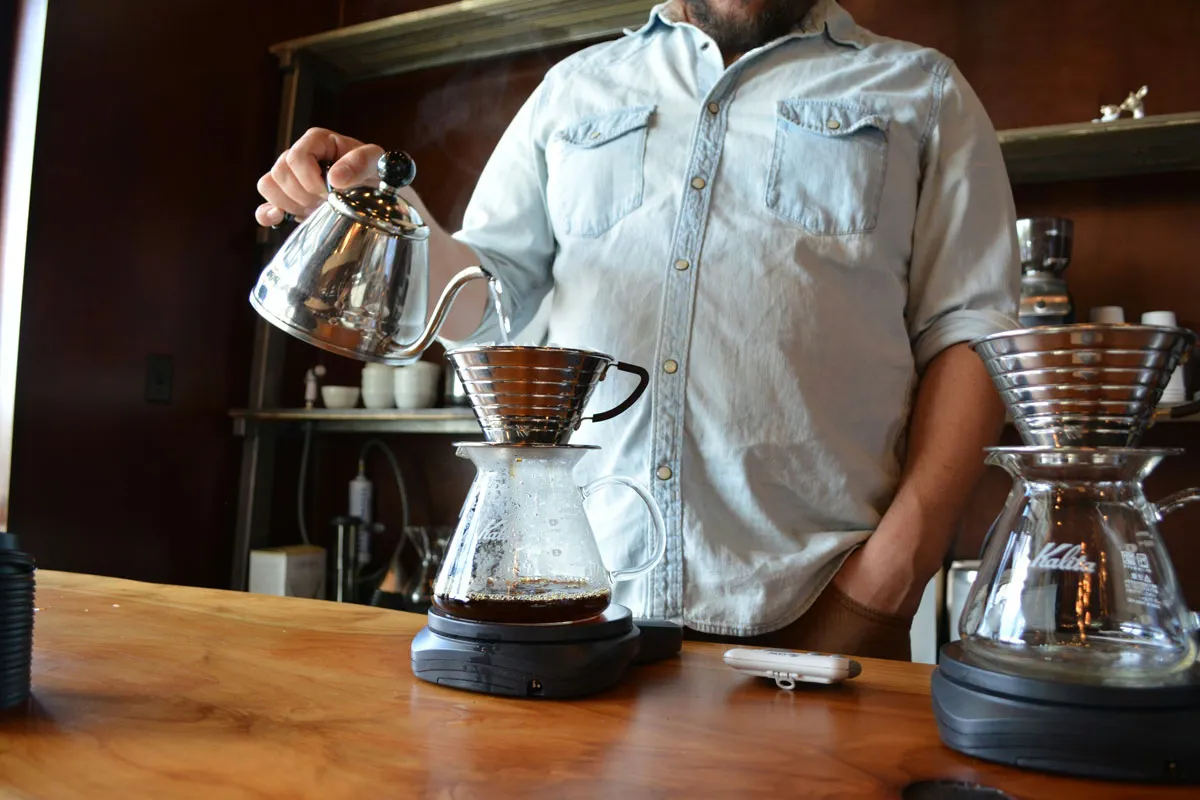
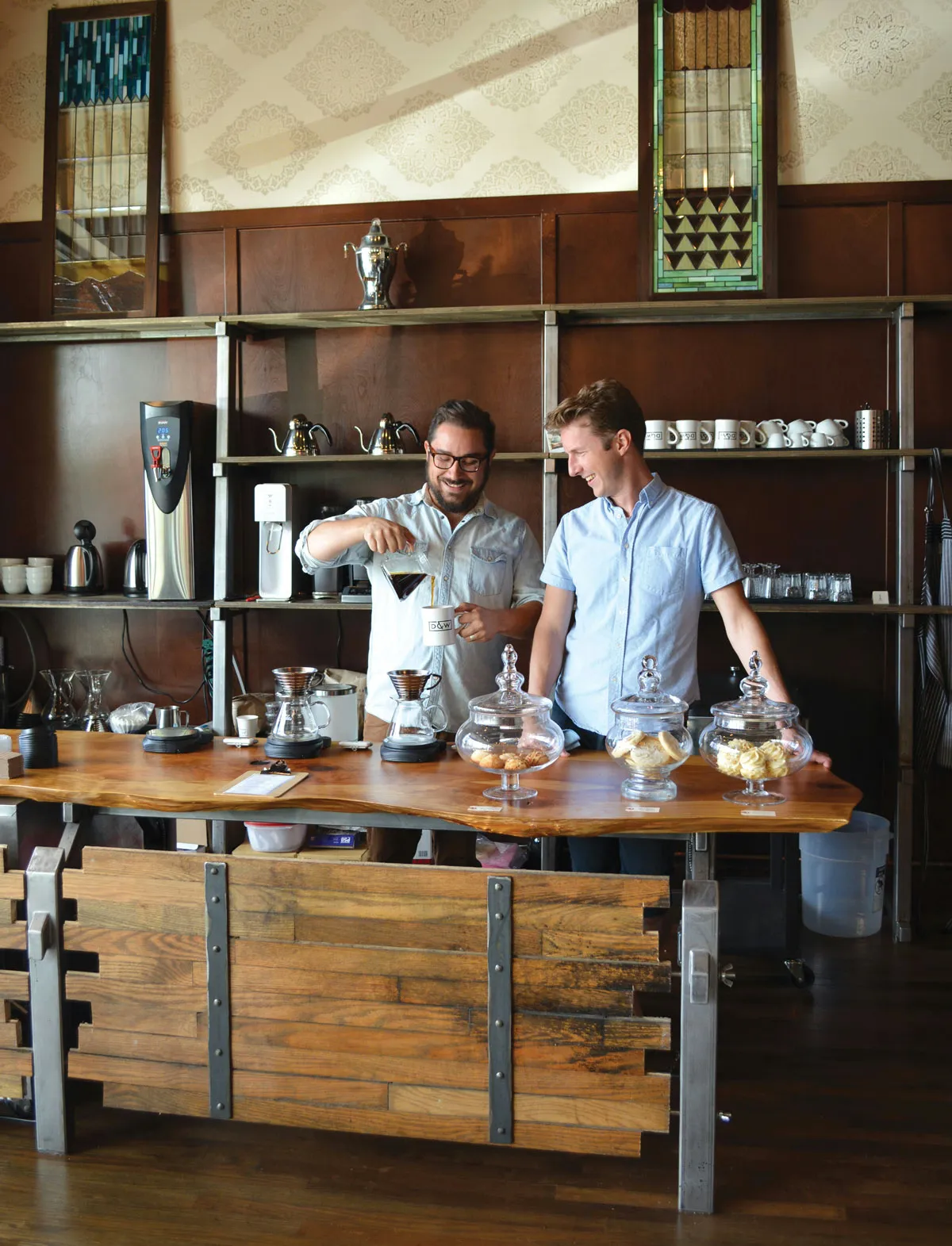
Dapper & Wise in Beaverton. (Photo and featured photo by Cynthia Meadors.)
The two businesses are actually across a strip mall parking lot from each other and will soon be next door, which creates a vibrant platform for conversation. Insomnia has the typical cluttered, syrup-and-frappuccino-heavy second-wave feel, with an old man unrolling his personal chess mat in the corner and postcard advertisements for community swaps in a pile close to the bar. It feels like a cozy, welcoming, neighborhood-wide cave. Dapper & Wise is a gorgeous, minimalist space built using reclaimed wood and boasting a Mahlkönig grinder and a La Marzocco Strada, filled with natural light.
“We want to make excellent coffee approachable. We will always be able to meet the needs of the people around us, whether they are second or third wavers.”
In the contrast between the two businesses and the way their owners are proud of both, a new perspective on coffee in the suburbs is clear. “We have this funny dual existence,” says Geel, “because they come into Insomnia and think we’re like everyone else in the suburbs. Then they taste our coffee, and they visit the roasting facility.” Aldrete adds, “We want to make excellent coffee approachable. We will always be able to meet the needs of the people around us, whether they are second or third wavers. Here in the suburbs we hope we can see more of the full picture.”
The gentlemen are happy to show how much Portland’s coffee culture has influenced them and their approach in their twin businesses. They drive in regularly to drink coffee, and they participate in many industry events. Still, they have no intention of forcing their suburban business into an urban mold. Geel says, “We just want to meet people where they are. I think it surprises coffee fans.”
CARAVAN COFFEE, Newberg
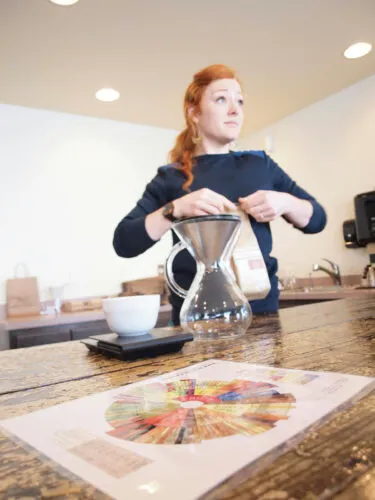
Caravan Coffee in Newberg.
Newberg roaster Caravan Coffee’s tasting room would fit just fine in Portland: a hand-painted map of the world with coffee-origin countries highlighted in Caravan’s dusty teal and brown covers the walls, and multiple brewing methods are available for walk-ins as well as a knowledgeable twenty-something barista to demonstrate them. Reclaimed coffee pallets cover the cabinet fronts, and whole-bean single origin coffee is available for sale or consumption. The incongruence starts with the customer who walks through the door and asks how the Ethiopian stacks up against the Folgers he drinks at home, like his mom drank her whole life, and extends to the cases of syrups on the shelves of the warehouse and the custom, proprietary blends (some dark like molasses and glistening with coffee oils) that form the backbone of Caravan’s business with restaurants and coffeehouses throughout Oregon. There’s an inherent tension to be felt here, one Marcus Karaffa likens to a Stretch Armstrong doll. One elastic hand in Portland and one touching the hinterlands; one hand extending lighter-roasted and proudly sourced single origin coffees and the other carrying dark blends. Sometimes, he says, the tension is painful.
There’s an inherent tension Marcus Karaffa likens to a Stretch Armstrong doll. One elastic hand in Portland and one touching the hinterlands; one hand extending lighter-roasted and proudly sourced single origin coffees and the other carrying dark blends.
Karaffa handles sales and development for Caravan, and from many conversations with him in my capacity as a freelance business writer for Caravan, I’ve come to appreciate his unique position to address the impact of Portland’s coffee culture. “We are like a bridge connecting people to excellent coffee,” he says. “One of our core values is to give people the coffee they want, whether it’s a single origin or a blend like the very dark Rakish Tilt, which we’ve been roasting for South Store in Hillsboro for years now. In downtown Portland you can be more niche and survive.” The team, helmed by Q Grader Paul Allen, fights to be relevant to Portland’s culture—experiencing a similar lack of media attention to Happyrock—while also trying to offer relevance to the mix of tourists and old school coffee drinkers who make up the majority of their customers. The conflict is felt in many ways, like in the monthly Hand-Picked Club subscription. The bag has a snazzy, clean design, with an engaging tidbit about the current featured single origin and altitude, latitude, and longitude, along with industry-standard cupping notes like “sweet lemon, papaya with lime, and blueberry syrup.” Then, at the bottom, is the listing for the blend of the month and its description. “Like biting into a roasted hazelnut truffle, complete with dry finish.” The Hand-Picked Club members are a fair cross-section of Caravan’s customers.
“There’s still a market for the customers who almost want their beans on fire when they come out of the roaster,” says Marcus, “and I don’t think it will ever completely go away—because some people really like that taste!”