Hiring for Values: How Coffee Businesses Find Staff Who Share Their Mission
A café or roastery that wants its sustainability and community commitments reflected in daily operations needs employees who genuinely embrace those priorities. Operators describe how they identify and onboard people whose outlook matches the company's purpose, rather than relying only on prior barista experience.
By Emerson Martin4 min read
Matching Staff to a Company's Purpose
A business built around environmental responsibility, local engagement, and ethical sourcing depends on a team that shares those priorities. The real question is how a café or roastery identifies applicants whose interests and outlook line up with the company's own.
Joe Kennedy, roaster and cofounder of King's Gambit Coffee Co. in Belvidere, New Jersey, which he opened in December with his wife, Laura, says the process begins with a clear sense of purpose and the ability to communicate it.
"The best message to give anybody starting out is, number one, know who you are and where you want to be," says Joe Kennedy. "Once you know that, then it's your job to sell that to the different people you come across. And the ones that are on board with that, they'll naturally cling on."
Screening Applicants
Peace Coffee, based in Minneapolis, uses several stages to evaluate prospective hires, as many companies do.
When a position opens, applicants first submit an application that includes "three screener questions, including, 'Why do you want to work at Peace Coffee?' This lets us see if they have any awareness of us and if they're going to be a good culture fit," says SueLynn Junkert, the company's human resources manager.
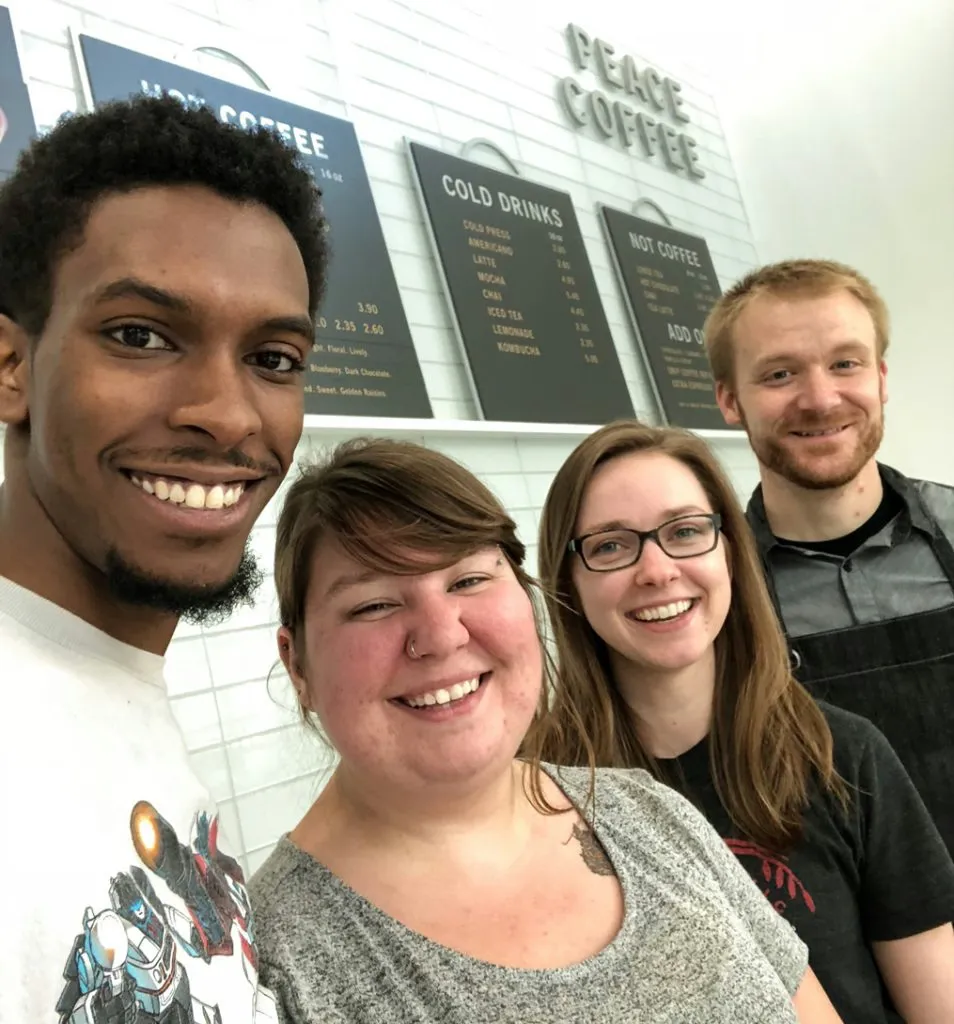
Peace Coffee adopts a multi-stage approach for interviewing new prospective hires.
Applicants who stand out then meet in person with Miré Regulus, director of drinkable hospitality, and her team.
Notably, Junkert and Regulus assess "culture fit" by looking beyond barista or coffee shop experience alone.
"We're looking for a variety of things. Most of what we're really interested in when we're looking for [new] people are candidates who are interested in building community—both with the customer and also with each other," says Regulus. "We believe we can teach anyone the mechanics of how to be a strong barista if they care. You can't teach people how to want to make that community connection."
Highwire Coffee Roasters, with several locations in the San Francisco Bay Area, takes a different route: informal, panel-style conversations between company leadership and applicants, intended to reveal whether the fit is right.
"We want them to feel like they're choosing us and we're choosing them rather than them just being interrogated," says Highwire CEO Robert Myers.
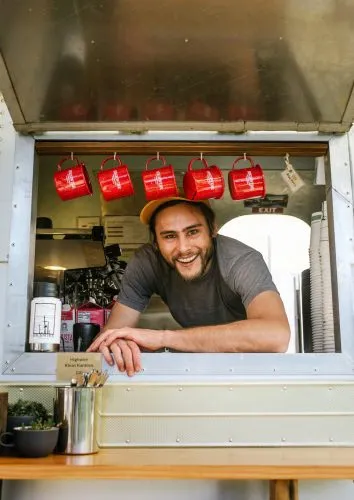
Highwire Coffee Roasters' Flowerland location.
Myers says many applicants arrive already familiar with the company's values-driven approach and mention that its "passion for values and sustainability" is a main reason they want to join.
"We have a fair number of candidates who come to us saying they're applying because they want to work for someone who is values-driven," he says. "Often, candidates will do their homework and read about us on social media. They'll pop into our store and read our Yelp reviews. Sometimes they'll even surprise us and mention something from our blog that I'd written about a few years ago."
Spotting Genuine Alignment
When an applicant truly shares the company's purpose, the interview itself often makes it visible.
While assembling a 10-person staff for the King's Gambit launch, Joe and Laura Kennedy brought candidates in and laid out their plans for the business. Those plans include sourcing milk from local dairy farmers, enabling customers to tip coffee growers via blockchain, and eventually creating a greenhouse education center that would show how coffee is grown.
"Once you understand your vision and communicate it, it really is just about reading candidates' body language," says Joe Kennedy. "The ones that light up are the ones who are really interested in making a difference."
"One woman in our group interview, when we described the milk we were going to bring in and how we were going to be helping farmers, literally almost started crying," adds Laura Kennedy. "It was clear, she was on board."
To move the applicants most likely to connect with that vision into the interview stage, Laura Kennedy reviewed online applications for keywords that revealed passions, hobbies, and community volunteer work.
The Kennedys, like the team at Peace Coffee, agree that such signals frequently mattered more than a candidate's background in coffee culture.
"Candidates' volunteer work and specific hobbies tell you about where they are in their lives and where they're headed," says Laura Kennedy. "Often from their résumé and from their past experience, you can get a sense of whether they're going to buy in [to your company values] or not."
At Highwire, a new hire's first day includes a full-day "foundation" session with at least two of the company's founders, giving a thorough introduction to how the business pursues its mission.
"It's an introduction of our values and the how and why of Highwire. More than just how to work the register, it's the guts behind what we're doing," says Myers. "We do it to ask them to buy in."
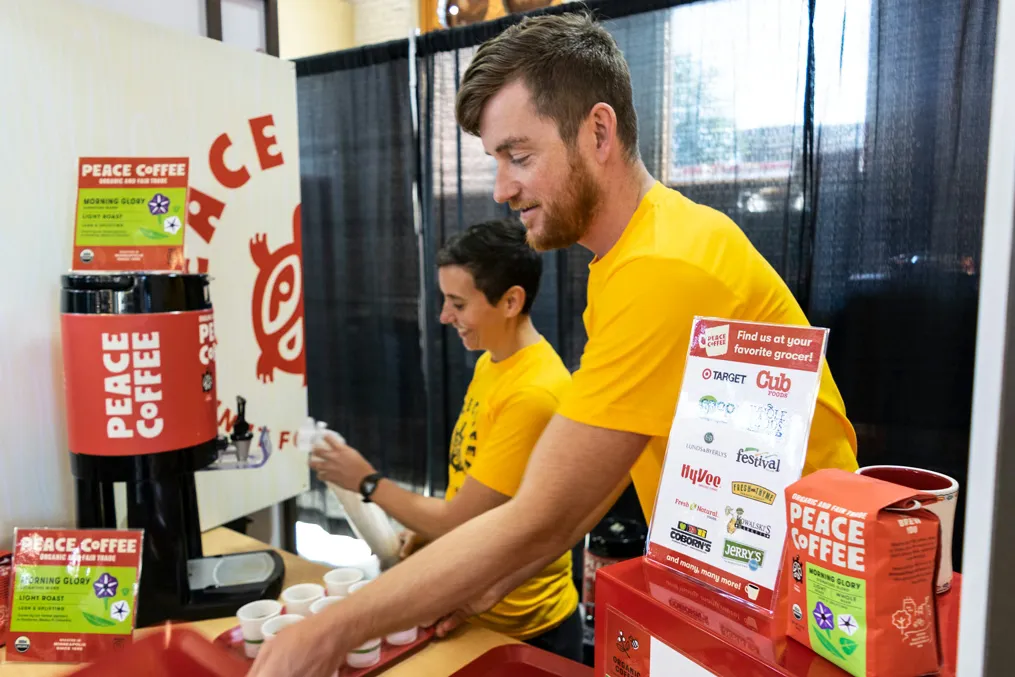
Peace Coffee's Melanie Meegan and Ryan Brown set up the booth for a show
Spending time aligning new employees with the company's purpose signals a genuine commitment—that the business actually practices what it promotes.
"I've worked for companies where you hear a mission statement once and then never again," says Myers. The foundational onboarding process "[lets us] make an out-loud promise to every Highwire employee that these values are what we're using to make every decision. It's also their invitation to have a conversation with us at any time about our mission—or to suggest ideas for how to improve."