How Coffee Shops Rethought Worker Safety and Pay During the Pandemic
From eliminating tips to creating wellness funds, independent cafés used the disruption of COVID-19 to address long-standing inequities for baristas.
By Harper Parker9 min read
When the pandemic hit, service businesses discovered that no level of preparation could forestall the upheaval that followed as confirmed cases and deaths climbed into the thousands.
By roughly mid-March, most of the United States had imposed some form of stay-at-home order to curb the virus’s spread. The temporary or permanent shuttering of restaurants translated into the loss of about 5.9 million jobs by early May. Across the country, virtual tip jars and crowdfunded relief efforts sprang up to assist baristas who suddenly found themselves without work, bridging the gap until Paycheck Protection loans or unemployment benefits arrived. For cafés with strong workplace cultures and deep commitments to their teams, business losses still forced painful layoffs.
Paper Moon Coffee Co., based in California’s Bay Area, provides employees with a 401k plan, healthcare, and paid time off. Last year, CEO Wendy Warren went further by finalizing 501(c)(3) nonprofit Coffee Housing, an ambitious project aimed at offering affordable housing to baristas in Silicon Valley. But COVID-19 put Paper Moon at risk of closing its Santa Clara location, and Warren says, “I’ve lost approximately $70,000, and I need to break even in the next 2–3 months or I will start to lose money that won’t have any chance of being recovered.”
The outlook for coffee businesses was bleak. If 2019 had been defined by a wave of barista-led activism, what did that amount to in the face of a pandemic? Lamplighter Coffee Roasters temporarily closed its Richmond, Virginia, locations. Seattle’s Broadcast Coffee cut hours and laid off 12 of its 20 employees. Amethyst Coffee Company closed all three of its Denver shops on March 16, and a team of 17 was reduced to two: co-owners Elle Taylor and Breezy Sanchez. These hardships were hardly unique. On the surface, it might look like a terrible moment to restructure a business, but for these cafés, there had never been a better time to reprioritize workplace equity and inclusion.
Putting the Barista Back at the Center
COVID-19 forced Lamplighter to close its three locations on March 23, laying off most of its 77 employees. The company donated the use of its Summit Avenue coffee bar and roast lab to Richmond Mutual Aid, a grassroots organization providing food, supplies, and funds to those in need. Lamplighter reopened its flagship Addison Street location on April 11, revising the menu to offer mostly locally sourced, nutrient-dense food at accessible prices. Co-owner and managing partner Noelle Forest says scaling down led Lamplighter to reevaluate its foundations. Founded in 2009 with few resources or help, Lamplighter adopted a more traditional business model as it grew to three locations. Starting over with a smaller team feels more authentic to Lamplighter’s roots and gives all staff a more equitable voice in the company, along with raises and paid sick time benefits going forward.
“Now that everything has been completely shut down, it’s been an opportunity to really evaluate. What was working well before? What wasn’t working before? And the things that have been really bad were from things that were already problems in the industry for our workers before,” says Forest. “People have to realize that more than ever these people are some of the least protected in our society who are serving food or preparing things like this. For us it’s been a really big opportunity to look at everything we’re doing and just say, ‘Wow, we don’t really want to build it back up the same way it was before. Maybe we can revamp not just how we’re going to seat people or how people are going to be touching things, but how can we really restructure in a way that’s going to be different?’”
Before COVID, Broadcast had been deliberate about putting staff first. Molly Flynn, project coordinator and service repair tech, recalls times when owner Barry Faught and general manager Natalie Walker “found ways to support the staff in times of need, whether it came from finding a few dollars in the business, or if Barry paid out of his own pocket. The whole leadership team has really stepped up to take care of the staff and I think it’s just important for people to know that’s just a core value at Broadcast is to care for the staff, and that’s not solely a response to COVID.”
The pandemic gave Broadcast time to acquire new tools to emerge as a stronger company. Along with staff raises, plans are in the works for anti-racist training and educational classes (both coffee-related and not), as well as the creation of an Employee Wellness Fund.
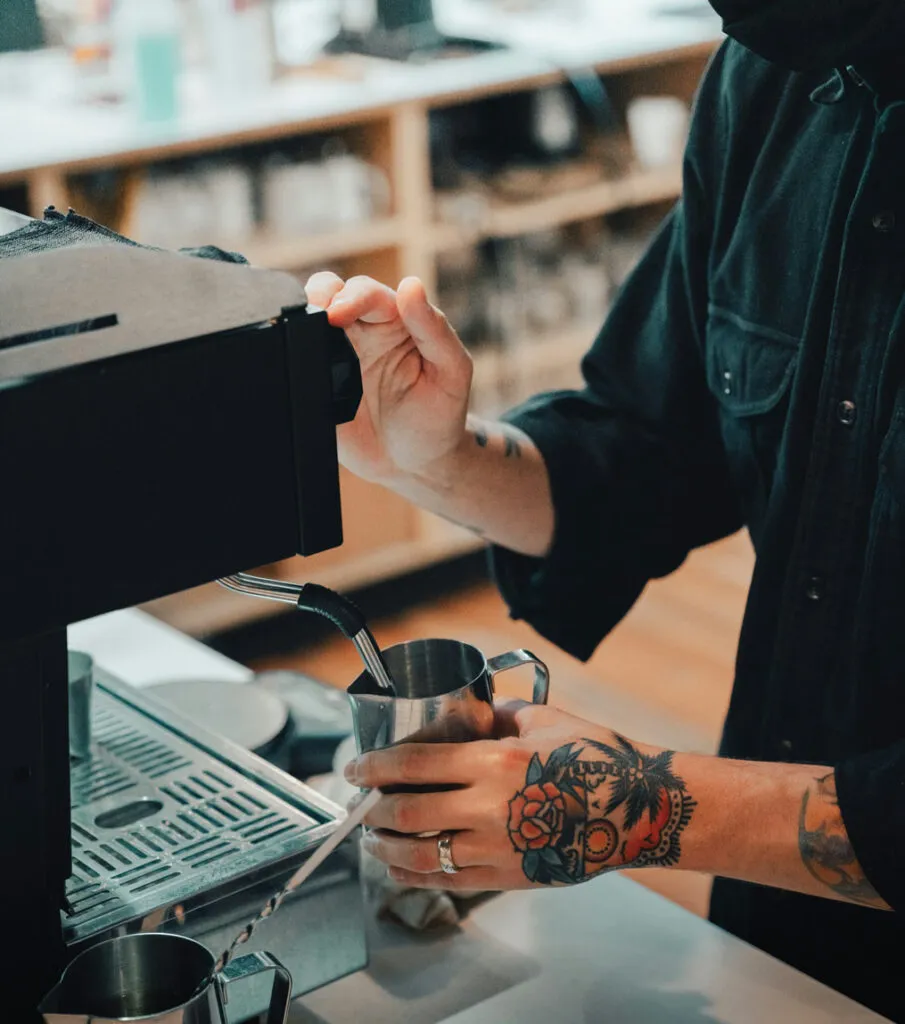
BROADCAST COFFEE established an Employee Wellness Fund. Available for all baristas in times of need, the fund originated out of the need to help support staff who were underemployed or laid off in mid-March during quarantine lockdown.
The wellness fund continues an earlier initiative begun with their Gimme Shelter blend. Five dollars from each bag sold went to support underemployed baristas, including those furloughed. Now that the company has brought back all 20 employees, the idea exists as a long-term fund.
“Moving forward, every coffee we have, as a blend or single-origin whole bean offering that we have, a dollar of that goes to the fund. Every single bean purchase, some portion of that pays into it,” Walker explains, also adding that a portion of seasonal drink sales as well as all proceeds from their hand sanitizer sales will go to the fund, with Faught matching up to $10,000.
The fund is available for any staff person in need—for example, suggests Walker, a barista needing more time off after exhausting their sick pay benefits.
“Even without a pandemic and a social uprising,” she says, “there are things that come up in people’s lives where they need some kind of extra support, and we want to be able to do what we can as an organization to take care of the folks who are working for us.”
Broadcast has also been deliberating another issue: gratuity.
“We are trying to navigate the pros and cons of whether we continue to offer tips. That may or may not change in the future,” says Walker. “It’s a touchy area because we want our staff to be financially taken care of, and for them right now that includes tips. We’re discussing what we might need to do as a company to take that out of the equation and offer a wage that would be fair, beyond fair.”
The Importance of Pay Equity
Amethyst Coffee Co. had also grappled with equity and gratuity. On May 12, one day before reopening two of its four locations after closing in mid-March, Amethyst announced it was eliminating gratuity and raising prices by 50% across the board. Though certainly not the only café to do away with gratuity, at Amethyst the decision means “everyone makes the same rate. Everyone’s at 50k a year and 30–35 hours [a week],” says Sanchez.
To some it seemed like a drastic move, but pre-pandemic, the company hadn’t raised prices in several years. Amethyst was already discussing a 30% price increase to keep up with rising costs of goods, and challenging the gratuity system had been on everyone’s minds. Co-owners Sanchez and Taylor combed through their monthly budget “with a microscope.” If they were going to restructure Amethyst, they reasoned, why not now?

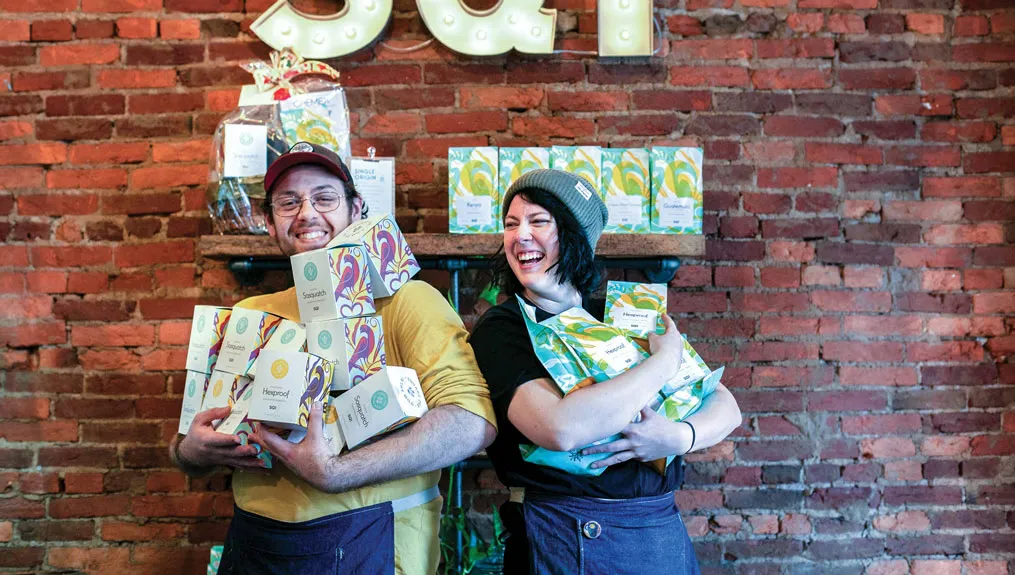
AMETHYST CO-OWNERS Breezy Sanchez (left) and Elle Taylor made the decision to eliminate gratuity and raise drink prices by 50%, making an equitable salary available for all staff.
“In this time of unprecedented economic crisis and humanitarian crises, if we can’t take stances for the working class and what’s going on, it seems like such a waste not to,” says Sanchez. “There’s a chance that Amethyst might be gone in a year. We might as well just try really hard to do what we actually want to do and combat these bigger things even though it’s scary, but I’d also be scared if we did this or not.”
The May 12 announcement was largely met with positive feedback, but there were some who disagreed with the move.
“I feel very lucky that we have a pretty big platform to be able to speak out about it, and make some pretty drastic changes to the company that not everyone agrees with,” she says. “Some of the backlash we got was from the baristas themselves in the community, which kind of surprised me and kind of didn’t at the same time. If you have stuff so deeply ingrained in you and that’s what you know, of course you’re going to combat it and break it down.”
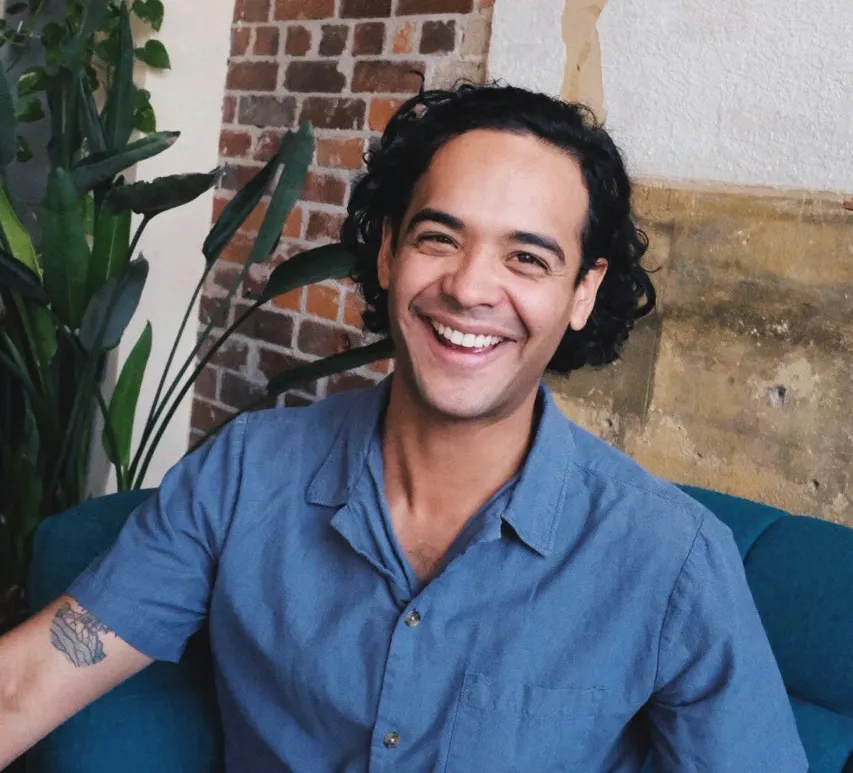
ALEXIS MEJIA of Amethyst Coffee Company.
As of August, Amethyst has six employees, a staff size that will remain for the foreseeable future, according to Sanchez.
Enforcing a Mask Policy
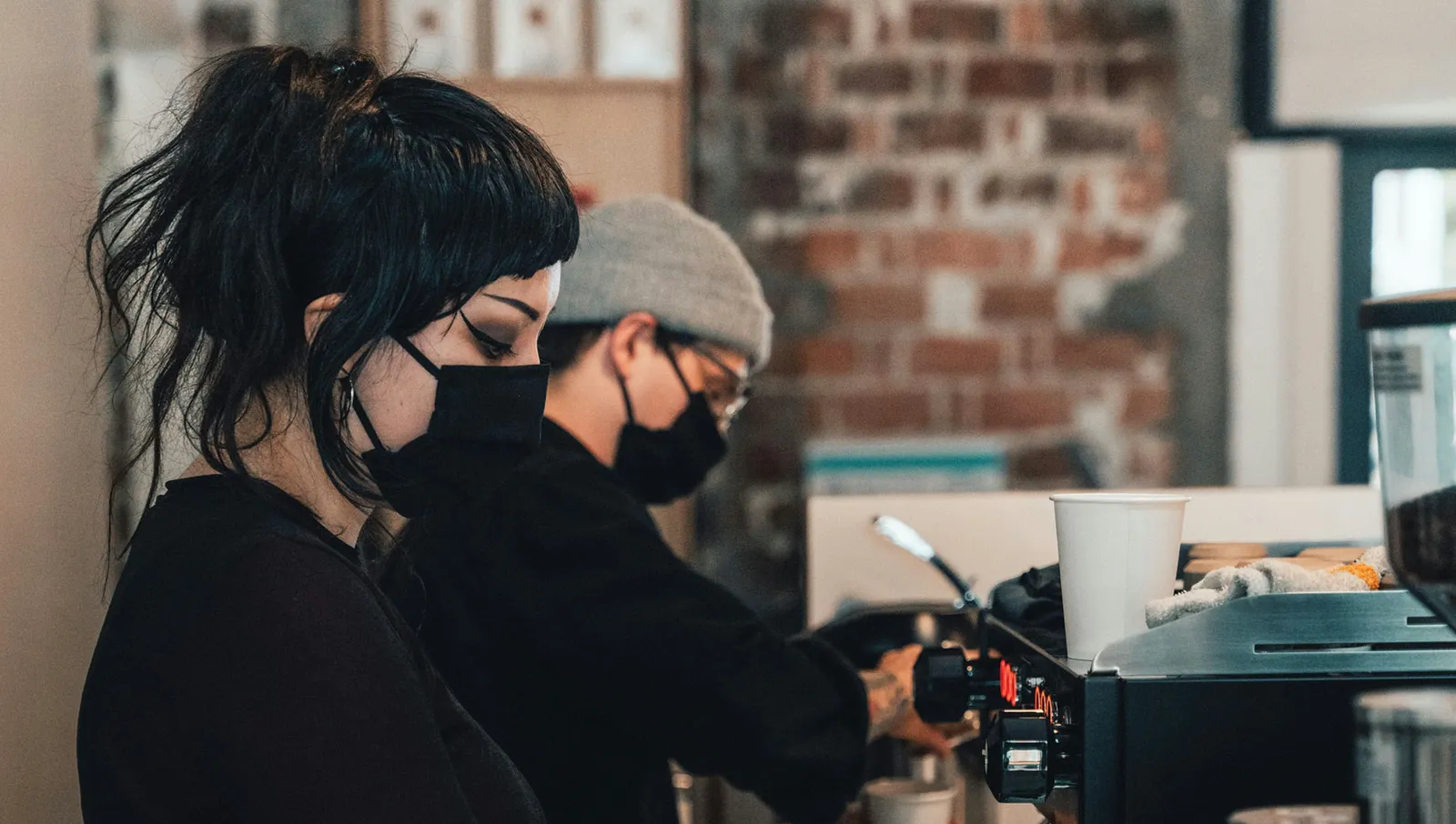
Not to be overlooked, taking a clear stance on face mask rules and enforcing them is a tangible way for businesses to prioritize staff safety. However, baristas are often the ones who shoulder the burden of enforcing mask rules among customers. In Richmond, Virginia, local guidelines placed the responsibility of mask protocols on the business, not the customer, which led Lamplighter to delay reopening indoor seating anytime soon.
“The businesses will get fined if people are not wearing masks,” says Forest. “That’s going to put workers in a really bad position in our state to have to enforce people wearing masks and be at the front lines of that philosophical battle is a really unfair position to put staff in. That’s another reason why we’re not going to have people in the building for a while, because I don’t want to put my staff in that position.”
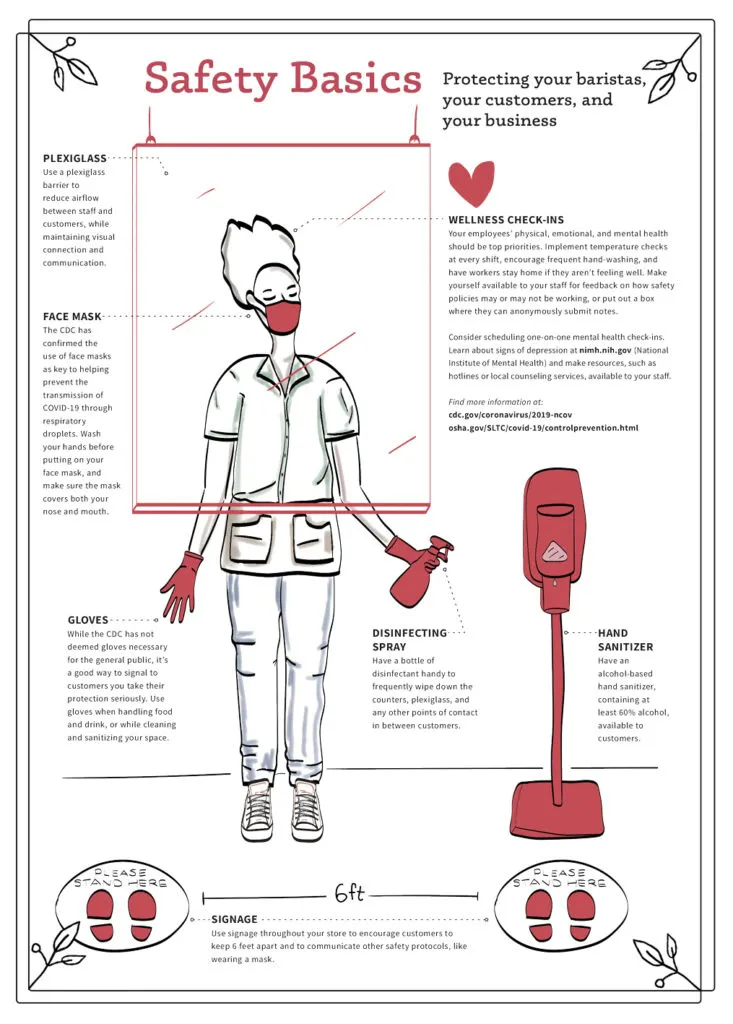
Mask rules might seem like a cut-and-dry issue, but it can get tricky for cafés entering Phase Two, which for most states means reopening indoor seating with reduced occupancy. Customers technically don’t have to wear masks while eating or drinking. That’s the case for Oceana Coffee’s two cafés in Tequesta, Florida. The two shops provide sanitizing stations for customers, and table placards to indicate when a space is occupied.
“If someone does come to sit down, we bring a little place card at their table that says, ‘This space is occupied.’ That little sign doesn’t leave until that guest leaves, and then everything at that table, the chair, everything, gets sanitized,” explains Oceana co-owner Amy Angelo. “It’s a good way for us to communicate with our team whether the space has been cleaned or not. Everything that people may touch: door handles, POS, all of that is sanitized and Lysoled many times throughout the day.”
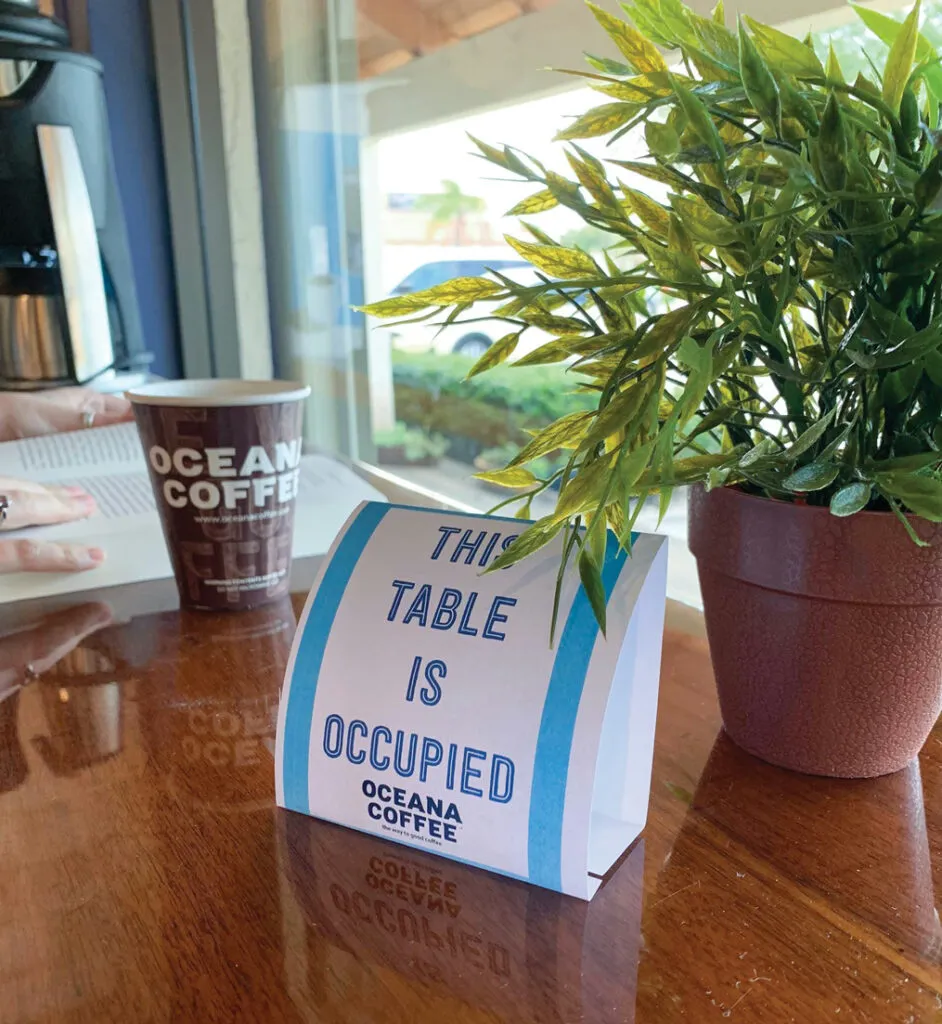
AT OCEANA COFFEE’S two locations, table place cards reserve a customer’s seat for the duration of their stay. Once they’ve left, the sign stays until staff have wiped down and sanitized the table and chair.
In Seattle, Broadcast made sure to put large, visible signage at the entrance to help mitigate the additional labor it would take baristas to enforce the protocol.
“It was really important to get that in people’s faces right away so that our staff don’t have the whole burden of enforcing it. It is a burden to have to ask every person, talk to every person about this. We are lucky that our clientele have by and large been wholeheartedly embracing it. The conversations that I’ve had with our team have been to keep it really short and positive,” says Walker. “We do emphasise, ‘Just keep it positive and stand your ground.’ I feel that way about a lot of things, this is just the latest instance of, ‘Here’s something we have to enforce, but I don’t want you to be put in a position where you feel unsafe or have an uncomfortable dialogue that goes on.’ Trying to quickly turn that around is the goal.”
To take some of the burden off of baristas, Broadcast has provided customers hand sanitizing stations and disposable masks if they don’t have their own. Between these extra measures, and backed by a city- or state-wide mandate, it’s easier to enforce.
Aside from being a part of barista advocacy, enforcing a mask policy is a sure way to continue flattening the curve, which will hopefully stave off another wave of closures.
As the latest Re:co Symposium revealed, the coffee world is working hard to make sense of what happens next in a pandemic that’s far from over. Even as the full effects across the supply chain have yet to be seen, the steps that these and other cafés are taking to center the most vulnerable serve as examples of a more equitable future.