Edward Fischer on How Coffee Gets Its Worth: A Q&A
The Vanderbilt anthropologist discusses his book on Guatemalan coffee, tracing how cultural beliefs, colonial legacies, and market structures turn certain beans into high-priced commodities.
By Elliot Lee6 min read
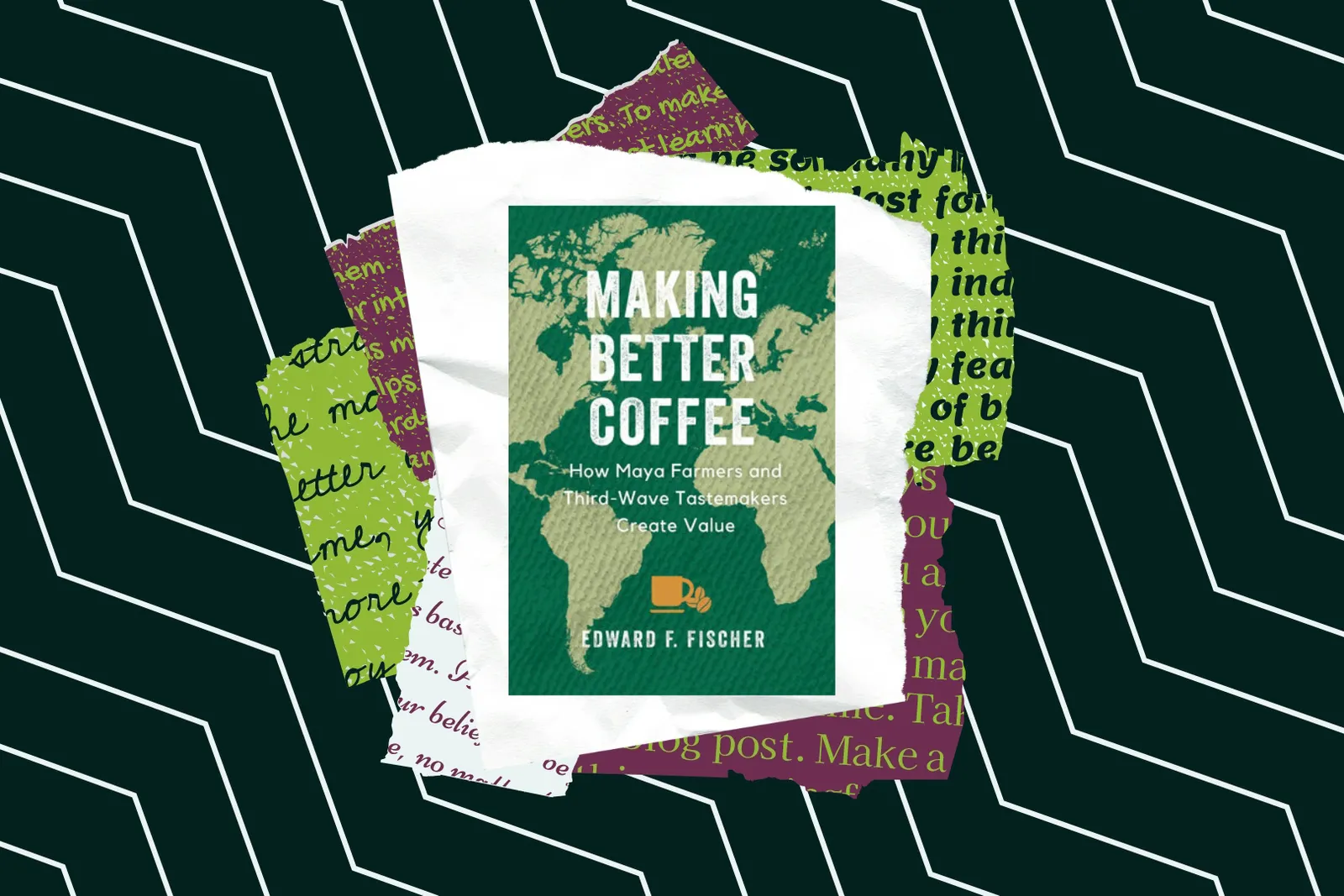
Edward Fischer's book Making Better Coffee begins with a question that likely crosses the mind of many coffee drinkers: what explains the high prices that small-lot, premium "Third Wave" coffees carry?
Fischer, a professor of anthropology at Vanderbilt University who leads its Institute for Coffee Studies, approaches that question through the lens of Guatemalan coffee growers. He examines how colonial history, evolving political and social values, and consumer tastes have influenced the way coffee is perceived and bought. The worth of coffee, his argument goes, is not simply a matter of what is inside the bean; his book, published by the University of California Press in 2022, explores how values—the beliefs and ideals people hold about how the world ought to function—get translated into economic value.
We spoke with Fischer about the book, its central themes, and what they reveal about the coffee business today:
Q: How would you sum up the book?
Fischer: The book is about coffee and the connections it creates among Guatemalan farmers, U.S. specialty roasters, and consumers. It is equally a book about values—what coffee signifies to the people who cultivate it, where it fits in their moral universe, and what it means to craft-coffee drinkers—and about how those cultural values are turned into economic returns. My argument is that value and quality are not out there waiting to be found; they are produced by everyone involved with coffee, including researchers, roasters, baristas, and enthusiasts.
You single out value creation as a major theme. What drew you to it?
I began the project wanting to understand why some Guatemalan coffees were suddenly fetching astonishing prices. In 2012, a farm named El Injerto sold a lot at $500.50 per pound, and I set out to figure out what was going on. During the research, I was struck by the way coffee professionals and traders spoke about value and quality—as though these were fixed features of the world simply awaiting discovery.
From an anthropological standpoint, however, value is socially constructed: our sense of what is worthy and desirable derives from cultural conventions. That perspective led me to conclude that the real power in this process lies not in controlling a particular terroir but in determining which traits are treated as valuable.
Could you share some of your background in Guatemala? Why did the book center on that country?
As an anthropologist, I have spent years working in Guatemala with Maya farmers, studying the inventive ways they interact with international markets. Coffee is central to Guatemala's economy, politics, and society. I believed I already knew the Guatemalan coffee story: an oligarchy of European descent ran the plantations, which depended on coerced Maya labor—a textbook case of neo-colonial exploitation.
But, from an anthropological perspective, value is a social construction: what we deem to have worth, to be desirable, stems from cultural conventions. That led me to the conclusion that the real power … is not in controlling a particular terroir but in deciding what traits get valued.
Edward fischer
Then Bill Hempstead [who comes from one of Guatemala's noted coffee families] showed me that the quality turn in the coffee market during the 1990s had shifted the power dynamics. Coffee was now being grown at higher altitudes (or denser, more flavorful beans), meaning that production had moved up the mountains into the Maya highlands. Many former plantation workers began cultivating small plots of coffee, and numerous Maya communities gained from the specialty coffee boom. That seemed to carry a kind of poetic justice, and I wanted to tell that story. But, like with all stories, it turned out to be more complicated.
What is the Institute for Coffee Studies? Can you tell us about your work there and how you incorporate coffee into your teaching and research?
The ICS was founded in 1999 by Vanderbilt psychiatry professor Peter Martin to encourage research into the physiological effects of coffee consumption. Major funding came from a consortium of coffee-producing countries (Brazil, Colombia, Mexico, and Guatemala), the U.S. National Coffee Association (NCA), the All Japan Coffee Association, and the International Coffee Organization. It was founded at the start of all these discoveries over the last twenty years about the beneficial health impacts of coffee.
Once that work had run its course, I took over in 2007, and with my colleague Bart Victor, we reoriented the work around economic development. We have recently run a Coffee Design Challenge with Hanes Motsinger, and I regularly teach a coffee seminar. Coffee is an excellent tool for teaching because we can show how history, economics, plant biology, cultural trends, and consumer tastes interact around this single item.
In an earlier interview, you said that "tastemakers talk about quality as an objective trait." Why does that happen, and what does it obscure when quality is treated as fixed?
From a marketing perspective, one almost has to talk about quality as an objective, timeless trait. Having that solidity is important to getting folks to part with their money.
But in fact, our definitions and standards of quality change over time. It wasn't long ago that East African naturally-processed coffees were looked down upon, and now they are celebrated. Something similar may be happening now with robusta. So, our definitions of quality change over time—and the power in that formation rests mainly on the consumption side and not with producers. Talking about quality as an objective trait obscures our role.
One point you make in the book that stuck out is that markets are never free. How can we look more critically at markets, specifically market access, to understand what success has meant for the farmers who've garnered higher prices for their coffee?
It is a key point to remember. We created markets through our legal, financial, and social institutions. Despite rhetoric to the contrary, getting out of the way and letting markets do their work is not an option. Accepting that can empower us to make markets work better for the common good.
Smallholding farmers are generally not critical of markets—or the promise of markets—but they are frustrated that the terms of engagement seem to be set against them. For example, the Cup of Excellence (CoE) is a cool innovation that uses market forces to reward quality growers. Great idea; cool things have come of it, and several medium-sized producers and a few small producers have struck the jackpot through good CoE placements.
The smallholding Maya farmers are growing coffee that, according to blind cupping scores, should be earning $4 per pound—and these coffees were selling for $1.25. Coffee is not some pure meritocratic market: those with social capital and networks do much better.
Edward fischer
But there are still barriers to entry. It is open to all, but internet access, knowledge of the program, speaking Spanish or French or English, etc. So some individual farmers do great, but many who prefer or have to sell through cooperatives are left out.
I still think about a map you showed at a coffee conference called Re:co in 2019—and you highlight it again in your book—can you describe the map of the farms in Huehuetenango and what it symbolized for you?
We found that medium-sized farms owned by European descendants and entrants in the CoE were able to get three times the value for their beans than smallholding Maya farmers in the same area whose coffees were cupping in the same range. The smallholding Maya farmers are growing coffee that, according to blind cupping scores, should be earning $4 per pound—and these coffees were selling for $1.25. Coffee is not some pure meritocratic market: those with social capital and networks do much better.
Finally, another theme worth spotlighting in your book: that most of the economic value in coffee comes from converting the material quality of beans into symbolic power.
Yes, and it illustrates the power differences I mentioned above: deciding what constitutes quality is where the real economic power rests: with coffee professionals and aficionados.
Fischer's book is available now.