Rising Prices Squeeze US Coffee Workers: Wages Lag Behind Inflation
Hourly coffee workers in the US face stagnant wages, rising costs, and the need for second jobs, according to interviews and a survey. Many struggle to cover basic expenses as inflation outpaces pay increases.
By Rowan Wilson9 min read
Paychecks vs. Rising Costs
A July 2022 survey found that 54.7% of American workers had not seen their hourly wage or salary keep pace with the consumer price index (CPI), the standard gauge of consumer inflation. For coffee workers, especially those in the lowest pay tiers, the squeeze is acute.
The CPI, which tracks changes in the cost of food, housing, gasoline, utilities, and other goods, jumped 9.1% in the 12 months ending in June—a four-decade high. In June alone, prices rose 1.3%. Energy costs saw the largest increases, affecting the price of nearly all goods since most items are manufactured and transported using power sources like gas or electricity.
Inflation ripples through supply chains, so even as higher goods costs hit small businesses, workers need more money to stay afloat. In September 2021, the Society for Human Resource Management (SHRM) projected salary increase budgets of 3.3% for 2022—a year in which inflation has tripled that figure.
The Federal Reserve has aggressively raised interest rates in an effort to curb inflation over the long term, but higher rates make credit card debt more expensive, worsening the strain for those who rely on credit cards to cover expenses.
These are aggregate numbers, but how do they play out for US coffee workers? Alongside interviews, we surveyed hourly coffee workers about their wages and inflation. The responses show cost increases that baristas and their employers are struggling to match.
From Comfort to Hardship
Sam*, a Minneapolis barista with seven years in coffee, described her shift from financial comfort in 2017 to struggle today. She now works a gig job outside coffee because her barista wages didn't cover expenses. The second job has raised her average hourly wage by $10, but she works far more hours between the two.
“I remember feeling abundant in 2017,” she says. “I could travel and get tattoos fairly often without feeling like I couldn’t pay my bills. Planning those luxuries fit into my paychecks just fine. I could save up my cash tips for a few weeks to come up with what I needed.” She recalls coworkers fighting over who would be sent home early on slow days, adding that “not many people worked second jobs.”
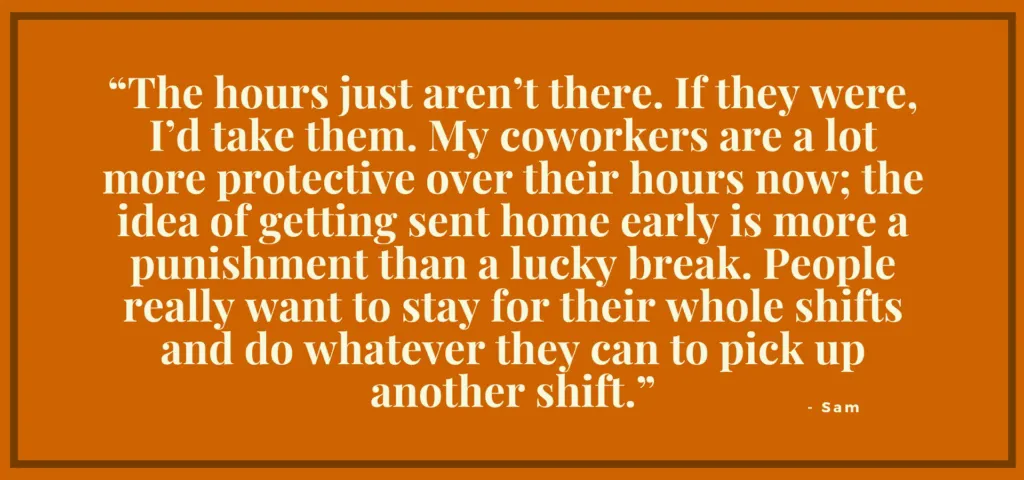
Now, she feels “extremely restricted with her cash flow,” partly because her coffee job has fewer hours. “The hours just aren’t there,” she says. “If they were, I’d take them. My coworkers are a lot more protective over their hours now; the idea of getting sent home early is more a punishment than a lucky break. People really want to stay for their whole shifts and do whatever they can to pick up another shift.” Second jobs or side gigs have become common among her coworkers.
On the side, she cleans luxury apartments through an app “as often as I can to make up for the gap. My hours for the app aren’t consistent, but when I get them, I make decent cash. I’m at least breaking even each month.”
Higher costs, fewer hours, less valuable wages, and four months of unemployment early in the pandemic drained her savings and led to credit card debt. She is now paying it down, but “it feels like a very steep mountain to conquer.”
Her pay is the Minneapolis minimum wage ($13.50 per hour as of July 2022), as her shop doesn't give raises. “Meanwhile, in 2017, the price guests paid for their 10oz coffee was $1.50 an in 2017; the price guests pay for that same cup in 2022 is $3.25.” She knows where that money goes, and it’s not into padding ownerships’ pockets. “We all know how wild coffee prices have gotten, so of course, we know where that extra $1.50 is going.”
Leaving Coffee Behind
For former barista Vanea, coffee is a family affair. She now lives in Holland, Michigan, but hails from Kailua-Kona, Hawai’i, where her family ran several cafés until the late 2000s. After moving to Michigan, she worked at an on-campus café in 2018 and moved to an off-campus one after businesses reopened in 2021.
“I chose this place because of their good reputation in the coffee community. I was told there were lots of chances for movement throughout the company,” Vanea says. Training lasted over a month before she could work the floor, meaning a lower training wage and no tips.
“I was hired part-time but worked 28-30 hours a week to make ends meet. Being hired in the summer with increased foot traffic, tips helped make up for the lack of pay.” She started at $10 an hour, which she felt was low for her experience and work-related expenses. “I asked for a raise after about eight months, expressing concerns to my manager about how I could barely put gas in my car, pay my rent and get groceries. He sympathized and requested a raise.” She was told there was a wage freeze. “I remember shortly after, we were all given swag bags with a notebook and a reusable cup. It felt like a slap in the face because I was struggling,” she says.
She kept pushing as expenses rose and her budget shrank, especially for non-fixed essentials like food. “After I paid my rent and put gas in my tank, I would have very little left over,” she says. “If I had to put more gas in my tank, I had to borrow money from my friends because I was struggling so much. I could only afford staples, nothing more.”
She couldn't save even small amounts, no matter how many shifts she picked up. “I was worried that if an emergency came up, I’d be screwed.” She would have breakdowns on the arrival of each paycheck.
“Sadly, I had to leave coffee,” she says. “It’s been my passion since I could crawl on the floor of my parent’s café. My greatest memories are with the people I worked with through college and at my former place of employment.”
Long Hours, Tight Budgets
Alex is an Indigenous two-spirit barista in Milwaukee, Wisconsin, with three and a half years in coffee, including training, management, catering, and barista competitions. They currently work three jobs “just to keep up with expenses,” which have risen sharply.
“At two of my jobs, the wage has increased since I started,” they say. One increase came when Alex took on a role that would normally go to a second full-time worker. “The second was due to not being able to fill staff positions. The increase has helped: it allowed me to have a full day off every week.” During COVID shutdowns, they had days where they worked from 5:30 in the morning to 10:00 at night “at least twice a week.” They still work six days a week to make ends meet.
They cite work-related expenses, especially gas. “Gas is an issue. Having to be places so early limits the amount of public transportation I can take. If I have to be at a café at 5:30, the earliest bus sometimes isn’t until 5:20 am.”
Parking is also costly since they work downtown. “Being responsible for commuting to different locations adds up,” they say.
Because of their schedule, food costs are a struggle. “Always being on the move, it’s hard to pack a lunch or even find time to go grocery shopping,” they say. “Eating out adds a lot of costs.”
“Inflation is massively impacting my groceries, utility bills, and gas,” says David, a roaster and barista trainer on Maui.
“When things started to go up, I made a rigid budget,” he says, “but staying under it usually means cutting non-essentials. Sometimes that’s difficult because those are things I consider self-care, so I’m reluctant to give them up.” He wants to work more but can’t—with young children at home, rising daycare costs make it impossible. “It’s really a rock and a hard place,” he says.
Raises: Impossible or Insufficient
Our reader survey shows that baristas and other hourly coffee workers struggle to meet expenses even after recent wage increases. Since coffee companies are also grappling with rising costs, many haven’t raised wages.
Barista Caitlin has worked in four cafés. In her current shop, she earns the most she ever has, “mostly thanks to tips as my hourly rate is very low.” In the past month, tips have dropped significantly, so her paychecks are smaller, “which isn’t fantastic with my cost of living increasing,” she says. Before her current job, she worked at a shop where the hourly wage was over a third higher than what she makes today. “In my first shop, right before the pandemic, I made $12 an hour, which was increased to $13 during the pandemic as tips flatlined. I make $8.50 an hour at my current shop, but tips ideally double my paycheck.”
Rose started as a barista during COVID, and raises haven’t kept up with expenses. “I can only pay 25% of my rent, so my partner pays the rest, including groceries,” she says. “I can barely pay my expenses, let alone save for my future.”
John, a barista in Oklahoma, also relies heavily on shared finances. “I live with my girlfriend, who pays the rent while I pay for utilities, groceries, etc. As it stands, I am able to afford my expenses with her second income, but we are still in poverty.” He started barista work in the summer of 2021 at the Oklahoma minimum wage (same as the national minimum wage of $7.25/hr). “I now make $9 per hour.”
“We’re in full swing of the season,” says Devon*, a barista in a mountain tourist town. “I have cycled through struggling and racking up credit card debt. After tips, Walmart employees here make more than I do.” Despite cost increases, the base pay at her shop is the same as when she started in 2020.
“My wages aren’t meeting my expenses,” says barista Michael*. “My bills have increased substantially, and I’m spending more on essentials each month. I have requested a raise from my manager—however, it has been denied. The minimum wage in my county recently increased from $8.90 an hour to $9.50, so it has gone up to the new minimum.”
Retail operations manager Shaylee shared that her wages almost meet her expenses. “Almost, but no. I can afford to pay my bills but have struggled when other life stuff happens (car towed, needing repairs, tickets, etc.).” For instance, her shoes had holes for six months because she couldn’t afford to replace them. “I ended up getting rid of my car, and I eat a lot of frozen food. I really can’t afford to do anything I enjoy.” She says that technically, she’s increased her income by 50% since 2020 but had to move to a state with a higher cost of living —so the extra money doesn’t go far.
“It’s a struggle, especially with recent gas and grocery price hikes,” says café manager Anna*. “I have an expensive chronic illness, and health insurance costs have also gone up, which immediately ate up the increase that I did get in wages.” Her wages have increased by $1.50 per hour since 2020.
Asked if his wages have increased and if they meet his expenses, coffee roaster Richie responded simply: “No and no.”
Coffee department head Pauline said her wages “barely” meet her cost of living and have “not increased at all,” despite inflation.
Jasmine*, a barista, says, “My wages are not meeting my expenses. I’m tapping into my savings and running out of money quickly.”
John, a roaster, also said his wages don’t meet his costs. “I have $0.14 in savings,” he says.” Every month I’m closer to bankruptcy.”
What Lies Ahead
With the Federal Reserve taking aggressive action to curb inflation, will cost pressures ease, or will rate hikes trigger a recession that makes things even harder for baristas, other coffee workers, and cafés? No one really knows.
As much as the inclination is to push for higher wages, simply raising wages is not enough to address the devastating effects of inflation on the retail coffee industry. Cost increases at every level of the supply chain have left many small businesses in a bind—and workers in an even worse one.
*Names with asterisks have been changed to protect anonymity. We also only used first names to protect respondents’ identities. Cover photo by Charisse Kenion