Brewing Inclusion: How One Coffee Brand Is Rewriting the Industry's Narrative
Coffee Uplifts People blends specialty coffee with social impact, aiming to bring more diversity to the coffee scene.
By Taylor Hayes6 min read
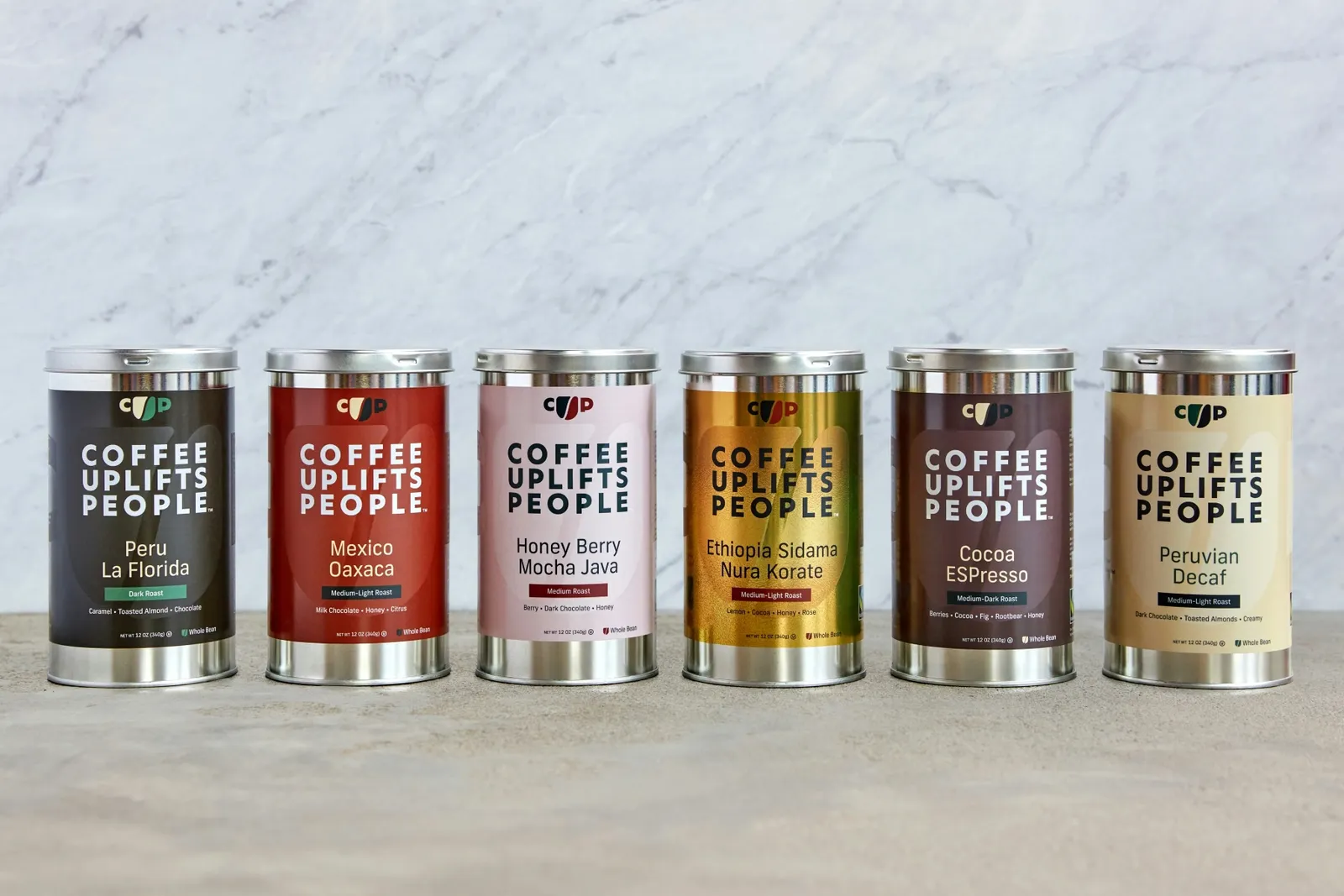
A March 2022 report from the National Coffee Association (NCA) found that 66% of Americans had consumed coffee in the previous day, totaling roughly 517 million cups daily. Among those, 43% opted for specialty coffee—a 20% increase since January 2021 and the highest share recorded to that point.
While coffee is one of the most widely consumed beverages globally, its popularity does not reach all demographic groups equally. An earlier NCA report from 2020 showed that 48% of Black American respondents had drunk coffee the day before. That was a modest rise from 42% in 2018, yet it remained the lowest consumption rate among ethnic groups.
Compounding this disparity, Black Americans represent only a small fraction of the coffee industry’s workforce and ownership.
Ignoring advice from friends, Angela Yee, LaRon Batchelor, and Tony Forte founded Coffee Uplifts People (CUP). Yee is a globally syndicated radio personality who already co-owns a business with Forte (Drink Fresh Juice), while Batchelor serves as CEO of Passport Food and Beverages and co-founder of Caminus Ventures. Through a physical location in Brooklyn’s Bed-Stuy neighborhood, as well as e-commerce and wholesale channels, CUP seeks to challenge conventional approaches to coffee service. The team hopes to draw a more diverse audience to coffee and make it accessible to all.
A Launch Amid Turmoil
CUP entered the coffee industry in 2020, during the COVID-19 pandemic—a period of uphill struggle. Instead of leisurely walking into cafés, workers were at home brewing their own coffee and yelling “you’re on mute” to colleagues on Zoom. “Having been birthed in the pandemic, we encountered unique challenges and opportunities unlike any other time, such as the significance of establishing a productive workspace that exemplified the new flexible working culture,” Forte says. “We knew a work-friendly coffee shop environment had to be one of [CUP’s] distinguishers.”
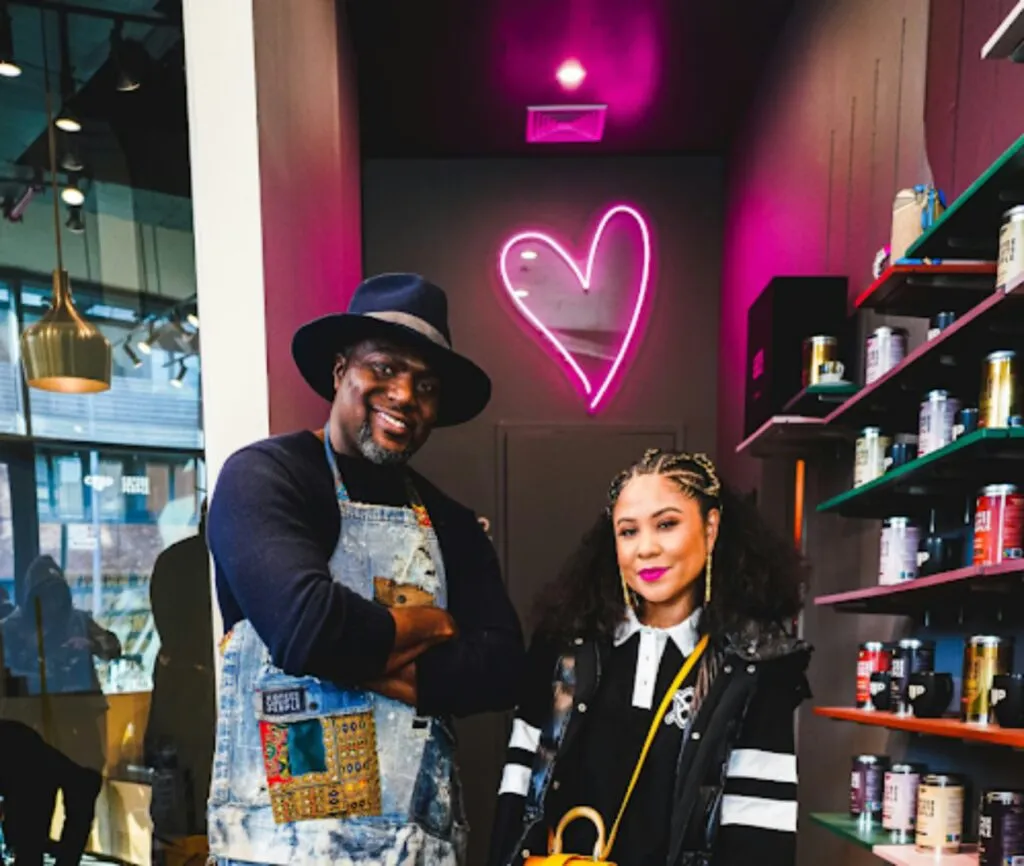
Forte (left) and Yee.
Thrust into the deep end during early planning, CUP faced unforeseen costs. “Another major influence of the pandemic was the shortage and excess cost of goods, supplies, and materials,” Forte notes. “This influenced every area of our business, most obviously the cost of green coffee nearly doubling from where it was in 2020. Inflation [costs] also showed up in supplies and materials for building our shops, the shortage of tins available for coffee, grocery, and e-commerce.”
But for this majority Black-owned brand, the timing of the launch had a more sobering effect for socio-political reasons than economic ones. “The pandemic, along with the murder of George Floyd, ushered in an era of consumer purchasing discretion unlike any era before it and rightfully so,” Forte says. “The pandemic’s influence cannot be overstated; it made us more resilient, nimble, crafty, and confident that CUP’s unique voice is needed and welcomed in the industry.”
Forte cautiously welcomes the socio-political changes he has observed in recent years. He feels that women, members of the LGBTQIA+ community, and people of color (POC) have long been excluded from the industry and exploited by it. “Where systems are designed and constructed for the unbalanced benefit for some at the expense of others, we’re all for real progress,” he says. “But the same energy taken to create such an unbalanced system should be spent correcting it.”
A New Name, A Renewed Purpose
The trio originally named their coffee brand “Coffee Unites People” and began as an online business, selling retail bags of beans while planning a brick-and-mortar location in Brooklyn. But they rebranded early to broaden their focus: “As a conscious and social impact founded brand, we create opportunities to strengthen communities,” Forte says. “We wanted to create a brand that would instill confidence in communities, partners, and suppliers, providing incomparable intentionality to uplift all areas that our brand intersects with. We firmly believe that: Coffee = Our Industry, Uplifts = Our Impact, People = Our Focus.”
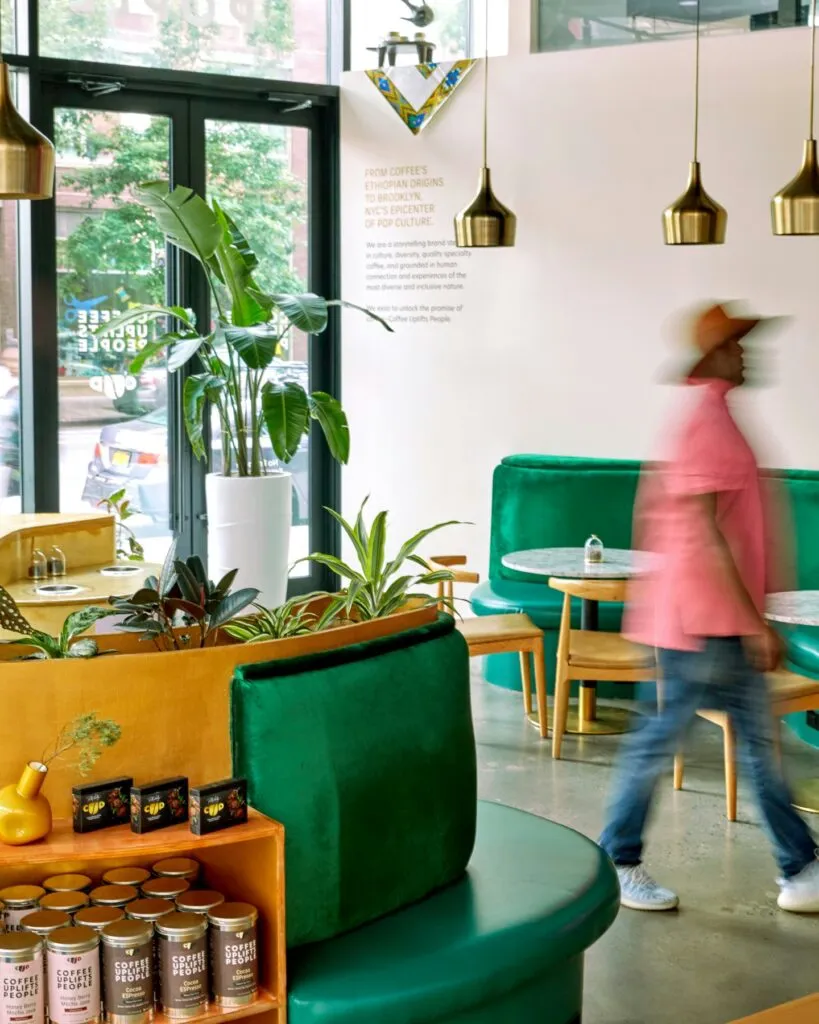
The concept of uplifting others is woven into the brand’s DNA. For instance, CUP partners with Brooklyn Roasting Company in a mutually beneficial arrangement: owner Jim Munson helped the group establish their coffee business and offered insights, while CUP’s team assisted the struggling company in emerging from bankruptcy.
CUP also aims to disrupt traditional notions of how coffee is served and to whom it is marketed. “We decided to launch CUP to extend the reach of coffee. Despite the saturation of coffee brands and shops, we feel there is a glaring void for inclusively progressive brands that embody a vibe rooted in lifestyle, contemporary design, and immersive culture,” Forte says. “We are a storytelling brand with a unique voice.”
Before opening its brick-and-mortar location in November 2021, CUP sought ways to introduce the brand to consumers that aligned with its values. They brought their message to community gatherings such as voter registration drives. They also organized “pop-uplifts”—community-focused pop-up experiences featuring other minority-owned vendors, including Island Pops, The Crabby Shack, and Flatbush Granola Company. These events help connect local businesses and leverage CUP’s social reach and media network to build community.
A Taste of Authenticity
CUP directly engages the 48% of coffee drinkers highlighted in the NCA report through marketing channels such as advertising on The Breakfast Club Power 105.1 FM and Ebony Magazine. “CUP attracts Black American beverage drinkers by authentically being a brand of high-quality coffee with a cultural sensitivity that addresses the voids of the coffee industry,” Forte says.
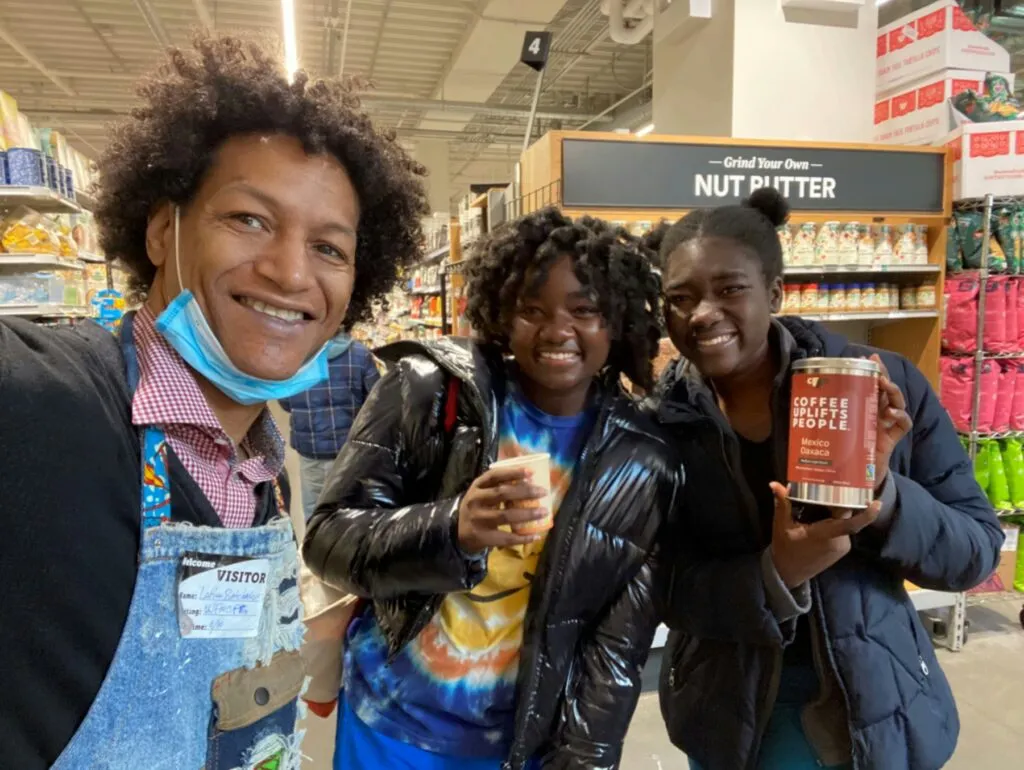
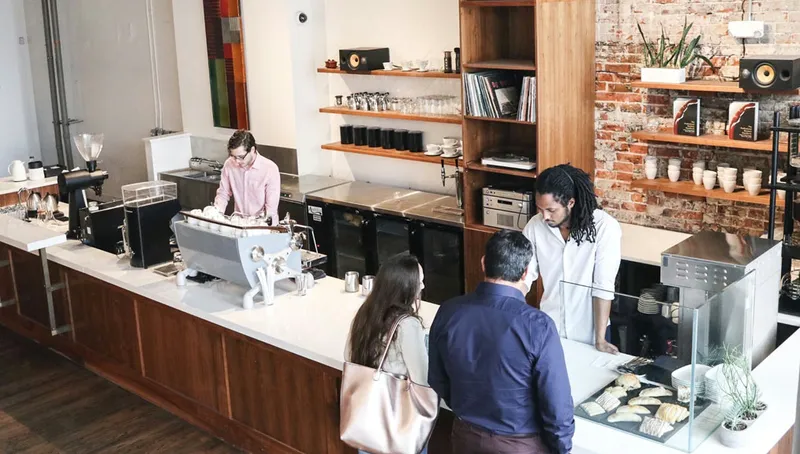
Batchelor (left) with customers.
Authenticity is central to CUP’s effort to amplify its cultural perspective. The brand works with local vendors who exemplify its values and communicates its affinity with its target market at every opportunity. “We unabashedly infuse premium global culture into every aspect of our experience,” Forte says, “from store design (POC-owned service providers built 100% of our flagship store) to merchandise to suppliers (100% of our grab-and-go offerings…are supplied by POC-owned businesses).”
Forte and his co-owners embed their heritage into the brand identity with the goal of increasing the number of POC coffee drinkers. “Our brand communication and social media unapologetically feature the cultural nuances and creativity that originate from Black culture,” Forte says. “We believe that the low consumption of coffee by Black Americans compared with other ethnicities has less to do with a distaste for coffee and more to do with lack of representation within the supply chain and coffee media communication, the checkered colonial history of coffee, and the cultural construct of coffee being less reflective of the lived Black American experience.”
CUP is rooted in the future but remains acutely aware of coffee’s past. Equity and fair wages for farmers and laborers, along with the colonial history of coffee and slavery, remain vital issues that CUP hopes to engage with “by speaking transparently about the industry and embodying change,” Forte says. “Fortunately, the legacy of slavery is not the sum of the [coffee] industry. CUP exists to unlock coffee’s potential beyond its checkered history. We want to show that we are here, have been here, and will only grow in size and contribution to the future of coffee.”
Stirring the Industry Awake
CUP seeks to serve as a positive link between coffee’s past and present by marketing to a frequently overlooked demographic. “A founding principle and guiding operational light is our Diversity, Inclusion, Representation, and Equity (DIRE) promise; the coffee industry needs DIRE change,” Forte says. “You can find DIRE stamped on all of our consumer products. We exhaust every effort to source excellence with a preference for POC and women-owned suppliers, importers, roasters, designers, and more.”
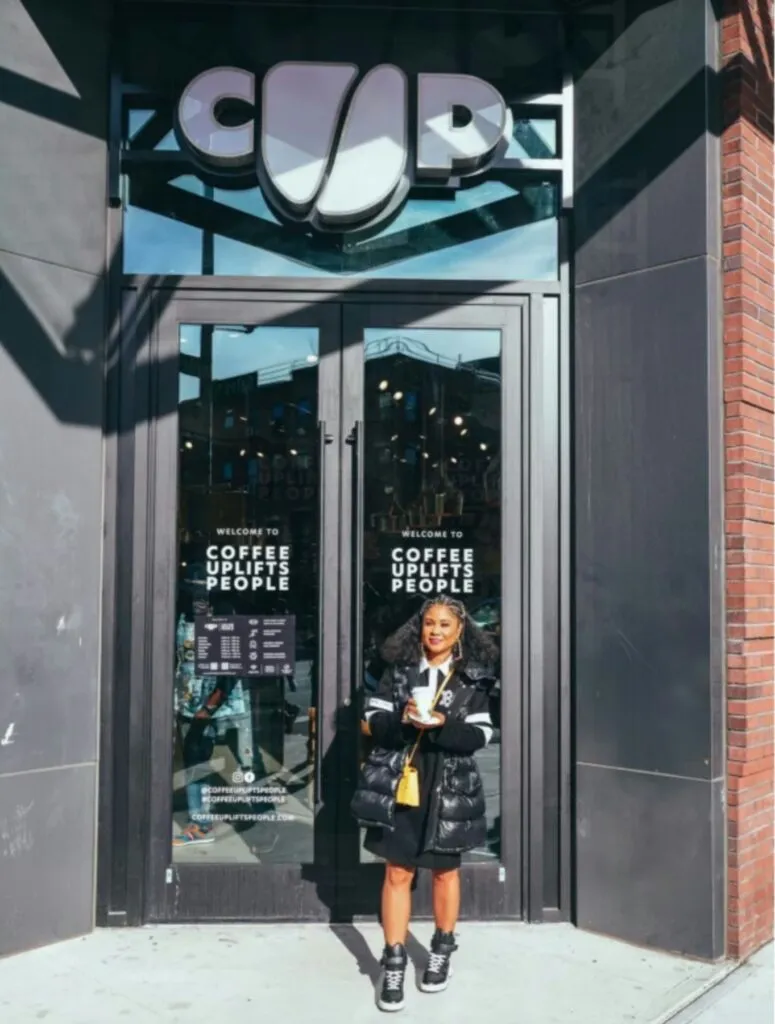
Yee in front of CUP.
CUP creates opportunities within its shops for those who may lack extensive knowledge of specialty coffee. “This is important as all too often the only way to get into specialty coffee is by having experience,” Forte explains. “We broaden our net to attract and welcome service connoisseurs and hospitality experts (this inevitably invites more POC into the industry) looking for an opportunity to learn and make their mark.”
CUP has also formed strategic educational partnerships aimed at greater inclusivity. “Our ‘Not Just Joe’ initiative aims to welcome women and POC as interns to learn and explore the coffee trade,” Forte says. “We do this by partnering with neighboring colleges and intern placement providers to attract women and POC to learn more about ‘Joe’ and not be just your ‘Average Joe,’ both colloquialisms that often fail to include women and POC.”
The founders of CUP aim to open two more shops in Brooklyn in 2022 and start franchising in 2023. “Delivering on our values and quality while growing the CUP brand into a major player in the industry while preserving majority Black ownership will go a long way to show what is possible.” CUP has addressed a critical gap in the market. Welcome the new narrator to the story of coffee.