A Tajik Teahouse in Colorado: Where Silk Road Craft Meets Local Community
In Boulder, Colorado, a handcrafted teahouse gifted by Dushanbe, Tajikistan, offers a space for connection over tea—without Wi-Fi—and serves as a symbol of cross-cultural collaboration.
By Finley Adams3 min read
A Unique Gift from Tajikistan
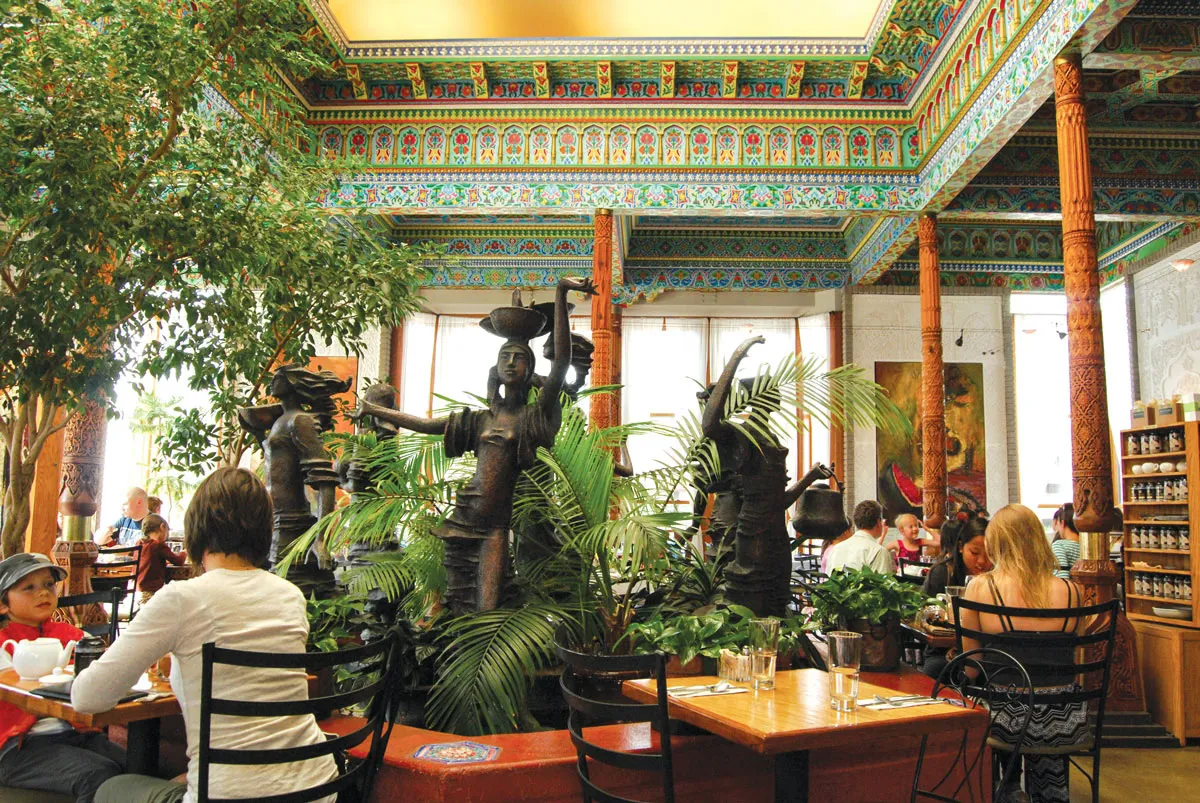
In Boulder, Colorado, there is a teahouse unlike any other in the Western Hemisphere: the Boulder Dushanbe Teahouse. Its design reflects Central Asian tea culture, while its service carries a touch of Japanese formality. Approaching the building, visitors pass through a fragrant rose garden before the structure comes into view. The exterior is striking, with blue and purple trim and floor-to-ceiling painted tiles, but the true wonder lies inside.
Upon entering, guests are greeted by the Fountain of the Seven Beauties, drawn from a twelfth-century Turkish folk tale shared along the Silk Road. Above, cedar pillars—wood that had to be shipped from Siberia because it is not found locally in Colorado—rise toward the ceiling. Oil paintings and traditional plaster tiles adorn the walls. Yet the most celebrated and magnificent feature is the ceiling: bright colors, traditional Tajik-Persian symbols such as flowers and geometric shapes, and the mihrab (Islamic prayer arch) on the ceiling tiles often make it hard to look anywhere else.
A Place to Slow Down
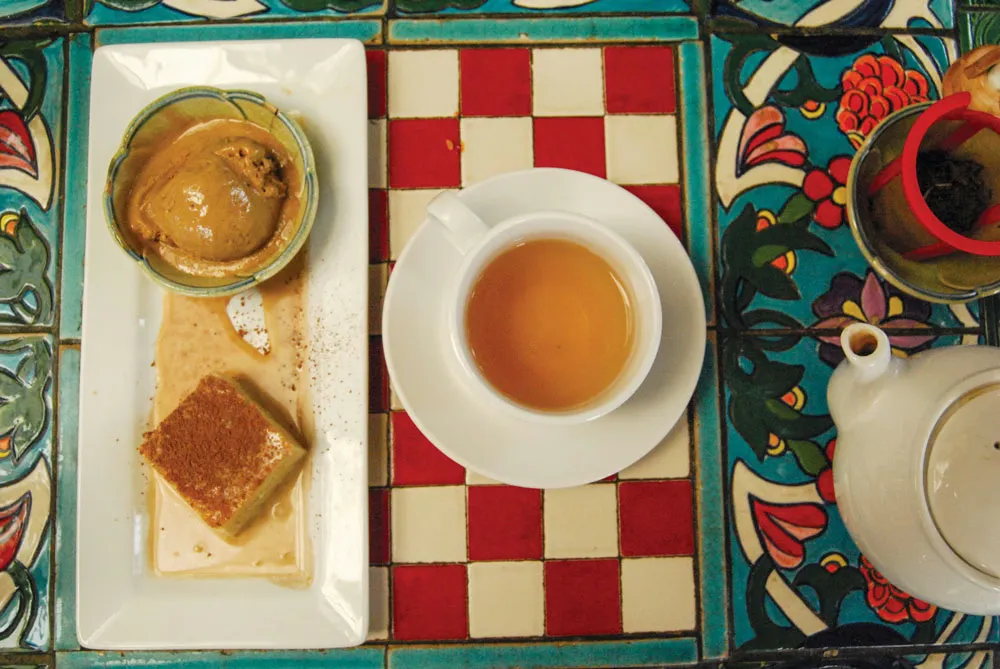
In Central Asia, teahouses—called choihonas—are meeting spots, places to slow down and talk about life over a cup of tea. That is exactly what this teahouse brings to a busy college town in Colorado.
The Boulder Dushanbe Teahouse has no Wi-Fi, so there are no students hunched over computers; instead, people connect with one another. I met Rebecca, a regular who comes to this “inspiring, gorgeous environment” to work on her novel. She told me about a man who works at the University of Colorado in Boulder and brings clients to the teahouse, and that college students usually bring their parents for a unique experience. We bonded over our shared love of exploring Colorado trails. All around the teahouse, people were observing each other, talking, and enjoying a cup of loose-leaf tea.
A Rocky Road to Boulder
The story of the teahouse was not always a happy one. In fact, many people did not want it at all. In late 1982, amid the Cold War, a couple of activists met and sought to establish a Sister City relationship with a city in the Soviet Union to foster understanding and possibly help ease tensions between the United States and the Soviet Union.
Dushanbe, the capital of the Tajik Soviet Socialist Republic, was chosen at random and pursued unsuccessfully until the mayor of Dushanbe learned that there was a traditional Tajik balalaika band in Boulder.
In May 1987, Mayor Maksud Ikramov visited Boulder and announced that Dushanbe would gift Boulder a traditional Tajik choihona. As the Tajik people began hand-painting the tiles, hand-carving the cedar pillars, and handcrafting the plaster panels, the Teahouse Trust began campaigning and working to secure funding from the Boulder City Council. In 1990, the teahouse arrived in Boulder in 200 shipping crates—only to be stored for the next seven years.
Arguments against the teahouse ranged from the need to spend tax money on something more useful to worries that the Soviets were bugging the teahouse to spy on the nearby Rocky Flats Plant, a former US nuclear weapons production facility. Meanwhile, in 1991, following the collapse of the Soviet Union, Tajikistan became an independent state. After much back and forth, the teahouse was finally approved and construction began at its current site in 1997.
Tea and International Cuisine
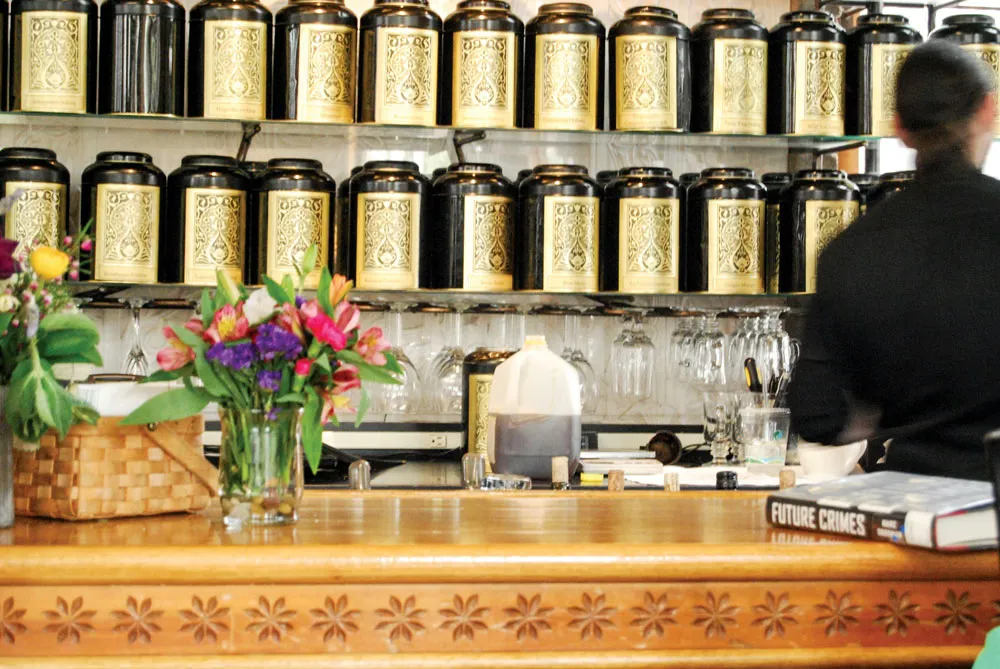
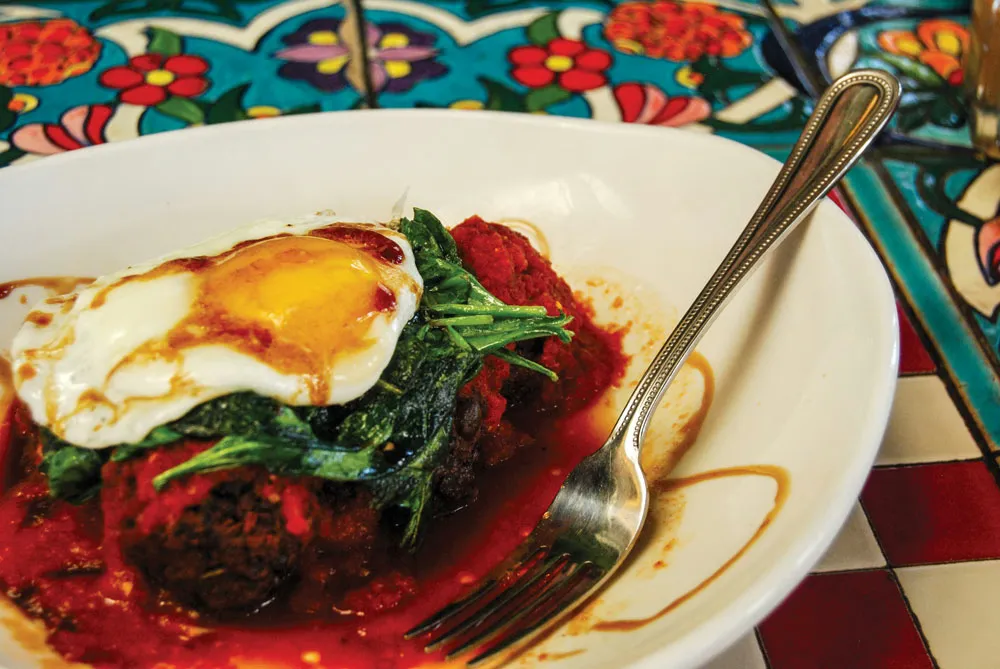
In the spirit of international understanding, the teahouse features international cuisine, including Moroccan, Indian, Persian, Malaysian, and traditional Tajik dishes that change seasonally. But the real focus is the tea. With more than 100 teas available at any given time, there is something for everyone. The teahouse offers loose-leaf teas from China, India, Sri Lanka, Japan, and Taiwan. Sara Martinelli, half of the wife-and-husband team that has run the teahouse since it opened in 1998, is a certified medical herbalist and has formulated some of the tea blends.
Manager Matt Keifer feels that the teahouse encourages a healthier lifestyle—not only because of the benefits of drinking tea, but also because Sara and Lenny Martinelli own the farm-to-table Three Leaf Farm, where tea scraps are used as compost for the soil and harvests end up in restaurants around Boulder, including on the menu at Dushanbe.
A Complete Work of Art
Though most people’s eyes are immediately drawn to the ceiling, Lenny describes the teahouse as “a complete piece of art.” He believes that it’s “an excellent example of what people can do in collaboration to bring cultures together. It’s an awesome example of traditional Persian art and architecture in a place that can be enjoyed on a participation level versus behind glass in a museum.”
When asked what has been his most valuable experience since being involved in the teahouse, Lenny says, “We have learned how to understand world cultures through food and tea.”