A Lingonberry Latte That Nods to Nordic Roots
A coffee professional explains how a Scandinavian-inspired syrup — warm spices, lingonberry juice, and local honey — became a signature latte at a new Minneapolis cafe.
By Harper Parker3 min read
Designing a Menu for a Watch Shop
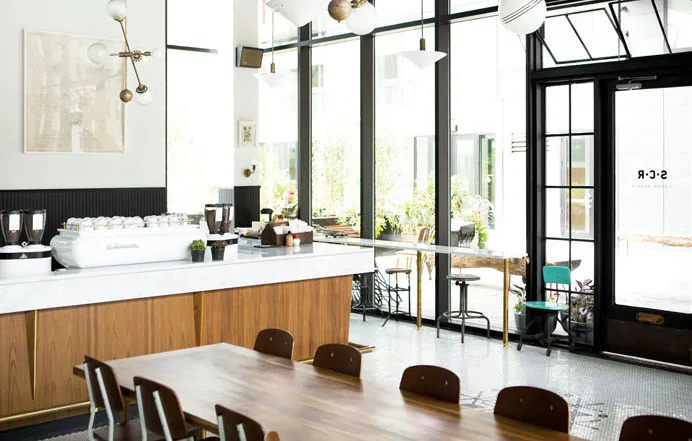
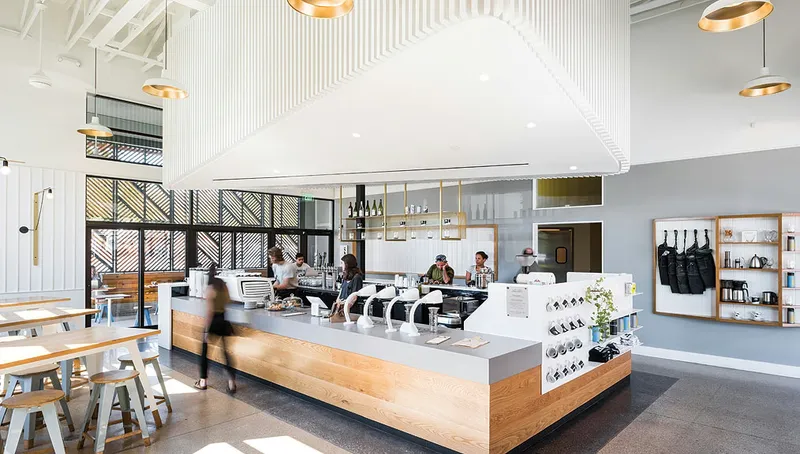
Setting up the newest Dogwood Coffee bar inside watch and bicycle retailer Shinola's North Loop store meant I had to build a menu from scratch, and that task felt more intimidating than anything else. The menu needed to carry the spirit of Dogwood, while also meeting Shinola and the surrounding neighborhood partway on branding and clientele.
That isn't meant as a knock on their shoppers. It's simply that their attention is on possibly buying a high-end watch. They're focused, and I didn't want to pull them away from that.
At the same time, the menu still had to feel distinctive and satisfy visitors from out of town. The regular, everyday guest remained the priority throughout.
Small Choices That Shaped the Menu
A few of the things we did:
- Espresso appears as a double, which heads off the usual questions right away.
- Coffee is offered as either fast or slow: fast means batch brewed and ready to order, slow means brewed to order in a Chemex.
- At the bottom of the menu I placed a set of pairings — a shot with a coffee, a shot with a cap, a macchiato with a cap, and a cap with a latte.
In a lot of ways that menu was built for the out-of-town guest. Having both a milk drink and an espresso is more or less what everyone hopes for. But it was for the daily regular too.
The Hardest Part: Signature Drinks
My most intimidating assignment was inventing the signature drinks.
Third-wave coffee hasn't reached this neighborhood before. Some locals know it, love it, and are glad we're here, but others genuinely just want a pumpkin spice latte. After all, this is Minneapolis: it's cold outside, and people want that warm spice.
The North Loop is fortunate to have several excellent restaurants. One of them, an original that helped set the neighborhood in motion, is The Bachelor Farmer. When it opened, it was described as "Nordic-inspired cuisine." They've since changed their framing to "North-inspired" cuisine, which I appreciate a great deal. Those of us in the North share a different outlook. We're quiet, we're understanding, and I think we're very conscious of relationships.
Relationships matter enormously in this neighborhood, and I wanted to draw on that. I also wanted to tie the menu to my own heritage — I'm Scandinavian — and to use a small restaurant from my hometown, the Norske Nook, as the seed for one of the signature drinks. It isn't a great restaurant, but its pie is amazing, and it's one of those small-town Wisconsin places you go to because that's simply what you do there. It's cute. It's quaint.
So my plan was a syrup built on warm spice — cinnamon and nutmeg — with something Scandinavian added, namely lingonberry. It needed a little sweetness, so I reached for Ames Farms honey. I also thinned it out so the consistency would be easier to work with. The outcome is a crowd-pleaser, a tip of the hat to my roots, and every bit as cute.
Norski Milk Latte
I begin by simmering the lingonberry juice, which I found online. I haven't managed to locate one that isn't fortified with grape juice or apple juice, but either kind works fine.
Simmer 500 milliliters of lingonberry juice, then add cinnamon and nutmeg, five grams of each. Once the mixture is warm, add 300 grams of honey (we use Ames Farms unfiltered). Then stir in 300 milliliters of water.
I run the whole thing through a Chemex fitted with an Able metal filter to remove most of the leftover spice particles.
Then there's the odd discovery I made: if you add the syrup to the espresso the way we do with nearly every other flavored latte, the first milk that meets the espresso-and-lingonberry mixture curdles. My assumption was that the acidity of the grape juice reacting with everything else was the cause. I tried acidity reducers, but they only made it taste strange. So we chose to put the base into the milk instead, steaming the two together and pouring that over the shots. That keeps the drink's ecosystem from being shocked.
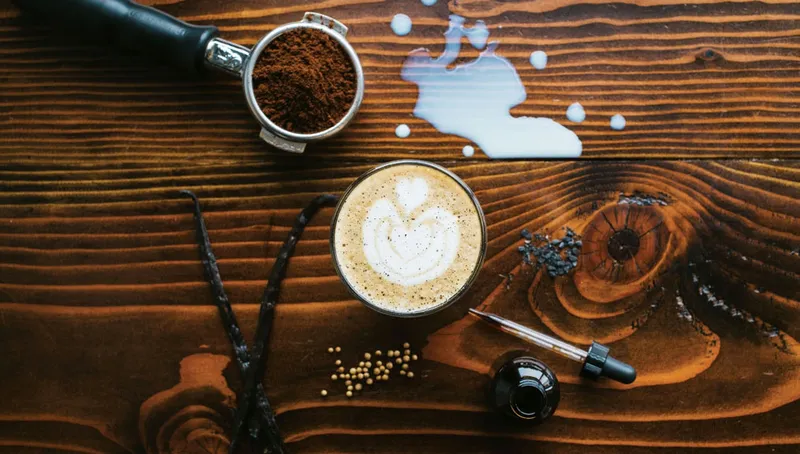
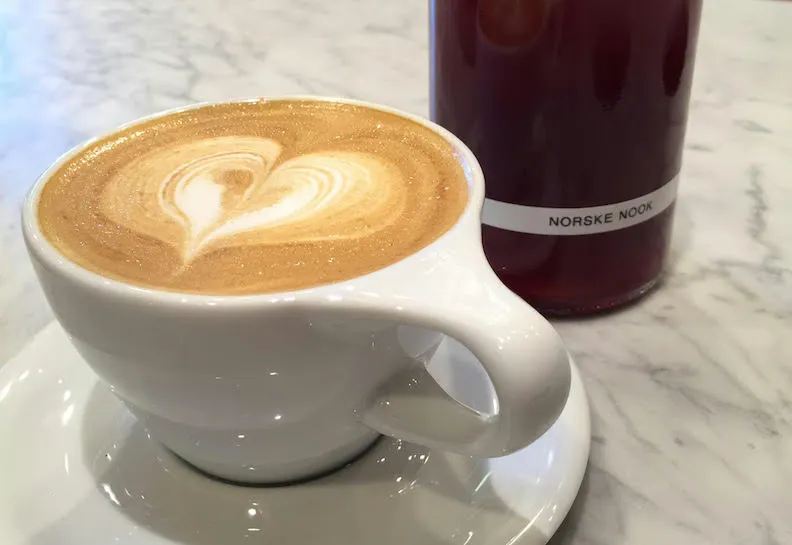
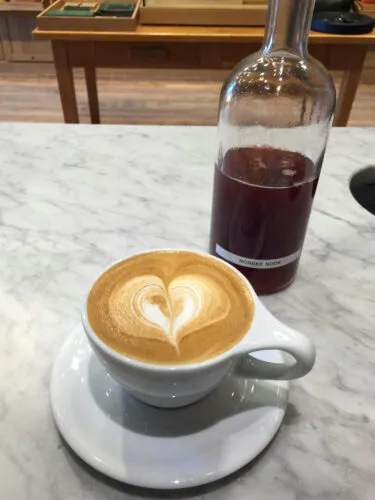
What comes out is a genuinely cute pinkish milk latte. And who doesn't love a pink latte?